Oct 2026 · The lancet. Gastroenterology & hepatology
U.S. Cyclosporiasis Cases and Outbreaks
Latest research
Recent Cyclospora publications
Sep 2026 · Revista brasileira de parasitologia veterinaria = Brazilian journal of veterinary parasitology : Orgao Oficial do Colegio Brasileiro de Parasitologia Veterinaria
Survey of endoparasites in Chelonoidis carbonarius and Chelonoidis denticulatus kept at the zoo of the Jungle Warfare Training Center (CIGS), Central Amazon.
Cunha EVD, Geissler DM, Siqueira LA et al.Sep 2026 · New microbes and new infections
An integrated One Health surveillance on cyclosporiasis outbreaks in the United States.
Aborode AT, Allison MO, Akinyosoye FO et al.Sep 2026 · Journal of microbiology, immunology, and infection = Wei mian yu gan ran za zhi
Cyclospora cayetanensis infection: current insights into foodborne outbreaks, diagnostic challenges, molecular epidemiology, and future directions.
Tseng YC, Hsiao CT, Wang YJ et al.Sep 2026 · NEJM evidence
Cyclosporiasis Outbreak in Michigan, May-July 2026 - An Interim Report.
Hasan MN, Leahy HL, Henderson J et al.1 of 5
Cyclospora in the United States
Cyclosporiasis is a gastrointestinal illness caused by a parasite called Cyclospora cayetanensis.
Cyclospora infections in the US increase in the summer, with cases typically detected widely across the US.
- Typical symptoms are watery diarrhea with frequent and sometimes explosive bowel movements.
- Illness may last from a few days to over a month, and symptoms may be periodic, where you start to feel better but then symptoms return.
- Symptoms typically begin two days to two weeks after exposure, most often around one week.
- Cyclosporiasis can be treated with trimethoprim-sulfamethoxazole.
2026 multistate outbreak
Iceberg lettuce outbreak
CDC, FDA, and state partners are investigating a multistate Cyclospora outbreak linked to processed iceberg lettuce from Taylor Farms de Mexico. This section uses the live CDC outbreak visualizations, separate from the broader surveillance data below.
12,883people sick in 21 states
Where sick people live
Source: CDC locations dataReported outbreak cases by state of residence. These are CDC case counts; counts directly from state health departments may differ.
0more reported cases
Illness onset curve
Source: CDC timeline data10,949 people with illness-onset information available.
US national surveillance overview
US national surveillance overview through Oct 3, 2026
This section is based on provisional reports sent to CDC by health departments. This includes individuals who may have acquired their illness due to travel outside the United States rather than local exposures. See the map above for cases associated with the lettuce recall. Data shown here covers Jan 4 through Oct 3, 2026.
US national surveillance overview
US national surveillance overview through Oct 3, 2026
This section is based on provisional reports sent to CDC by health departments. This includes individuals who may have acquired their illness due to travel outside the United States rather than local exposures. See the map above for cases associated with the lettuce recall. Data shown here covers Jan 4 through Oct 3, 2026.
Cases reported by state over time
Use play or drag the timeline to see cumulative 2026 case counts appear by state. New York City is combined with New York for this state-level view, including the ranking.
Through Oct 3, 20260
cases reported to the CDC in 2026
Show
01-2425-99100-499500+
State detail
Cumulative reported cases by week
Lines show the cumulative reported-case total in each CDC weekly table.
Cyclospora timeline: 2026 cases are ahead of recent years at this point in time
Lines show cumulative cases reported to CDC by report week. Includes all reported cases including those acquired through international travel.
Michigan spotlight
Michigan reported cyclosporiasis cases
Michigan Department of Health and Human Services reports 14,718 cyclosporiasis cases so far in 2026. Case data comes from the Michigan DHHS website; population denominators for rates come from USAFacts. Thank you to MDHHS for their comprehensive daily updates.
Michigan spotlight
Michigan reported cyclosporiasis cases
Michigan Department of Health and Human Services reports 14,718 cyclosporiasis cases so far in 2026. Case data comes from the Michigan DHHS website; population denominators for rates come from USAFacts. Thank you to MDHHS for their comprehensive daily updates.
Michigan outbreak total
14,718reported cases through Sep 6, 2026
Hospitalizations
366reported by Michigan as of Sep 3, 2026
Michigan cases by county
Map shading uses Michigan county boundaries. Detroit is listed separately in the Michigan table and is included here with Wayne County.
Show
01-2425-7475-199200+
Top 10 counties
Wayne2,616
Oakland1,692
Washtenaw1,115
Ingham925
Genesee690
Muskegon587
Macomb535
Shiawassee503
Livingston493
Jackson440
Michigan cases by symptom-onset and reporting week
Choose either view. Michigan may revise counts as additional reports are received.
Based on 8,397 cases with an onset date available. Source: MDHHS dashboard.
The July 24, 2026 reported date includes approximately 475 cases that were not previously reported to MDHHS due to delayed laboratory reporting. These cases do not reflect a sudden increase in illnesses. Source: MDHHS dashboard.
Current outbreak investigations
FDA Cyclospora investigations
FDA Cyclospora outbreak investigations for 2026 extracted from the FDA outbreaks table.
Current outbreak investigations
FDA Cyclospora investigations
FDA Cyclospora outbreak investigations for 2026 extracted from the FDA outbreaks table.
| Date posted | FDA reference | Product linked to illnesses | Cases | Status | FDA response |
|---|---|---|---|---|---|
| Aug 5, 2026 | #1398 | Not Yet Identified | 22 | Ended |
|
| Jul 22, 2026 | #1392 | Not Yet Identified | 235 | Ended |
|
| Jul 15, 2026 | #1390 | Iceberg Lettuce | 12,883 | Ended |
|
| Jul 8, 2026 | #1385 | Not Yet Identified | 38 | Ended |
|
| Jul 8, 2026 | #1384 | Not Yet Identified | 18 | Ended |
|
FDA data retrieved Oct 12, 2026. Investigation details and counts may change as FDA updates its table.
Background
Historical outbreak records
The publicly available CDC's National Outbreak Reporting System (NORS) data file includes 181 outbreak records from 1990 through 2023, totaling 6,251 illnesses and 198 hospitalizations.
Background
Historical outbreak records
The publicly available CDC's National Outbreak Reporting System (NORS) data file includes 181 outbreak records from 1990 through 2023, totaling 6,251 illnesses and 198 hospitalizations.
1990-2023
Reported outbreak investigations
181Outbreak investigations in CDC data where Cyclospora was listed as the cause in the NORS (National Outbreak Reporting System) report.
Reported outbreak total cases
People sickened in those outbreaks
6,251Illness counts are summed from the CDC outbreak records.
Reported outbreak total
Hospitalizations
198Hospitalization counts are summed from the downloaded CDC outbreak records.
Reported outbreaks by year
Bars show the number of NORS outbreak records listing Cyclospora as the cause in each year.
Color by: Setting
Reported outbreaks by month
Bars show the month listed for historical NORS outbreak records, highlighting the summer seasonality of reported Cyclospora outbreaks.
Food categories and vehicles in outbreak records
Treemap boxes show CDC-listed food categories. Select a category to drill into the listed food vehicles for those records. Data is presented as reported in the NORS data, not cleaned or aggregated.
Explore outbreak records
Search or filter downloaded CDC NORS records. Food category, food vehicle, and contaminated ingredient fields are shown when available in the public file.
What is the difference between “Food Vehicle” and “Contaminated Ingredient”?
The contaminated food item a person ate before becoming sick. It may contain more than one ingredient.
The more specific food or ingredient within the food vehicle that was implicated, when one was identified.
CDC example
In an August 2010 Michigan outbreak of 41 illnesses caused by Salmonella serotype Javiana,potato salad was the food vehicle and yellow onion was the contaminated ingredient.
If a contaminated ingredient is not listed, the food vehicle provides the best information available.
Source: CDC BEAM frequently asked questions.
| Year | Month | State | Ill | Hosp. | Setting | Food category | Food vehicle | Contaminated ingredient |
|---|
Literature Watch
Cyclospora publications
Recent and historical PubMed-indexed papers matching Cyclospora and cyclosporiasis search terms.
1,001 PubMed papers
Literature Watch
Cyclospora publications
Recent and historical PubMed-indexed papers matching Cyclospora and cyclosporiasis search terms.
Cyclosporiasis and CDC cuts: the perfect storm.
Survey of endoparasites in Chelonoidis carbonarius and Chelonoidis denticulatus kept at the zoo of the Jungle Warfare Training Center (CIGS), Central Amazon.
The genus Chelonoidis tortoises are terrestrial reptiles susceptible to gastrointestinal endoparasites, mainly due to improper management. The present study aims to analyze the frequency of gastrointestinal parasites detected in samples from Chelonoidis carbonarius and Chelonoidi...
An integrated One Health surveillance on cyclosporiasis outbreaks in the United States.
Cyclospora cayetanensis infection: current insights into foodborne outbreaks, diagnostic challenges, molecular epidemiology, and future directions.
Cyclospora cayetanensis causes prolonged or relapsing watery diarrhea and is an important cause of foodborne outbreaks, most often associated with contaminated fresh produce. Recent multistate outbreaks in the United States have highlighted how short product shelf life, complex s...
Cyclosporiasis Outbreak in Michigan, May-July 2026 - An Interim Report.
AbstractIn June 2026, Michigan identified a cyclosporiasis outbreak; the number of reported cases substantially exceeded the usual number of seasonal reports. As of July 22, 2026, 6065 cases had been reported across 69 of Michigan's 83 counties, with dates of illness onset rangin...
What the Cyclospora Outbreak Reveals About the State of US Foodborne Disease Surveillance.
Domestically Acquired Cyclosporiasis Cases in Multiple U.S. States, 2026.
Cyclospora: "Explosive diarrhoea" cases now spread to almost every US state.
The silence of the alarms: Cyclospora and the fragility of foodborne surveillance.
Optimization of the Mit1C real-time PCR assay using Bio-Rad CFX96 for the detection of Cyclospora cayetanensis in agricultural waters.
Increased cases of cyclosporiasis within the United States linked to domestically grown fresh produce highlight the need to identify sources of environmental contamination for Cyclospora cayetanensis. Recently, the Mit1C real-time PCR assay was validated by the U.S. FDA as the US...
Cyclosporiasis: "Explosive diarrhoea" spreads to UK in outbreak linked to Mexico.
What Is Cyclosporiasis?
Cyclosporiasis: should people avoid fruit and vegetables?
Cyclosporiasis: as "explosive diarrhoea" sweeps US, what's behind the outbreak and what is Trump's role?
WHO estimates of the global, regional, and national burden of 14 foodborne diarrhoeal enteric hazards, 2000-21: an updated data synthesis.
Foodborne diseases cause significant illness and death globally. We updated WHO estimates of the burden caused by diarrhoeal hazards commonly transmitted by food: Campylobacter jejuni, Campylobacter coli, and other thermotolerant Campylobacter species; Cryptosporidium spp; Cyclos...
Burden of intestinal protozoan parasites coinciding with Helicobacter pylori infection in patients with gastrointestinal symptoms.
Protozoal infections are underdiagnosed contributors to gastrointestinal disease. As their symptoms frequently overlap with those of Helicobacter pylori infection, a leading cause of gastrointestinal illness, coinfections may be overlooked. This study aimed to determine the preva...
A Review of Reclaimed Water Use for Irrigation of Produce Crops and Food Safety Aspects in the United States.
The global use of reclaimed (or recycled) water for irrigation in agriculture presents a sustainable solution to water scarcity and regional saltwater intrusion control by augmenting freshwater supplies. Reclaimed water typically consists of municipal wastewater effluent that has...
Intestinal protozoa in celiac disease: Detection and phylogenetic characterization.
Celiac disease (CD) is a chronic, immune-mediated enteropathy of the small intestine and may be associated with parasitic infections. This study investigated the prevalence of intestinal protozoan parasites in patients with CD and evaluated genetic variation using phylogenetic an...
Senescent Oocysts Maintain Transcriptional Activity During Extended Refrigerated Storage and Differentially Express Characteristic Genes.
Enteric coccidian parasites harm agriculture and human health. Infectious, sporulated parasites eventually senesce. Here, we examined transcriptional changes in sporulated oocysts of stored for 4-30 months at 4 °C. Precipitous decline in RNA abundance and transcription followed...
Clinical and Epidemiologic Characteristics With Molecular Confirmation of Cyclosporiasis in Pediatric Patients Presenting to the Emergency Department With Acute Diarrheal Disease in Quindio, Colombia.
No analyses have explored the differential clinical characteristics of cyclosporiasis compared with other diarrheal etiologies. We conducted a prospective study of 118 children with diarrheal illnesses. Stool samples were analyzed using Ziehl-Neelsen (ZN) staining and polymerase...
Development of a loop-mediated isothermal amplification (LAMP) assay for the detection of .
Many surveillance studies worldwide have reported the presence of oocysts, or DNA, on a variety of fruits and vegetables using either microscopy or PCR-based methods respectively. However, the true prevalence of on foods is still largely unknown due to a lack of efficient, acce...
Molecular detection of Cyclospora cayetanensis in fresh produce and irrigation water in peri-urban settings: a cross-sectional study of the environmental-agricultural interface.
Cyclospora cayetanensis is an important foodborne parasite worldwide, with fresh produce and contaminated irrigation water as major transmission vehicles. In South Asia, environmental surveillance data remain limited. We investigated the occurrence of C. cayetanensis DNA in fresh...
Persistence of protozoan parasites and on plant tissue in soil.
Tilling under is a method growers employ in an effort to remediate instances of widespread contamination in fields of crops, but its effectiveness with respect to specific pathogens remains poorly understood. This study had two overarching goals: first, to assess the survival dyn...
Coccidian co-infections in immuno-compromised patients: Prevalence, clinical impact, and insights from a tertiary care centre.
Coccidian parasites are significant emerging contributors to the changing aetiological landscape of diarrhoeal diseases, primarily affecting individuals from lower socio-economic backgrounds. They pose a great threat to the immuno-compromised in whom co-infections may lead to con...
Validating the Updated BAM Chapter 19b Method for the Detection of Cyclospora cayetanensis in Outbreak-Linked Fresh Produce.
Cyclospora cayetanensis is a human-specific protozoan parasite that induces the diarrheal illness cyclosporiasis. This study evaluated the ability to detect C. cayetanensis in artificially contaminated fresh produce commodities previously linked to C. cayetanensis outbreaks. Pars...
The burden of cyclosporiasis in immuno-compromised patients: A growing public health issue lessons from case studies.
is an emerging notifiable food-and-water-borne coccidian parasite causing gastro-intestinal-disease in humans. Detailed information about its biology-associated risk-factors and routes of transmission remain poorly understood; the lack-of-comprehensive epidemiological data underl...
Current research trends towards the control of protozoans in foods.
Protozoan parasites such as Cryptosporidium spp., Giardia duodenalis, Toxoplasma gondii and Cyclospora cayetanensis remain difficult-to-control hazards in food due to environmental persistence, low infectious doses, and the interpretability gap between nucleic acid detection and...
First molecular detection and characterization of in an Italian clinical case.
We report the first molecularly confirmed, genetically sequenced, and phylogenetically traced case of locally acquired infection in Italy. Earlier Italian reports described clinical cases of cyclosporiasis. However, sequence-based molecular confirmation and phylogenetic traceabi...
Revelation of DNA aptamer sequences that bind Cyclospora cayetanensis.
This article completes the preliminary work published in the Journal of Fluorescence (PMID: 38109032) that demonstrated both external surface and seemingly internal binding of DNA aptamers to Cyclospora cayetanensis oocysts by disclosing the actual aptamer DNA sequences for publi...
Updated Estimates of the Global, Regional and National Burden, and Etiology of Diarrheal Diseases Transmissible via Food: A Systematic Review and Meta-Analytical Modelling Study for the World Health Organization.
Diarrheal disease is caused by diverse species of viruses, bacteria and protozo that are transmitted from different sources, including from contaminated food. Sustaining progress in reducing diarrheal illnesses and deaths, including vaccines and food safety measures, may require...
Deep learning-based detection and viability assessment of Eimeria oocysts.
Coccidiosis, caused by Eimeria species, is a significant disease affecting the poultry industry worldwide, leading to substantial economic losses due to reduced flock performance. Effective vaccination strategies require the precise quantification of the dosage of viable Eimeria...
Molecular characterization of human pathogenic Enterocytozoon bieneusi, Giardia duodenalis and Cyclospora cayetanensis of diarrheal outpatients in Yangtze river delta region, China.
Giardia duodenalis, Enterocytozoon bieneusi and Cyclospora cayetanensis are usually classified as Neglected Tropical Diseases, causing giardiasis, microsporidiosis and cyclosporiasis, respectively, which significantly contributed to food- and water-transmitted intestinal illnesse...
Next-Gen intestinal parasite detection: Leveraging metataxonomics for improved diagnosis of intestinal protists and helminths.
Intestinal parasites continue to pose a significant public health burden in low- and middle-income countries and are increasingly recognized in developed regions. Traditional diagnostic methods, primarily based on microscopy, remain widely used despite limitations in sensitivity...
Current Knowledge and Future Directions for Cyclospora cayetanensis Research and Its Surrogates.
Cyclospora cayetanensis is a foodborne protozoan parasite that causes cyclosporiasis, a disease transmitted by the consumption of sporulated oocysts, often via contaminated produce. Since 2018, outbreaks traced back to domestically grown produce in the United States have raised g...
Clinical and epidemiological characteristics of travel-associated cyclosporiasis in Santiago, Chile: Descriptive analysis over 5 years.
is a neglected intestinal parasite and emerging cause of gastrointestinal illness in travelers. The global distribution, life cycle, and clinical features of cyclosporiasis remain poorly understood. The present study analyzes the clinico-epidemiological characteristics of cyclosp...
The Rinconada Lake System (RLS) as a Potential Reservoir of Protozoan Parasites in Camarines Sur, Philippines.
Protozoan and helminthic parasitism remain significant health and economic burdens, particularly in developing countries such as the Philippines. This study evaluated the Rinconada Lake System (RLS) in Camarines Sur, comprising Lakes Buhi, Bato, and Baao, as a potential reservoir...
Opportunistic intestinal parasitic infections and associated factors among patients living with HIV/AIDS attending antiretroviral therapy in the Central Ethiopia Regional State: a multi-center analytical cross-sectional study.
BACKGROUND: Opportunistic infections have several complications and negative impacts on the patients and the family. Despite the improvement in the provision of antiretroviral therapy, opportunistic intestinal parasitic infections are major public health concerns, especially in a...
Gastrointestinal Parasites in Humans and Rhesus Macaques: A Cross-Sectional Study in Bhaktapur, Nepal.
Gastrointestinal parasitism in wild animals at the human-wildlife interface may be a warning concern both for wildlife health and human health. The current study was conducted to determine the prevalence of gastrointestinal parasites in humans and rhesus macaques () in the Nilbar...
Development of a field-deployable RPA-CRISPR/Cas12a assay for the detection of Cyclospora cayetanensis in human feces.
Cyclospora is an emerging intestinal pathogenic protozoan transmitted through foodborne and waterborne routes. At least 19 countries in the world have recorded outbreaks of cyclosporiasis, mainly associated with the consumption of contaminated fresh agricultural products. The lac...
Metagenomic analysis of gut microbiota composition and function in wild mice () infected with .
() is a pathogenic microsporidian that infects a variety of hosts, including wild mice, potentially influencing their gut microbiota. This study aims to explore how infection influences the gut microbiota composition and function in wild mice. Fecal samples were collected from 2...
Suppression/competition PCR: A novel method to minimize unwanted amplicons in metabarcoding, with applications to parasite detection in fecal samples.
Metabarcoding is widely used for detecting microorganisms in fecal samples, but its effectiveness is often limited by the co-amplification of abundant non-target DNA. In this study, a novel metabarcoding assay was developed to amplify a near-complete 18S rRNA gene fragment suitab...
Burden and Distribution of Protozoan Pathogens in Diarrhea Cases Worldwide: A Systematic Review and Meta-Analysis, 1999-2024.
Protozoan pathogens are significant contributors to global diarrheal morbidity and mortality, particularly in resource-limited settings. Despite their clinical importance, the global burden and geographic distribution of protozoan-related diarrhea remain incompletely characterize...
Prevalence of Cyclospora cayetanensis in Diarrheal Patients in Eastern India.
Cyclospora cayetanensis, a food and waterborne pathogen, is responsible for prolonged diarrheal illness. This study aimed to investigate the prevalence, risk factors, and seasonal patterns of C. cayetanensis infection among diarrheal patients in eastern India. A hospital-based cr...
Diagnostic Challenges of Cyclosporiasis in Chronic Diarrhea: A Case Study.
Cyclosporiasis, caused by , is a rare opportunistic infection, particularly in immunosuppressed patients with inflammatory bowel disease (IBD). Its clinical presentation may mimic IBD, with chronic diarrhea and anemia resistant to standard therapy. We report the case of a 24-year...
Epidemiology of Infections in Canada: 2000-2022.
is a human-specific protozoan parasite that causes gastrointestinal illness, primarily through the ingestion of contaminated water or fresh produce. This study provides an epidemiological overview of cyclosporiasis in Canada from 2000 to 2022 using data from the Canadian Notifiab...
Frequency of Intestinal Protozoa in Patients Receiving Treatment at Van Special Physioactive Special Education and Rehabilitation Center.
The aim of this study is to determine the frequency of intestinal protozoa in disabled patients attending a rehabilitation center, thereby highlighting the significance of intestinal protozoa in individuals with disabilities. The study included a total of 300 individuals, compris...
Chronic infection in a heart transplant patient with intestinal malabsorption: a case report.
Cyclosporiasis is a rare cause of chronic diarrhea and malabsorption in immunosuppressed patients. We report an unusual case of chronic infection in a heart transplant patient with a five-month history of watery diarrhea and weight loss. Initial stool testing failed to discover...
Prevalence and Associated Risk Factors of in Immunocompromised Patients: A Systematic Review and Meta-Analysis.
, an opportunistic protozoan parasite, poses significant risks to immunocompromised patients, including those with cancer, transplants, or on hemodialysis. The aim of this study was to determine the pooled prevalence of in immunocompromised individuals (cancer, transplant, and h...
Therapeutic potential of greenly synthesized selenium nanoparticles against experimental cyclosporiasis.
Cyclospora cayetanensis (C. cayetanensis), an opportunistic intracellular coccidian, is responsible for chronic debilitating diarrheal outbreaks possessing life-threatening penalties, especially in immunocompromised patients. The solemn therapeutic agents against cyclosporiasis a...
Worldwide Epidemiology of Cyclospora cayetanensis in HIV/AIDS Patients: A Systematic Review and Meta-Analysis.
Cyclospora cayetanensis is a coccidian protozoan parasite belonging to the phylum Apicomplexa. This systematic review and meta-analysis aimed to assess the prevalence and risk factors of C. cayetanensis in patients with Human Immunodeficiency Virus (HIV)/ Acquired Immunodeficienc...
Evaluation of nucleic acid extraction methods for recovery of Cyclospora cayetanensis, Salmonella enterica, and murine norovirus from water and sludge.
The coccidian parasite Cyclospora cayetanensis is the causative agent for foodborne outbreaks of cyclosporiasis and multiple fresh produce recalls annually. In recent years, this organism has been reported in the water near produce growing operations during outbreak investigation...
Multicenter evaluation of the QIAstat-Dx Gastrointestinal Panel 2, a multiplex PCR platform for the diagnosis of acute gastroenteritis.
The QIAstat-Dx Gastrointestinal Panel 2 (GI2 Panel) is a sample-to-answer multiplex PCR instrument that can detect 17 targets in a run time of about 80 minutes. The performance of the QIAstat-Dx GI2 Panel was evaluated by testing 1,939 prospective, 119 prospectively collected and...
Molecular Prevalence of spp. in Tibetan Antelope () in China.
spp. is a globally distributed foodborne intestinal parasite with potential zoonotic risk. The Tibetan antelope (), an iconic wildlife species in China, is classified as a national first-class protected animal. However, data on spp. infections in Tibetan antelope remain limited....
The first molecular study of Cystoisospora belli and Cyclospora cayetanensis in HIV/AIDS patients from Northern Iran.
Cystoisospora belli and Cyclospora cayetanensis have been known to cause a range of gastrointestinal and systemic complications, particularly in HIV/AIDS patients with low immunity. The manifestations are more severe in patients with CD4 + T-cell counts below 200 cells/µl. The cu...
The Epidemiology and Determinants of Opportunistic Intestinal Parasites Among HIV-Positive Patients Attending Care and Treatment Centers in Northcentral Ethiopia.
Opportunistic intestinal parasites (OIPs) cause significant morbidity and mortality among HIV-positive people due to the decline of CD4+ T-cells. In Ethiopia, the burden of this infection is high due to poor personal and environmental hygiene. The present study is aimed at findin...
First report of biological contaminants in household water in the Philippines and long-term viability of Acanthamoeba species in one-year-old household water sediment.
This study aimed to detect biological contaminants, specifically Cryptosporidium, Cyclospora, Giardia, and FLAs, in Metro Manila, Philippines' household water samples. Eighty household water samples comprising 40 unfiltered water/water filter scrapings (F0) and 40 filtered water...
Stool multiplex PCR assay versus conventional stool tests for detecting gastrointestinal infection as a cause for flare of inflammatory bowel disease.
In inflammatory bowel disease (IBD), a flare can be due to natural history of disease or due to gastrointestinal infection. Infection is conventionally diagnosed by stool microscopy and culture. Stool multiplex polymerase chain reaction (PCR) assay or Biofire® FilmArray GI Panel...
Assessing the sequencing success and analytical specificity of a targeted amplicon deep sequencing workflow for genotyping the foodborne parasite .
Epidemiological investigations of the foodborne parasitic illness cyclosporiasis can be aided by molecular techniques that enable the identification of genetically related clusters of isolates. At the Centers for Disease Control and Prevention (CDC), routine genotyping for the...
Isolation and molecular detection of from water samples in Mosul city.
can be transferred via water- and food-borne routes, and it causes diseases; therefore, it is considered a major public health concern worldwide. The objectives of this study were to detect in water using microscopic examination and molecular biology and to determine the relatio...
Detectability and Persistence of Oocysts in Artificially Contaminated Soil and Fresh Herbs Grown Under Controlled Climatic Conditions.
oocysts are thought to be highly resistant in the environment but the climatic factors which determine the presence/persistence of oocysts are currently unknown. The main objective of this study was to determine the effects of temperature, water content, and soil texture on det...
Correction: Molecular confirmation of Cryptosporidium and Cyclospora species in children with acute diarrhoea in Quindio region, Colombia.
Outbreak of Cyclosporiasis Among Patrons of a Mexican-Style Restaurant - Limestone County, Alabama, May-June 2023.
In early June 2023, the Alabama Department of Public Health identified five laboratory-confirmed cyclosporiasis case reports with a common patient exposure of eating at one Mexican-style restaurant. Common signs of cyclosporiasis include diarrhea, abdominal cramps, nausea, and lo...
Morphological and autofluorescence assessment of oocysts differentiate live from dead coccidian parasites.
To assess and mitigate foodborne risk, regulatory agencies and produce growers require the means not merely to detect but moreover determine the viability of foodborne eukaryotic pathogens such as Cyclospora cayetanensis. Viability assessment would also aid those employing live a...
Intestinal parasite infection in non-human primates from The Gambia, West Africa, and their relationship to human activity.
In many areas of The Gambia, West Africa, population crowding in a degraded environment has forced close interactions of diurnal primate species with humans. We assessed intestinal parasitic infection prevalence and diversity in 4 diurnal non-human primate (NHP) species, and ac...
Updating global estimates of pathogen-attributable diarrhoeal disease burden: a methodology and integrated protocol for a broad-scope systematic review of a syndrome with diverse infectious aetiologies.
Sustaining declines in global infectious disease burden will increasingly require efforts targeted to specific aetiological agents and common transmission pathways, particularly in this era of global change and human interconnectivity accelerating transmission and emergence of in...
Transmission of parasites to people via food: how can we determine their impact and why do we need to know?
Foodborne parasites exert a considerable burden on human health, and this can be estimated using the disability-adjusted life year metric, enabling comparisons across regions, age groups, and among parasites and other foodborne hazards. Previous estimates of the burden exerted by...
Impact of the SARS-CoV-2 Pandemic on the Prevalence and Incidence of Enteric Protozoa in a Spanish Tertiary-Care Hospital and a Referral Center for Tropical Diseases, 2019-2023.
The aim of this study was to describe the impact of non-pharmaceutical interventions (NPIs) against SARS-CoV-2 in patients with symptoms of enteric protozoa (EP), including spp., , , spp., , and , in the overall population and in patients who were consulted at a National Referr...
Molecular confirmation of Cryptosporidium and Cyclospora species in children with acute diarrhoea in Quindio region, Colombia.
There are no reports with molecular confirmation of Cryptosporidium spp. and Cyclospora spp. in children consulting the emergency service due to diarrhoea in Colombia. A descriptive study was performed on 137 children who visited the Hospital San Juan de Dios Emergency Service in...
Cyclospora Genotypic Variations and Associated Epidemiologic Characteristics, United States, 2018-2021.
Seasonal cyclosporiasis outbreaks occur in the United States every year. To better understand the disease, the Centers for Disease Control and Prevention developed a novel genotyping system that successfully clusters nonclonal eukaryotes. We examined temporal-geographic distribut...
Epidemiology, molecular characterization, and risk factors of Acanthamoeba spp., Blastocystis spp., and Cyclospora spp. infections in snakes in China.
Snakes are widely farmed in China for medicinal purposes and as pets worldwide. Acanthamoeba spp., Blastocystis spp., and Cyclospora spp. are significant zoonotic pathogens frequently discovered in various animals, causing diseases with global public health implications. However,...
Investigation of Cyclospora spp. in farmed fur animals based on PCR-RFLP.
Cyclospora spp., foodborne intestinal protozoa with potential zoonotic risk, are distributed across the globe. However, their presence in animals bred for fur has not been extensively studied, raising concerns about zoonotic transmission. To assess the prevalence of Cyclospora sp...
UV radiation at 222, 254, and 282 nm inhibits sporulation and suppresses infectivity of oocysts.
is one of several apicomplexan parasites that can cause the economically important disease avian coccidiosis, which is transmitted the fecal-oral route. It is also a valuable model for exploring interventions capable of reducing the public health risks posed by the related foodb...
Anti-protozoal potential of electrospun polymeric nanofiber composite membranes for treatment of contaminated drinking water.
The effectiveness of conventional techniques for removal of water contaminants remains doubtful on micropollutants, including waterborne protozoa. To the best of knowledge, this study is the first highlighting the use of electrospun polymeric nanofiber composite membranes coated...
Multi-laboratory validation of a modified real-time PCR assay (Mit1C) for the detection of Cyclospora cayetanensis in fresh produce.
Cyclospora cayetanensis is a foodborne protozoan parasite that causes the human diarrheal disease cyclosporiasis. Recently, the US FDA developed a modified real-time PCR method based on a specific mitochondrial target gene (Mit1C) to detect C. cayetanensis in fresh produce. The m...
Severe symptomatic hypocalcemia due to infestation: A rare case.
Severe hypocalcemia can affect multiple systems, causing a wide variety of symptoms ranging from muscle weakness to twitching. In severe cases, it can lead to heart rhythm disturbances and seizures. A rare cause of hypocalcemia is due to malabsorption associated with prolonged ga...
or Who Caused the Diarrhea?
Cyclospora cayetanensis, a parasite causing human enteritis, has been rarely reported from healthcare laboratories despite its universal presence. While it is usually responsible for self-limiting diarrhea in immunocompetent individuals, we present a case where the patient suffer...
Microbial Safety of Sachet Water in Ghana: A Systematic Review.
Access to safe drinking water is crucial for health and survival, yet many developing countries face significant challenges in this regard. In West Africa, rapid urbanisation has outpaced efforts to improve access to potable water, compelling households to rely on private vendors...
Development of a High-Throughput qPCR Assay for Detecting Waterborne Protozoa and Helminths Across Different Environmental Media in China.
The establishment of a high-throughput quantification approach for waterborne pathogenic protozoa and helminths is crucial for rapid screening and health risk assessment. We developed a high-throughput quantitative polymerase chain reaction (HT-qPCR) assay targeting 19 waterborne...
Prevalence and genotypic characterization of zoonotic intestinal protozoan parasites in transboundary migratory Mongolian Gazelles (): the first survey.
The migration of Mongolian gazelles () poses a potential risk of outbreak for zoonotic intestinal protozoan parasite infections. This study aims to investigate the infection status of zoonotic intestinal protozoan parasites in these migratory Mongolian gazelles. We collected 120...
Shedding new light on : how the use of ultraviolet fluorescence microscopy can improve diagnosis of cyclosporiasis.
Cyclosporiasis has historically been underdiagnosed due to a lack of clinical recognition and challenges in laboratory detection. Microscopic detection of requires either the modified Kinyoun's acid-fast or safranin stains, which are not part of the standard ova-and-parasite exa...
Evaluation of aqueous chlorine and peracetic acid sanitizers to inactivate protozoa and bacteria of concern in agricultural water.
Agricultural water is a potential source of microbial contamination whereby and can enter the food supply. To reduce this risk, effective sanitization of agricultural water may be critical to food safety. As such, it is important to investigate the effects of aqueous peracetic...
Zero-Valent Iron and Sand Filtration Reduces Levels of Surrogates, and , in Water.
Recurring outbreaks of cyclosporiasis linked to fresh produce demonstrate the need to develop interventions to reduce in irrigation water. is resistant to commonly used irrigation water treatments, such as chemical sanitizers, making removal of oocysts by filtration the most su...
Evaluating Foodborne Cyclosporiasis Using Foodborne Diseases Active Surveillance Network and Foodborne Disease Outbreak Surveillance System Data, 2015-2019.
Cyclosporiasis has been a nationally notifiable disease in the United States since 1999, and cases have increased in recent years. We evaluated characteristics of U.S. cases and outbreaks to identify gaps and potential prevention measures for mitigating cyclosporiasis. We assesse...
Prevention of foodborne viruses and pathogens in fresh produce and root vegetables.
Every year, 1 in 10 people suffers from food poisoning, and in recent years, the highest number of foodborne outbreaks has been attributed to roots/underground vegetables and fresh produce. Major pathogens include as Escherichia coli, Salmonella enterica, Listeria monocytogenes,...
Molecular Survey of Parasitic Contamination of Frozen Berries.
Berries represent healthy dietary options and contain bioactive compounds associated with a decreased risk of diseases. Despite representing healthy food choices, these products can be contaminated by pathogenic microorganisms, including parasites. Among foodborne parasites, , ,...
Filters comprised of sand and Zero Valent Iron hold promise as tools to mitigate risk posed by oocysts.
Irrigation water contaminated by human fecal material may elevate the risk of produce contamination with the enteric parasite Oocysts of are resistant to commonly used disinfectants and a method of removing from irrigation water would mitigate this risk. We evaluated zero vale...
Molecular Identification and Survey of spp. in Cattle in Shanxi Province, North China.
To date, more than 20 species in the genus have been reported. Among them, has been recognized as the causative agent of human cyclosporiasis, which is characterized by severe intestinal injury and prolonged diarrhea in patients with immune dysfunction. The presence of in catt...
The epidemiology of intestinal protozoa in the Israeli population based on molecular stool test: a nationwide study.
Stool examination using microscopy was the traditional method for the diagnosis of intestinal parasites. Recently, the use of molecular tests to identify stool protozoa has become the main tool used in most clinical laboratories in Israel. This study aimed to evaluate the prevale...
Reported Incidence of Infections Caused by Pathogens Transmitted Commonly Through Food: Impact of Increased Use of Culture-Independent Diagnostic Tests - Foodborne Diseases Active Surveillance Network, 1996-2023.
Reducing foodborne disease incidence is a public health priority. This report summarizes preliminary 2023 Foodborne Diseases Active Surveillance Network (FoodNet) data and highlights efforts to increase the representativeness of FoodNet. During 2023, incidences of domestically ac...
Factors influencing stunted growth in children: A study in Bandung regency focusing on a deworming program.
The prevalence of neglected tropical diseases, specifically those caused by soil-transmitted helminths (STHs) and other parasites that infest the intestine as part of their life cycle, remains a problem in Indonesia. We assessed the effects of deworming programs and socioeconomic...
Evaluation of coccidia DNA in irrigation pond water and wastewater sludge associated with 18S rRNA gene qPCR detections.
The coccidian parasite is the causative agent for foodborne outbreaks of cyclosporiasis disease and multiple annual fresh produce recalls. The aim of this study was to identify potential cross-reacting species for the 18S rRNA and MIT1C gene target real-time quantitative polyme...
Study on intestinal parasitic infections and gut microbiota in cancer patients at a tertiary teaching hospital in Malaysia.
Intestinal parasitic infections (IPIs) can lead to significant morbidity and mortality in cancer patients. While they are unlikely to cause severe disease and are self-limiting in healthy individuals, cancer patients are especially susceptible to opportunistic parasitic infection...
Intestinal protozoa in returning travellers: a GeoSentinel analysis from 2007 to 2019.
Prolonged diarrhoea is common amongst returning travellers and is often caused by intestinal protozoa. However, the epidemiology of travel-associated illness caused by protozoal pathogens is not well described. We analysed records of returning international travellers with illnes...
Occult Amebiasis among Pediatric with Enterocolitis in National Referral Hospital in Indonesia.
Enterocolitis and gastroenteritis remain major health problems, particularly in children living in developing countries. Intestinal protozoa, such as , and are frequently associated with these conditions. Amebic colitis can cause serious complications, including fulminant necrot...
Sources and Prevalence of Cyclospora cayetanensis in Southeastern U.S. Growing Environments.
Recent cyclosporiasis outbreaks associated with fresh produce grown in the United States highlight the need to better understand Cyclospora cayetanensis prevalence in U.S. agricultural environments. In this study, C. cayetanensis occurrence was assessed in municipal wastewater sl...
Collider Bias Assessment in Colombian Indigenous Wiwa and Kogui Populations with Chronic Gastroenteric Disorder of Likely Infectious Etiology Suggests Complex Microbial Interactions Rather Than Clear Assignments of Etiological Relevance.
Multiple microbial detections in stool samples of indigenous individuals suffering from chronic gastroenteric disorder of a likely infectious origin, characterized by recurring diarrhea of variable intensity, in the rural north-east of Colombia are common findings, making the ass...
Detection of Cyclospora cayetanensis in Food and Water Samples: Optimized Protocols for Specific and Sensitive Molecular Methods from a Regulatory Agency Perspective.
Cyclospora cayetanensis is a coccidian parasite of the phylum Apicomplexa that causes cyclosporiasis, a human-specific gastrointestinal disease. Unlike most enteric pathogens, C. cayetanensis does not infect via direct fecal-oral transmission between humans because shed oocysts m...
Enteric parasites Cyclospora cayetanensis and Cryptosporidium hominis in domestic and wildlife animals in Ghana.
Enteric parasitic infections remain a major public health problem globally. Cryptosporidium spp., Cyclospora spp. and Giardia spp. are parasites that cause diarrhea in the general populations of both developed and developing countries. Information from molecular genetic studies o...
Evaluation of the Increased Genetic Resolution and Utility for Source Tracking of a Recently Developed Method for Genotyping .
is a foodborne parasite that causes cyclosporiasis, an enteric illness in humans. Genotyping methods are used to genetically discriminate between specimens from cyclosporiasis cases and can complement source attribution investigations if the method is sufficiently sensitive for a...
The global prevalence of Cyclospora cayetanensis infection: A systematic review, meta-analysis, and meta-regression.
Cyclospora cayetanensis (C. cayetanensis) is a significant pathogen that causes diarrheal illness and causes large foodborne diarrhea outbreaks in the USA and Canada. However, there is currently a lack of published meta-analysis on the prevalence of C. cayetanensis infection in t...
Aqueous Ozone Exposure Inhibits Sporulation in the Cyclospora cayetanensis Surrogate Eimeria acervulina.
Ozone is a potent disinfecting agent used to treat potable water and wastewater, effectively clearing protozoa such as Giardia and Cryptosporidium spp. It is unclear whether ozone treatment of water or fresh produce can reduce the spread of the emerging parasite Cyclospora cayeta...
The first Cyclospora cayetanensis lineage A genome from an isolate from Mexico.
Cyclospora cayetanensis is a protozoan parasite that causes intestinal illness in humans worldwide. Despite its global distribution, most genomic data for C. cayetanensis has been obtained from isolates collected in the United States, leaving genetic variability among globally di...
Field study of parasitic contamination of fruits, vegetables and leafy greens in the Ecuadorian Andes.
Raw vegetables have been considered vehicles of enteroparasites. South American countries are among the most important exporters of fresh vegetables, including Ecuador, which has a tropical climate and soils rich in organic matter that allow it to harvest throughout the year for...
Editorial for the Special Issue and Cyclosporiasis.
Cyclosporiasis is a foodborne diarrheal illness caused by the parasite [...].
A systematic review and meta-analysis of protozoan parasite infections among patients with mental health disorders: an overlooked phenomenon.
Patients with mental disorders have a high risk of intestinal parasitic infection due to poor hygiene practices. Hence, to better clarify this overlooked phenomenon, the current study is conducted to determine the global prevalence of protozoan parasite infections in patients wit...
The burden of intestinal parasitic infections in Antioquia, Colombia: Impact in childhood growth development and nutritional status.
Gastrointestinal protist (GP) and soil-transmitted helminth (STH) infections cause significant morbidity among children in poor-resource settings of tropical and sub-tropical countries including Colombia. Few prospective transversal studies investigating how GP and STH infections...
RNA-Seq of Phenotypically Distinct Strains Reveals Coordinated and Contrasting Maturation and Shared Sporogonic Biomarkers with .
Strains of , an enteric parasite of poultry, vary in virulence. Here, we performed microscopy and RNA sequencing on oocysts of strains APU-1 (which exhibits more virulence) and APU-2. Although each underwent parallel development, APU-1 initially approached maturation more slowly....
Profiling pathogenic protozoan and their functional pathways in wastewater using 18S rRNA and shotgun metagenomics.
Despite extensive research, little is known about the composition of eukaryotic protists in environmental samples. This is due to low parasite concentrations, the complexity of parasite diversity, and a lack of suitable reference databases and standardized protocols. To bridge th...
DNA Aptamer-Based Staining and Fluorescence Microscopy for Rapid Detection of Cyclospora Cayetanensis Oocysts.
There are no commercial antibodies for detection of Cyclospora cayetanensis, only a relatively slow polymerase chain reaction (PCR) test developed by the U.S. Food and Drug Administration (FDA). However, DNA aptamers have recently been developed by our group against known protein...
Potent efficiency of the novel nitazoxanide-loaded nanostructured lipid carriers against experimental cyclosporiasis.
Cyclosporiasis is a ubiquitous infection caused by an obligate intracellular protozoan parasite known as Cyclospora cayetanensis (C. cayetanensis). The disease is characterized by severe diarrhea which may be regrettably fatal in immunosuppressed patients. The commercially availa...
Prevalence of intestinal parasites in HIV/AIDS-infected patients with correlation to CD4+ T-cell count at hospital in Eastern India.
In developing nations, one of the most common reasons for death and illness is due to infections that are brought on by intestinal parasites. People who have HIV are more likely to contract parasites that are either well-established intestinal pathogens, like and or an opportun...
Development and Evaluation/Verification of a Fully Automated Test Platform for the Rapid Detection of in Produce Matrices.
Cyclosporiasis, caused by the coccidian parasite , has emerged as an increasing global public health concern, with the incidence of laboratory-confirmed domestically acquired cases in the US exceeding 10,000 since 2018. A recently published qPCR assay (Mit1C) based on a mitochond...
Common Intestinal Parasites.
Parasites are a source of significant illness worldwide. In the United States, giardiasis, cryptosporidiosis, cyclosporiasis, and trichinellosis are nationally notifiable conditions. Pinworm, the most common intestinal parasite in children, is not a locally notifiable infection....
Surrogates of foodborne and waterborne protozoan parasites: A review.
The protozoan parasites , , and are major causes of waterborne and foodborne diseases worldwide. The assessment of their removal or inactivation during water treatment and food processing remains challenging, partly because research on these parasites is hindered by various econ...
Waterborne transmission of protozoan parasites: a review of worldwide outbreaks - an update 2017-2022.
The current study presents a comprehensive review of worldwide waterborne parasitic protozoan outbreaks reported between 2017 and 2022. In total, 416 outbreaks were attributed to the waterborne transmission of parasitic protozoa. Cryptosporidium accounted for 77.4% (322) of outbr...
Comparison of two novel one-tube nested real-time qPCR assays to detect human-infecting spp.
Human-infecting spp. cause gastrointestinal distress among healthy individuals contributing to morbidity and putting stress on the economics of countries and companies in the form of produce recalls. Accessible and easy-to-use diagnostic tools available to a wide variety of labo...
Novel insights on the genetic population structure of human-infecting spp. and evidence for rapid subtype selection among isolates from the USA.
Human-infecting was recently characterized as three species, two of which ( and ) are currently responsible for all known human infections in the USA, yet much remains unknown about the genetic structure within these two species. Here, we investigate genotyping data from 2018 t...
An improved framework for detecting discrete epidemiologically meaningful partitions in hierarchically clustered genetic data.
Hierarchical clustering of microbial genotypes has the limitation that hierarchical clusters are nested, where smaller groups of related isolates exist within larger groups that get progressively larger as relationships become increasingly distant. In an epidemiologic context, in...
Modeling Preharvest Cyclospora cayetanensis Sampling and Testing for Various Water and Produce Sampling Plans.
As of August 2023, the two U.S. Food and Drug Administration (FDA) official detection methods for C. cayetanensis are outlined in the FDA Bacteriological Analytical Manual (BAM) Chapters 19b (produce testing) and 19c (agricultural water testing). These newly developed detection m...
Molecular detection and viability discrimination of zoonotic protozoan pathogens in oysters and seawater.
The presence of foodborne protozoan pathogens including Cryptosporidium parvum, Giardia duodenalis, Toxoplasma gondii, and Cyclospora cayetanensis in commercial shellfish has been reported across diverse geographical regions. In the present study, a novel multiplex nested polymer...
Evaluation of nuclear and mitochondrial phylogenetics for the subtyping of Cyclospora cayetanensis.
Cyclospora cayetanensis is an enteric coccidian parasite responsible for gastrointestinal disease transmitted through contaminated food and water. It has been documented in several countries, mostly with low-socioeconomic levels, although major outbreaks have hit developed countr...
: A Perspective (2020-2023) with Emphasis on Epidemiology and Detection Methods.
infections are prevalent worldwide, and the parasite has become a major public health and food safety concern. Although important efforts have been dedicated to advance toward preventing and reducing incidences of cyclosporiasis, there are still several knowledge gaps that hamper...
The Application of 3base™ Technology to Diagnose Eight of the Most Clinically Important Gastrointestinal Protozoan Infections.
Globally, over 3.5 billion people are infected with intestinal parasites each year, resulting in over 200,000 deaths. Three of the most common protozoan pathogens that affect the gastrointestinal tract of humans are spp., , and . Other protozoan agents that have been implicated...
Profuse diarrhoea in an immunocompetent returning traveller.
The limit of detection of the BioFire® FilmArray® gastrointestinal panel for the foodborne parasite Cyclospora cayetanensis.
Cyclosporiasis is a foodborne diarrheal illness caused by the parasite Cyclospora cayetanensis. The BioFire® FilmArray® gastrointestinal (FilmArray GI) panel is a common method for diagnosing cyclosporiasis from clinical stool samples. The currently published limit of detection (...
First case report of Cyclosporiasis from eastern India: Incidence of Cyclospora cayetanensis in a patient with unusual diarrheal symptoms.
Cyclospora cayetanensis, a recently described coccidian parasite causes severe gastroenteric disease worldwide. Limited studies are found on the incidence of C. cayetanensis infection from India; hence remains largely unknown. To date, no case of cyclosporiasis from eastern India...
Microscopic and Molecular Identification of and in HIV-Infected People in Tabriz, Northwest of Iran.
Opportunistic pathogens such as , , and cause various gastrointestinal and non-digestive disorders in people with HIV/AIDS. These symptoms are especially severe in HIV-infected people who have a CD4+ count of less than 200 cells/mL. This study aimed to determine the prevalence o...
An Unlikely Guest With an Overstayed Welcome: -Induced Postinfectious Irritable Bowel Syndrome.
Postinfectious irritable bowel syndrome is a phenomenon that can occur following bouts of acute gastroenteritis. While bacterial pathogens are typically implicated in the development of postinfectious irritable bowel syndrome, viral and parasitic infections should also be conside...
Retrospective evaluation of an integrated molecular-epidemiological approach to cyclosporiasis outbreak investigations - United States, 2021.
Cyclosporiasis results from an infection of the small intestine by parasites after ingestion of contaminated food or water, often leading to gastrointestinal distress. Recent developments in temporally linking genetically related isolates demonstrated effectiveness in supportin...
Notes from the Field: Doubling of Cyclosporiasis Cases Partially Attributable to a Salad Kit - Florida, 2021-2022.
Evaluation of the Performance of the Novodiag Stool Parasites Assay for the Detection of Intestinal Protozoa and Microsporidia.
We aimed to assess the performance of the Novodiag Stool Parasites (NSP) assay in the diagnosis of the most common intestinal protozoan and microsporidia infections. A panel of 167 selected stool samples was retrospectively analysed with the NSP assay and compared to routine micr...
Protozoan parasites and free-living amoebae contamination in organic leafy green vegetables and strawberries from Spain.
In this study, the presence of spp., sp., spp., sp., and was assessed in organic leafy green vegetables (lettuce, spinach, cabbage) and fruits (strawberry), which are usually consumed raw. A total of 110 organic samples were collected in Valencia (Spain). Protozoa were conc...
Development of a targeted amplicon sequencing method for genotyping from fresh produce and clinical samples with enhanced genomic resolution and sensitivity.
Outbreaks of cyclosporiasis, an enteric illness caused by the parasite , have been associated with consumption of various types of fresh produce. Although a method is in use for genotyping from clinical specimens, the very low abundance of in food and environmental samples pres...
Preliminary Incidence and Trends of Infections Caused by Pathogens Transmitted Commonly Through Food - Foodborne Diseases Active Surveillance Network, 10 U.S. Sites, 2022.
Each year, infections from major foodborne pathogens are responsible for an estimated 9.4 million illnesses, 56,000 hospitalizations, and 1,350 deaths in the United States (1). To evaluate progress toward prevention of enteric infections in the United States, the Foodborne Diseas...
Molecular Detection of in Two Main Types of Farm Soil Using Real-Time PCR Assays and Method Modification for Commercial Potting Mix.
is a foodborne protozoan parasite that causes outbreaks of diarrheal illness (cyclosporiasis) with clear seasonality worldwide. In the environment, oocysts are very robust, and contact with contaminated soil may serve as an important vehicle in the transmission of this organism,...
Investigation of spp., spp. and in Samples Collected from Different Spring Waters Iğdır, Türkiye.
In this study, it was aimed to investigate the physical and chemical properties of different spring waters and parasitic factors with different methods. This study was carried out on 69 water samples collected from different spring waters in and around Iğdır Province in April and...
Molecular Epidemiological Investigation of spp. in Holstein Cattle in Partial Areas of the Yunnan Province, China.
spp. is a food-borne intestinal protozoan, which is widely distributed in the world and poses the risk of zoonosis. In order to reveal the prevalence of spp. in Holstein cattle in partial areas of the Yunnan Province, 524 fresh fecal samples of Holstein cattle were collected fro...
Epidemiologic Utility of a Framework for Partition Number Selection When Dissecting Hierarchically Clustered Genetic Data Evaluated on the Intestinal Parasite Cyclospora cayetanensis.
Comparing parasite genotypes to inform parasitic disease outbreak investigations involves computation of genetic distances that are typically analyzed by hierarchical clustering to identify related isolates, indicating a common source. A limitation of hierarchical clustering is t...
Intestinal Coccidian Infections in Cancer Patients: A Case Series.
Introduction Coccidian protozoa and microsporidian fungi are opportunistic pathogens increasingly implicated in infections in immunosuppressed individuals. These parasites typically infect the intestinal epithelium, resulting in secretory diarrhea and malabsorption. The disease b...
[Outbreaks Due to Parasites: Examples from the World and Türkiye].
Outbreaks due to parasites can occur in various parts of the world and in different periods. These outbreaks can be caused by water and food, as well as by human-to-human or vector-borne transmission. Cryptosporidium spp. and Giardia intestinalis were among the pathogens that aff...
Enterocytozoon bieneusi and Encephalitozoon intestinalis (microsporidia) in HIV-positive patients in central Spain.
Microsporidia are fungi-related eukaryotic intracellular parasites that opportunistically infect immunocompromised individuals such as those infected by the human immunodeficiency virus (HIV). Among them, Enterocytozoon bieneusi and Encephalitozoon spp. are the most clinically re...
Microsporidia in HIV-Positive and HIV-Negative Pediatric Patients with Diarrhea at a Tertiary Care Hospital.
Human microsporidiosis presents as an important and rapidly emerging opportunistic infection. However, the exact burden of this infection especially in the pediatric population of Northern India remains unknown. In this study, we investigated the prevalence of microsporidia among...
Editorial: , and - Insights into their transmission.
Diarrhoeal pathogens in the stools of children living with HIV in Ibadan, Nigeria.
Diarrhoea can be debilitating in young children. Few aetiological investigations in Africans living with human immunodeficiency virus (HIV) have been performed since antiretrovirals became widely available. Stool specimens from children with diarrhoea living with HIV, and HIV-uni...
Migrating Anatidae as Sources of Environmental Contamination with Zoonotic , , and Microsporidia.
, , , and microsporidia are gastrointestinal pathogens that can cause various disease symptoms in both animals and humans. Numerous studies worldwide have confirmed the presence of these eukaryotic pathogens in nesting and migrating wild geese, ducks, and swans. Migration spreads...
The Tubulin Superfamily in Apicomplexan Parasites.
Microtubules and specialized microtubule-containing structures are assembled from tubulins, an ancient superfamily of essential eukaryotic proteins. Here, we use bioinformatic approaches to analyze features of tubulins in organisms from the phylum Apicomplexa. Apicomplexans are p...
Microbial bowel infections-induced biochemical and biological abnormalities and their effects on young Egyptian swimmers.
Swimmers' personal hygiene affects the spread of microbes in pools. The present study aimed to determine the incidence of microbial infections among young Egyptian swimmers and its impact on swimmers' scores. From January 2020 to June 2021, 528 public club swimmers were examined...
Development of a new multiplex PCR to detect fecal coccidian parasite.
Cryptosporidium spp., Cystoisospora belli and Cyclospora cayetanensis are common intestinal coccidian parasites causing gastroenteritis. The clinical presentation caused by each parasite is indistinguishable from each other. Uniplex polymerase chain reaction (PCR) for these three...
Immunogenic multi-epitope-based vaccine development to combat cyclosporiasis of immunocompromised patients applying computational biology method.
Cyclospora cayetanensis infections, also known as cyclosporiasis, persist to be the prevalent emerging protozoan parasite and an opportunist that causes digestive illness in immunocompromised individuals. In contrast, this causal agent can affect people of all ages, with children...
Monitoring the Trends in Intestinal Parasite Frequencies; 2018 and 2022 Data.
Monitoring intestinal parasite frequencies is effective on diagnosis, treatment, and prevention strategies to be developed against these parasites. In this study, it was aimed to reveal the parasite species and frequency data of stool samples in parasitology direct diagnosis labo...
Infection in Developed Countries: Potential Endemic Foci?
infection has emerged as a significant public health concern worldwide. Developed countries are generally considered non-endemic for infection. However, sporadic cases and non-travel-related outbreaks of infections associated with domestically grown produce are becoming more com...
Optimizing hierarchical tree dissection parameters using historic epidemiologic data as 'ground truth'.
Hierarchical clustering of pathogen genotypes is widely used to complement epidemiologic investigations of outbreaks. Investigators must dissect trees to obtain genetic partitions that provide epidemiologists with meaningful information. Statistical approaches to tree dissection...
Expression of Concern: The Complete Mitochondrial Genome of the Foodborne Parasitic Pathogen Cyclospora cayetanensis.
Should we treat Blastocystis sp.? A double-blind placebo-controlled randomized pilot trial.
Blastocystis sp. is a worldwide-distributed protist colonizing the guts of humans and a great variety of animals. It is unclear whether it is just a commensal or an infectious parasite that prompts eradication.The main objective of this study was to evaluate the usefulness of met...
Factors associated with Cyclospora infection in a Venezuelan community: extreme poverty and soil transmission relate to cyclosporiasis.
Transmission dynamics of Cyclospora cayetanensis in endemic areas and the factors associated with soil contamination remain unclear. The effects of environmental factors on Cyclospora have been insufficiently studied, particularly in South America, thus a Venezuelan community was...
Development and Single Laboratory Evaluation of a Refined and specific Real-time PCR Detection Method, Using Mitochondrial Primers (Mit1C), for the Detection of Cyclospora cayetanensis in Produce.
Regulatory methods for detection of the foodborne protozoan parasite Cyclospora cayetanensis must be specific and sensitive. To that end, we designed and evaluated (in a single laboratory validation) a novel and improved primer/probe combination (Mit1C) for real-time PCR detectio...
A NEW EIMERIAN (APICOMPLEXA: EIMERIIDAE) FROM EASTERN MOLE, SCALOPUS AQUATICUS (MAMMALIA: EULIPOTYPHLA: TALPIDAE), IN CENTRAL ARKANSAS, WITH ADDITIONAL INFORMATION ON CYCLOSPORA YATESI MCALLISTER, MOTRIUK-SMITH, AND KERR.
The eastern mole, Scalopus aquaticus (L.), is a common inhabitant of loamy soils in Canada, the eastern United States, and Mexico. Seven coccidian parasites have been previously reported from S. aquaticus, including 3 cyclosporans and 4 eimerians from hosts taken in Arkansas and...
comprises at least 3 species that cause human cyclosporiasis.
The apicomplexan parasite causes seasonal foodborne outbreaks of the gastrointestinal illness cyclosporiasis. Prior to the coronavirus disease-2019 pandemic, annually reported cases were increasing in the USA, leading the US Centers for Disease Control and Prevention to develop...
First report on occurrence and genotypes of Enterocytozoon bieneusi, Cryptosporidium spp. and Cyclospora cayetanensis from diarrheal outpatients in Ningbo, Southeast China.
Enterocytozoon bieneusi, Cryptosporidium spp. and Cyclospora cayetanensis are three important zoonotic pathogens which were a major cause of foodborne or waterborne intestinal diseases in humans and animals. However, very little data about occurrence and genotypes of the three pa...
Cyclosporiasis in immunocompetent and immunocompromised patients - A Twelve years experience from a tertiary care centre in Northern India.
Cyclosporiasis is an emerging enteric coccidian parasitic disease worldwide, caused by the parasite . There is scanty data from India, especially among immunocompetent patients. The aim is to evaluate the occurrence of in immunocompetent and immunocompromised patients. It is a p...
Review on Cyclosporiasis Outbreaks and Potential Molecular Markers for Tracing Back Investigations.
Cyclosporiasis is an emerging disease caused by , which induces protracting and relapsing gastroenteritis and has been linked to huge and complicated travel- and food-related outbreaks worldwide. Cyclosporiasis has become more common in both developing and developed countries as...
The Presence of Protozoan Parasites in Drinking Waters and Environmental Waters in Denizli City Center.
The presence of protozoan parasites in agricultural irrigation and drinking water resources at Denizli city center was investigated in detail for the first time. The research was carried out between October 2017 and October 2018 and 84 water samples were taken from 7 different st...
Targeted next generation sequencing of mitochondrial genomes from seeded fresh produce and other seeded food samples.
a coccidian apicomplexan parasite, causes large outbreaks of foodborne diarrheal disease globally. Tracking the source of oocyst contamination in food items is essential to reduce, even prevent outbreaks. We previously showed that a genotyping method based on mitochondrial singl...
Hastening Progress in Requires Studying Surrogates.
is an enigmatic human parasite that sickens thousands of people worldwide. The scarcity of research material and lack of any animal model or cell culture system slows research, denying the produce industry, epidemiologists, and regulatory agencies of tools that might aid diagnosi...
Preliminary Incidence and Trends of Infections Caused by Pathogens Transmitted Commonly Through Food - Foodborne Diseases Active Surveillance Network, 10 U.S. Sites, 2016-2021.
To evaluate progress toward prevention of enteric infections in the United States, the Foodborne Diseases Active Surveillance Network (FoodNet) conducts active population-based surveillance for laboratory-diagnosed infections caused by Campylobacter, Cyclospora, Listeria, Salmone...
A baseline epidemiological study of the co-infection of enteric protozoans with human immunodeficiency virus among men who have sex with men from Northeast China.
Human immunodeficiency virus (HIV) and enteric parasite co-infection not only aggravates the clinical symptoms of parasites but also accelerates acquired immunodeficiency syndrome (AIDS) progression. However, co-infection research on men who have sex with men (MSM), the predomina...
Development of a Molecular Marker Based on the Mitochondrial Genome for Detection of in Food and Water Samples.
Cyclospora cayetanensis is a coccidian parasite that causes diarrheal illness outbreaks worldwide. The development of new laboratory methods for detection of C. cayetanensis is of critical importance because of the high potential for environmental samples to be contaminated with...
Evaluation of various distance computation methods for construction of haplotype-based phylogenies from large MLST datasets.
Multi-locus sequence typing (MLST) is widely used to investigate genetic relationships among eukaryotic taxa, including parasitic pathogens. MLST analysis workflows typically involve construction of alignment-based phylogenetic trees - i.e., where tree structures are computed fro...
Molecular identification of Eimeria species in liver and feces of naturally infected rabbits in Japan.
Among the 11 species of Eimeria in rabbits, some of which are known to be pathogenic and cause enteritis, E. stiedae induces severe liver lesions resulting in elevated mortality. Unlike in other countries, the incidence and prevalence of the parasites in rabbits have not been rep...
Comparative Evaluation of an Easy Laboratory Method for the Concentration of Oocysts and Commercial DNA Isolation Kits for the Molecular Detection of in Silt Loam Soil Samples.
Cyclospora cayetanensis is a protozoan parasite that causes foodborne outbreaks of diarrheal illness (cyclosporiasis) worldwide. Contact with soil may be an important mode of transmission for C. cayetanensis and could play a role in the contamination of foods. However, there is a...
The Clinical Features and Immunological Signature of Co-Infection among People Living with HIV in Ghana.
Background: There is a paucity of information on the contemporary burden, disease patterns, and immunological profile of people living with HIV who are co-infected with C. cayetanensis in the post-antiretroviral therapy era. Methods: For this cross-sectional study, stool samples...
Seasonal trends of Cyclospora cayetanensis infections in a community of Falcon State, Northwestern Venezuela.
Cyclosporiasis has a marked seasonality. Few community-based studies have addressed this issue and there are no reports from Venezuela. A study was conducted to determine the seasonal variation of infection in a community from Falcon State, Venezuela. A sample of 732 individuals...
Microbial Safety of Beef Along Beef Value Chains in the Ashaiman Municipality of Ghana.
Food from animal sources continues to be a significant food safety hazard. This study determined the microbial quality and safety of beef along beef value chains with case studies in the Ashaiman Municipality of Ghana. Raw beef samples were collected from four slaughter slabs in...
Global Burden of Infection and Associated Risk Factors in People Living with HIV and/or AIDS.
infections remain one of the most common protozoan opportunistic causes of gastrointestinal diseases and diarrhea among people living with HIV and/or AIDS (PLWHA). This study was conducted to provide a summary of the evidence on the global burden of infection and associated risk...
Applications in Which Aptamers Are Needed or Wanted in Diagnostics and Therapeutics.
One strategy for bringing aptamers more into the mainstream of biomedical diagnostics and therapeutics is to exploit niche applications where aptamers are truly needed or wanted for their innate differences versus antibodies. This brief review article highlights some of those rel...
Transmission electron microscopy on a case of infection from an immune-competent case confirms and extends prior detailed descriptions of its notably small endogenous stage.
Although infections with are prevalent worldwide, many aspects of this parasite's life cycle remain unknown. Humans are the only known hosts, existing information on its endogenous development has been derived from histological examination of only a few biopsy specimens. In hist...
Genotyping Cyclospora cayetanensis From Multiple Outbreak Clusters With An Emphasis on a Cluster Linked to Bagged Salad Mix-United States, 2020.
Cyclosporiasis is a diarrheal illness caused by the foodborne parasite Cyclospora cayetanensis. Annually reported cases have been increasing in the United States prompting development of genotyping tools to aid cluster detection. A recently developed Cyclospora genotyping system...
The Impact of COVID-19 Pandemic on Access to Healthcare: The Experience of the Diagnostic Parasitology Laboratory of Ege University.
Beyond the Coronavirus disease-2019 (COVID-19) itself, the pandemic influenced healthcare settings in all aspects. It is aimed to demonstrate the effect of the pandemic on access to the healthcare setting in the parasitology direct diagnosis laboratory. Stool parasitological exam...
Retrospective Analysis of the Distribution of Intestinal Parasites in Patients Admitted to Dicle University Faculty of Medicine Between the Years 2011-2020.
The purpose of this study was to determine and evaluate retrospectively the distribution of intestinal parasites detected in patients who applied to Dicle University Medical Faculty Parasitology Laboratory between 2011-2020. Stool samples sent to the parasitology laboratory for p...
Identification and Semi-quantification of Protozoa from the Digestive System Microbiota of the Lobster Cockroach Nauphoeta cinerea Oliver, 1789 (Insecta:Blattaria).
The lobster cockroach Nauphoeta cinerea (N. cinerea) is indicated as a promising non-mammalian model, because it presents behavioral and biochemical alterations also observed in conventional models. In this research, we identified and characterized the distribution of protozoa th...
Standardization of molecular techniques for the detection and characterization of intestinal protozoa and other pathogens in humans.
The intrinsic sensitivity limitations of basic parasitological methods, along with the particular biological characteristics of parasites, make these methods ineffective to differentiate morphologically indistinguishable species. Molecular detection and characterization technique...
Cyclosporiasis in an immunocompromised patient who had undergone renal allograft transplant-A rare case report.
Cyclospora spp. is an important cause of traveler's diarrhea or water and food-borne diarrhoeal diseases. We present an interesting but rare case report of cyclosporiasis in a 51-year-old male who had undergone renal allograft transplant six years ago. He also had a past history...
Verification and Use of the US-FDA BAM 19b Method for Detection of in a Survey of Fresh Produce by CFIA Laboratory.
To facilitate the harmonized surveillance and investigation of cyclosporiasis outbreaks in the US and Canada, we adapted and verified the US-FDA's BAM 19b method and employed it in a national produce survey. Performance was verified by spiking 200, 10, 5 or 0 oocysts onto berrie...
Intestinal Protozoan Infections in Patients with Diarrhea - Shanghai Municipality, Zhenjiang City, and Danyang City, China, 2011-2015 and 2019-2021.
Intestinal protozoa are common pathogens of diarrhea globally. However, the etiology of diarrhea due to intestinal protozoan infections in China is not known. Based on active syndromic surveillance in Shanghai, Zhenjiang, and Danyang during 2011-2015 and 2019-2021, 89 (1.67%) pat...
A case of severe diarrhoea caused by in an immunocompromised patient in northern Spain.
is a parasite that causes intestinal disease that can be especially severe in immunocompromised patients. Most cases occur in tropical and subtropical areas, and in industrialized countries their diagnosis is mostly linked to international travel or the ingestion of imported food...
Genotyping Canadian Isolates to Supplement Cyclosporiasis Outbreak Investigations.
is an emerging foodborne parasite that causes cyclosporiasis, an enteric disease of humans. Domestically acquired outbreaks have been reported in Canada every spring or summer since 2013. To date, investigations into the potential sources of infection have relied solely on epidem...
Occurrence of the protozoan parasites Toxoplasma gondii and Cyclospora cayetanensis in the invasive Atlantic blue crab Callinectes sapidus from the Lesina Lagoon (SE Italy).
The occurrence of the protozoan parasites Toxoplasma gondii and Cyclospora cayetanensis was molecularly investigated in the hemolymph, gills, stomach, hepatopancreas and gonads of the eleven invasive Atlantic blue crab Callinectes sapidus from the Lesina Lagoon (Mediterranean Sea...
Selecting a multiplex PCR panel for accurate molecular diagnosis of intestinal protists: a comparative study of Allplex (Seegene), G-DiaParaTrio (Diagenode), and RIDAGENE (R-Biopharm) assays and microscopic examination.
Commercial multiplex PCR assay panels were developed to overcome the limitations of microscopic examination for parasitological diagnosis on stool samples. However, given the increased supply of this diagnostic approach, these assays must be evaluated to position them in a diagno...
Draft Hybrid Genome Assembly of a Canadian Cyclospora cayetanensis Isolate.
The apicomplexan parasite Cyclospora cayetanensis causes foodborne gastrointestinal disease in humans. Here, we report the first hybrid assembly for C. cayetanensis, which uses both Illumina MiSeq and Oxford Nanopore Technologies MinION platforms to generate genomic sequence data...
Surveillance of berries sold on the Norwegian market for parasite contamination using molecular methods.
The risk of foodborne parasite infection linked to the consumption of contaminated fresh produce has long been known. However, despite epidemiological links between the outbreaks and contaminated berries, few studies have assessed the magnitude of parasite contamination on fresh...
Comparison of Three Real-Time PCR Assays for the Detection of in Stool Samples Targeting the 18S rRNA Gene and the Gene.
Diagnostic real-time PCR for the detection of in human stool samples has been applied for two decades. However, recent comparative assessments between in-house and commercial assays suggested room for improvement regarding the agreement of positive signals of the applied real-ti...
Life Cycle and Transmission of : Knowns and Unknowns.
Although infections with are prevalent worldwide, many aspects of this parasite's life cycle and transmission remain unknown. Humans are the only known hosts of this parasite. Existing information on its endogenous development has been derived from histological examination of on...
Intestinal apicomplexan parasitoses among a hospital-based population in Honduras, 2013-2019.
Intestinal apicomplexa protozoa are a recognized cause of gastroenteritis. They are endemic in Honduras and their epidemiology varies in different population groups. To identify risk factors for cyclosporiasis, cryptosporidiosis, and cystoisosporiasis. We conducted a case-control...
Cyclospora cayetanensis.
Dynamically expressed genes provide candidate viability biomarkers in a model coccidian.
Eimeria parasites cause enteric disease in livestock and the closely related Cyclospora cayetanensis causes human disease. Oocysts of these coccidian parasites undergo maturation (sporulation) before becoming infectious. Here, we assessed transcription in maturing oocysts of Eime...
Waterborne protozoan outbreaks: An update on the global, regional, and national prevalence from 2017 to 2020 and sources of contamination.
The aim of this review is to identify the worldwide trend of waterborne protozoan outbreaks and how it varies between geographic regions during the period from 2017 to 2020. Data about waterborne protozoan outbreaks were gathered and stratified by continent, country, water source...
Evaluation of microbiological quality and safety of fresh-cut fruit products at retail levels in Korea.
The risk of foodborne illnesses caused by pathogens could be increased in fresh-cut fruit products owing to contamination during processing. Therefore, this study was conducted to investigate the microbiological quality and safety of commercial fresh-cut fruit products in Korea....
Risk Evaluation of Pathogenic Intestinal Protozoa Infection Among Laboratory Macaques, Animal Facility Workers, and Nearby Villagers From One Health Perspective.
Previous epidemiological studies have confirmed non-human primates (NHPs) as reservoirs for spp. , , and . It highlights the possibility of interspecies transmission between humans and macaques in laboratory animal facilities. This study aimed to investigate the prevalence of pa...
Cyclosporiasis-Updates on Clinical Presentation, Pathology, Clinical Diagnosis, and Treatment.
is an intestinal coccidian parasite transmitted to humans through the consumption of oocysts in fecally contaminated food and water. Infection is found worldwide and is highly endemic in tropical and subtropical regions with poor sanitation. Disease in developed countries is usua...
Investigation of US outbreaks in 2019 and evaluation of an improved genotyping system against 2019 cyclosporiasis outbreak clusters.
Cyclosporiasis is an illness characterised by watery diarrhoea caused by the food-borne parasite Cyclospora cayetanensis. The increase in annual US cyclosporiasis cases led public health agencies to develop genotyping tools that aid outbreak investigations. A team at the Centers...
Cyclosporiasis Action Plan Aims to Reduce Food Contamination.
Molecular detection of Cryptosporidium spp., Giardia duodenalis, and Enterocytozoon bieneusi in school children at the Thai-Myanmar border.
Few data are available on the genetic identity of enteric protists Cryptosporidium spp., Giardia duodenalis, and Enterocytozoon bieneusi in humans in Thailand. In this study, 254 stool samples were collected from primary school children from Ratchaburi Province at the Thai-Myanma...
Prevalence of Pathogens in Young Children Presenting to Hospital with Diarrhea from Lambaréné, Gabon.
Diarrheal disease is the second most frequent cause of mortality in children younger than 5 years worldwide, causing more than half a million deaths each year. Our knowledge of the epidemiology of potentially pathogenic agents found in children suffering from diarrhea in sub-Saha...
Reactive Arthritis Update: Spotlight on New and Rare Infectious Agents Implicated as Pathogens.
This article presents a comprehensive narrative review of reactive arthritis (ReA) with focus on articles published between 2018 and 2020. We discuss the entire spectrum of microbial agents known to be the main causative agents of ReA, those reported to be rare infective agents,...
A review of Cyclospora cayetanensis in animals.
Cyclosporiasis is a global, emerging disease in humans caused by Cyclospora cayetanensis. The role of animals in the epidemiology of cyclosporiasis is not fully understood. We conducted a narrative review of the published literature on C. cayetanensis in animals. MEDLINE (Web of...
Reactivation of latent infections in solid organ transplant recipients from sub-Saharan Africa: What should be remembered?
International migration from Sub-Saharan African countries to the European Union and the United States has significantly increased over the past decades. Although the vast majority of these immigrants are young and healthy people, a minority can be affected by chronic conditions...
The nexus between improved water supply and water-borne diseases in urban areas in Africa: a scoping review.
The sub-Saharan Africa has the fastest rate of urbanisation in the world. However, infrastructure growth in the region is slower than urbanisation rates, leading to inadequate provision and access to basic services such as piped safe drinking water. Lack of sufficient access to s...
Single-strand conformation polymorphism-based genetic characterization of the strains collected from different provinces in Turkey.
, a coccidian protozoan species, has been recently found to cause diarrhea in all age groups in immunocompetent and immunocompromised individuals in most regions of the world. This study aimed to conduct the molecular detection of and to determine the genetic diversity of the 18...
Frequency of enteroparasites in Cebidae and Callitrichidae primates at the Zoológico de Cali, Colombia: zoonotic implications.
Introduction: Enteroparasites can cause problems in animals kept under human care in zoos and shelters. Wild animals have low parasitic loads but when sheltered in closed places they can be higher and lead to clinical manifestations, which increases the cost of medical treatments...
Coinfection of HIV-1 with spp. and with Intestinal Parasites in Patients Attending Boane Health Center, Maputo Province, Mozambique.
It is hypothesized that schistosomiasis and intestinal parasites increase susceptibility to HIV-1 infection and enhance AIDS progression by immunomodulation. This study aims to compare the prevalence and risk factors for schistosomiasis and intestinal parasites in HIV-1 infected...
Detection of , , spp. and microsporidia in fresh produce using molecular methods: - A review.
The current trend for a healthy lifestyle corresponds with a healthy diet, which is associated with regular and frequent consumption of raw fruit and vegetables. However, consumption of ready-to-eat (RTE) food without heat treatment or sufficient washing may pose a risk to consum...
Real-time gastrointestinal infection surveillance through a cloud-based network of clinical laboratories.
Acute gastrointestinal infection (AGI) represents a significant public health concern. To control and treat AGI, it is critical to quickly and accurately identify its causes. The use of novel multiplex molecular assays for pathogen detection and identification provides a unique o...
Detection of Cyclospora cayetanensis on bagged pre-cut salad mixes within their shelf-life and after sell by date by the U.S. food and drug administration validated method.
Recently, outbreaks of Cyclospora cayetanensis in the U.S. were linked to the consumption of a variety of salads containing romaine and/or iceberg lettuce, carrots and/or red cabbage. The Bacteriological Analytical Manual (BAM) Chapter 19b method was validated for the detection o...
Contamination of fresh produce sold on the Italian market with Cyclospora cayetanensis and Echinococcus multilocularis.
To investigate the presence of Cyclospora cayetanensis, Toxoplasma gondii and Echinococcus spp. in fresh produce sold in Italy, 324 locally produced 'ready-to-eat' (RTE) mixed-salad packages belonging to three brands and 324 berries packages (blueberries and blackberries imported...
Comparison of five commercial real-time PCRs for in-vitro diagnosis of Entamoeba histolytica, Giardia duodenalis, Cryptosporidium spp., Cyclospora cayetanensis, and Dientamoeba fragilis in human stool samples.
Seasonal Differences in Prevalence in Colombian Indigenous People.
Fecal-orally transmitted cyclosporiasis is frequent in remote resource-limited settings in Central and South America with poor hygiene conditions. In this study, we aimed at assessing seasonal effects on the epidemiology of colonization or infection with in Colombian indigenous...
The structure of a major surface antigen SAG19 from Eimeria tenella unifies the Eimeria SAG family.
In infections by apicomplexan parasites including Plasmodium, Toxoplasma gondii, and Eimeria, host interactions are mediated by proteins including families of membrane-anchored cysteine-rich surface antigens (SAGs) and SAG-related sequences (SRS). Eimeria tenella causes caecal co...
Removal of Parasite Transmission Stages from Berries Using Washing Procedures Suitable for Consumers.
Due to the delicate nature of berries and the reduced shelf-life once washed, producers usually do not wash berries. Therefore, consumers are expected to wash the berries prior to consumption, and this might be a more effective way of infection prevention. However, the efficacy o...
Ready-to-use qPCR for detection of or in food matrices.
Foodborne outbreaks caused by parasites have long been a public health issue. Among the available contamination detection methods, qPCR is one of the most sensitive and specific. However, it can be cumbersome and error-prone, if used by unexperienced users. Moreover, qPCR reagent...
Detection of in produce irrigation and wash water using large-volume sampling techniques.
The recent increase of reported cyclosporiasis outbreaks associated with fresh produce has highlighted the need for understanding environmental transmission of in agricultural settings and facilities. Conducting such environmental investigations necessitates robust sample collec...
A scoping review of the detection, epidemiology and control of with an emphasis on produce, water and soil.
Cyclospora cayetanensis is a parasite causing cyclosporiasis (an illness in humans). Produce (fruits, vegetables, herbs), water and soil contaminated with C. cayetanensis have been implicated in human infection. The objective was to conduct a scoping review of primary research in...
Molecular characterization of the waterborne pathogens Cryptosporidium spp., Giardia duodenalis, Enterocytozoon bieneusi, Cyclospora cayetanensis and Eimeria spp. in wastewater and sewage in Guangzhou, China.
The waterborne pathogens Cryptosporidium spp., Giardia duodenalis, Enterocytozoon bieneusi and Cyclospora cayetanensis can cause intestinal diseases in humans. An understanding of their occurrence and transport in the environment is essential for accurate quantitative microbial r...
Attribution of Illnesses Transmitted by Food and Water to Comprehensive Transmission Pathways Using Structured Expert Judgment, United States.
Illnesses transmitted by food and water cause a major disease burden in the United States despite advancements in food safety, water treatment, and sanitation. We report estimates from a structured expert judgment study using 48 experts who applied Cooke's classical model of the...
The nexus between improved water supply and water-borne diseases in urban areas in Africa: a scoping review protocol.
: Currently, an estimated two thirds of the world population is water insufficient. As of 2015, one out of every five people in developing countries do not have access to clean sufficient drinking water. In an attempt to share the limited resource, water has been distributed at i...
Modifications of the U.S. food and drug administration validated method for detection of Cyclospora cayetanensis oocysts in prepared dishes: Mexican-style salsas and guacamole.
Although multiple outbreak clusters of Cyclospora cayetanensis have been traced back to consumption of dishes in Mexican-style restaurants, the FDA Bacteriological Analytical Manual (BAM) does not currently provide methods to detect C. cayetanensis in dishes that contain multiple...
Asymptomatic Intestinal Parasitic Infestations among Children Under Five Years in Selected Communities in the Ho Municipality, Ghana.
The study investigated intestinal parasitic infestations (IPIs) and possible risk factors associated with asymptomatic children under five (5) years in five (5) selected communities in the Ho Municipality. The study design was cross- sectional, with a simple random sampling techn...
Cyclospora Cayetanensis-Major Outbreaks from Ready to Eat Fresh Fruits and Vegetables.
is a coccidian protozoan that causes cyclosporiasis, a severe gastroenteric disease, especially for immunocompromised patients, children, and the elderly. The parasite is considered as an emerging organism and a major contributor of gastroenteritis worldwide. Although the global...
Diagnosis of intestinal protozoan infections in patients in Cuba by microscopy and molecular methods: advantages and disadvantages.
Microscopy is the gold standard for diagnosis of intestinal parasitic diseases in many countries, including Cuba, although molecular approaches often have higher sensitivity as well as other advantages. Fecal samples from 133 patients were analyzed by light microscopy and also re...
Mapping of aetiologies of gastroenteritis: a systematic review and meta-analysis of pathogens identified using a multiplex screening array.
Emergence of molecular methods to screen stools could provide a more complete picture of pathogens causing gastroenteritis, allowing to adequately treat patients whenever required but, so far, no aggregate data have been released. Our objective was to report pathogens identified...
Dead-End Ultrafiltration and DNA-Based Methods for Detection of Cyclospora cayetanensis in Agricultural Water.
is a protozoan parasite that causes foodborne and waterborne diarrheal illness outbreaks worldwide. Most of these outbreaks are associated with the consumption of fresh produce. Sensitive and specific methods to detect in agricultural water are needed to identify the parasite in...
Assessment of Commercial DNA Cleanup Kits for Elimination of Real-Time PCR Inhibitors in the Detection of Cyclospora cayetanensis in Cilantro.
Inhibited reactions have occasionally been observed when cilantro samples were processed for the detection of Cyclospora cayetanensis using quantitative real-time PCR (qPCR). Partial or total inhibition of PCR reactions, including qPCR, can occur, leading to decreased sensitivity...
Outbreak of Cyclosporiasis in Korean Travelers Returning from Nepal.
Cyclospora cayetanensis is an apicomplexan protozoan and is one of the most common pathogens causing chronic diarrhea worldwide. Eight stool samples with diarrheal symptom out of 18 Korean residents who traveled to Nepal were obtained, and examined for 25 enteropathogens includin...
Acute kidney injury associated with intestinal infection by Cyclospora cayetanensis in a kidney transplant patient. A case report.
This study shows a clinical case report of a kidney transplant patient who traveled from Mexico to The Netherlands and ate green vegetables in an international food restaurant. After 5 days, he started having diarrhea, nausea, colic, and a physical feeling of malaise. The patient...
Identification of a Cyclospora cayetanensis Oocyst Antigens and Their Validity in the Detection of Immunogenic Patterns of Cyclosporiasis Patients.
The diagnosis of cyclosporiasis is currently based on the microscopic detection of oocysts, which may provide invalid results. The availability of simple, objective immunological screening tests would facilitate epidemiological studies of cyclosporiasis. Therefore, the present st...
Enteric pathogens in German police officers after predominantly tropical deployments - A retrospective assessment over 5 years.
The study was performed to assess the infection risk of German police officers on predominantly tropical deployments, mostly United Nations missions, with gastrointestinal pathogens. Police officers were offered PCR-based screening for gastrointestinal pathogens before and after...
Multiplex Quantitative PCR Analysis of Strawberries from Bogotá, Colombia, for Contamination with Three Parasites.
Berries are potential vehicles for the transmission of parasites and have been implicated in illness outbreaks in various countries around the world, particularly in the United States. Although data on contamination of fresh produce with foodborne parasites have been obtained fro...
Food and waterborne protozoan parasites: The African perspective.
Parasitic food-borne diseases, particularly those caused by the protozoan parasites , , and are increasingly becoming common and have received considerable attention in the last two decades. The ability of the transmission stages of the parasites to survive in the environment f...
Uncommon Cause of Emesis and Diarrhea in a Nonverbal Elderly Patient.
High Prevalence of Intestinal Pathogens in Indigenous in Colombia.
Intestinal infections remain a major public health burden in developing countries. Due to social, ecological, environmental, and cultural conditions, Indigenous peoples in Colombia are at particularly high risk. 137 stool samples were analyzed by microscopy and real-time-Polymera...
Determining the long-term health burden and risk of sequelae for 14 foodborne infections in British Columbia, Canada: protocol for a retrospective population-based cohort study.
Over one in eight Canadians is affected by a foodborne infection annually; however, the long-term consequences, including the risks and costs of sequelae, are unclear. We aim to estimate the health burden and direct costs of 14 infections commonly transmitted by food, considering...
Enteric parasitic infection disturbs bacterial structure in Mexican children with autoantibodies for type 1 diabetes and/or celiac disease.
Intestinal bacterial dysbiosis and increased gut permeability are associated with higher risk of developing type 1 diabetes (T1D) or celiac disease (CD). There is a lack of information on parasitism involved in gut disturbance of predisposed children. We evaluated the effect of e...
Evaluation of an ensemble-based distance statistic for clustering MLST datasets using epidemiologically defined clusters of cyclosporiasis.
Outbreaks of cyclosporiasis, a food-borne illness caused by the coccidian parasite Cyclospora cayetanensis have increased in the USA in recent years, with approximately 2300 laboratory-confirmed cases reported in 2018. Genotyping tools are needed to inform epidemiological investi...
Detection of human intestinal protozoan parasites in vegetables and fruits: a review.
Diarrheal diseases caused by intestinal protozoan parasites are a major food-borne public health problem across the world. Vegetables and fruits provide important nutrients and minerals, but are also common sources of some food-borne human pathogenic microorganisms. The contamina...
Protozoan infections are under-recognized in Swedish patients with gastrointestinal symptoms.
In acute gastroenteritis (GE), identification of the infectious agent is important for patient management and surveillance. The prevalence of GE caused by protozoa may be underestimated in Swedish patients. The purpose was to compare the prevalence of E. histolytica, Cryptosporid...
Profile of intestinal parasitic infections in human immunodeficiency virus/acquired immunodeficiency syndrome patients in Northeast India.
Diarrhea is one of the major complications occurring in over 90% of human immunodeficiency virus (HIV)-infected individuals in developing countries. Coccidian group of parasitic infections remain the standout opportunistic pathogens in many parts of the world. The objective was t...
Comparison of commercial and in-house real-time PCR platforms for 15 parasites and microsporidia in human stool samples without a gold standard.
A test comparison of in-house and commercial real-time PCR (qPCR) kits for the detection of human parasites and microsporidia in stool samples was conducted without a gold standard. Three different commercial kits were included in the comparison, with a range of 3-15 different PC...
Evaluation of the Allplex Gastrointestinal Panel-Parasite Assay for Protozoa Detection in Stool Samples: A Retrospective and Prospective Study.
This study aims at evaluating the performances of the multiplex PCR Allplex Gastrointestinal Panel-Parasite Assay (GIPPA), which detects , spp., , , , and , by comparison to microscopy. A retrospective evaluation was conducted on a series of positive clinical samples ( = 99) sto...
Endogenous Developmental Cycle of the Human Coccidian Cyclospora cayetanensis.
Cyclospora cayetanensis is a coccidian parasite of humans of known and growing importance. However, we are surprisingly naïve as to our understanding of how to diagnose it and how it develops inside the human body. Here we provide details of the developmental stages of C. cayetan...
Development of a workflow for identification of nuclear genotyping markers for Cyclospora cayetanensis.
Cyclospora cayetanensis is an intestinal parasite responsible for the diarrheal illness, cyclosporiasis. Molecular genotyping, using targeted amplicon sequencing, provides a complementary tool for outbreak investigations, especially when epidemiological data are insufficient for...
The Influence of HIV Status on the Burden and Clinical Manifestations of Gastrointestinal Pathogens in Yangon, Myanmar.
The impact of HIV infection on the burden of gastrointestinal pathogens in Myanmar is poorly defined. Stools of 103 HIV-infected and 105 HIV-uninfected adult outpatients at a tertiary referral hospital in Yangon were examined microscopically. Stool antigen tests for infection we...
Sporadic cyclosporiasis in symptomatic Cuban patients: Confirmation of positive results from conventional diagnostic methods by molecular assay.
In Cuba, there are few studies on cyclosporiasis. Here, we report results from 1247 stool samples from symptomatic patients that were examined by microscopy methods and positive cases confirmed by nested PCR targeting the 18S rRNA gene, followed by sequencing. Seven positive samp...
Molecular typing of Cyclospora cayetanensis in produce and clinical samples using targeted enrichment of complete mitochondrial genomes and next-generation sequencing.
Outbreaks of cyclosporiasis, a diarrheal illness caused by Cyclospora cayetanensis, have been a public health issue in the USA since the mid 1990's. In 2018, 2299 domestically acquired cases of cyclosporiasis were reported in the USA as a result of multiple large outbreaks linked...
A Molecular Tool for Rapid Detection and Traceability of in Fresh Berries and Berry Farm Soils.
Due to recent outbreaks of cyclosporiasis associated with consumption of fresh berries, producers are demanding modern microbiological tools for the rapid and accurate identification of the human pathogen in berries and environmental samples. The aim of the present work was to d...
Prevalence of Parasitic Contamination of Cockroaches Collected from Fresh Markets in Chachoengsao Province, Thailand.
Cockroaches are the greatest potential mechanical vector of various pathogenic microorganisms. This study aimed to determine the prevalence and species type of human pathogenic parasite infestations on the external body surface of the cockroaches. A total of 450 cockroaches colle...
Advances in Cyclosporiasis Diagnosis and Therapeutic Intervention.
Cyclosporiasis is caused by the coccidian parasite and is associated with large and complex food-borne outbreaks worldwide. Associated symptoms include severe watery diarrhea, particularly in infants, and immune dysfunction. With the globalization of human food supply, the occur...
Cyclosporiasis Epidemiologically Linked to Consumption of Green Onions: Houston Metropolitan Area, August 2017.
During July 2017, Texas public health officials noted an increase in the number of reported cyclosporiasis cases. They detected a cluster in the Houston metropolitan area that involved four locations of a Mediterranean restaurant chain, restaurant A. A case-control study was cond...
[Abundance Dynamic of Oocysts in the Groundwater of Mbankomo, a Sub-urban Area Yaounde: Physico-chemical Factors and Health Risk].
To determine the dynamics of dissemination of the different forms of enteric sporozoa in the groundwater of Mbankomo, a study was carried out from August 2018 to July 2019. The physico-chemical analyzes were carried out both in the field and in the hydrobiology and environment la...
Two cases of bacteraemia in solid organ transplant recipients.
Nocardiosis is an opportunistic infection occurring in immunosuppressed patients. While disseminated nocardiosis is common in immunosuppressed patients, Nocardia bacteraemia is rare. There are few reports of Nocardia bacteraemia following solid organ transplantation. We report tw...
Comparative evaluation of UNEX-based DNA extraction for molecular detection of Cyclospora cayetanensis, Toxoplasma gondii, and Cryptosporidium parvum as contaminants of berries.
The potential public health impact of foodborne parasites (FBP) transmitted via contaminated fresh produces indicates the necessity for robust and reliable laboratory methods for their detection and identification on this infection vehicle. Standardization of methods for detectio...
Performance and Impact of the BioFire FilmArray Gastrointestinal Panel on a Large Outbreak in Wisconsin, 2018.
Evaluation of the U.S. Food and Drug Administration validated molecular method for detection of Cyclospora cayetanensis oocysts on fresh and frozen berries.
Outbreaks and sporadic cases of Cyclospora cayetanensis have been linked to consumption of berries. The efficacy of the U.S. Food and Drug Administration (FDA) method for detection of C. cayetanensis was evaluated in fresh berries (blackberries, strawberries, blueberries and mixe...
Intestinal Protozoan Parasitic Infections in Immunocompromised Child Patients with Diarrhea.
Intestinal protozoan parasites are common causes of infectious diarrhea in children receiving anticancer therapy or undergoing transplantation. Additionally, immunosuppression therapy in such patients may exacerbate the symptoms related to these parasitic infections. The aim of t...
How globalization and climate change could affect foodborne parasites.
Foodborne parasites, most of which are zoonotic, represent an important human health hazard. These pathogens which include both protozoa (e.g., Cryptosporidium spp., Cyclospora cayetanensis, Toxoplasma gondii) and helminths (e.g., liver and intestinal flukes, Fasciola spp., Parag...
infection in humans: biological characteristics, clinical features, epidemiology, detection method and treatment.
Cyclospora cayetanensis, a coccidian parasite that causes protracted and relapsing gastroenteritis, has a short recorded history. At least 54 countries have documented C. cayetanensis infections and 13 of them have recorded cyclosporiasis outbreaks. Cyclospora cayetanensis infect...
Updates to the Canadian Notifiable Disease Surveillance System and its interactive website.
The Canadian Notifiable Disease Surveillance System (CNDSS) provides data on diseases that have been identified as priorities for public health monitoring and control. Several advances that have been made on Notifiable Diseases Online, the CNDSS interactive website, are consisten...
Silver nanoparticles as a therapeutic agent in experimental cyclosporiasis.
Cyclosporiasis is an emerging worldwide infection caused by an obligate intracellular protozoan parasite, Cyclospora cayetanensis. In immunocompetent patients, it is mainly manifested by self-limited diarrhea, which is persistent and may be fatal in immunocompromised patients. Th...
Chronic Gastrointestinal and Joint-Related Sequelae Associated with Common Foodborne Illnesses: A Scoping Review.
To strengthen the burden estimates for chronic sequelae of foodborne illness, we conducted a scoping review of the current literature for common foodborne pathogens and their associated sequelae. We aim to describe the current literature and gaps in knowledge of chronic sequelae...
Human intestinal protozoa in fresh asparagus from different types of markets in northwest Mexico.
Caborca is one of the most productive asparagus-growing regions in the state of Sonora in northwest Mexico, an area where some fresh fruits and vegetables are sold at unregulated open-air street markets. This is a cross-sectional study in which fifty bundles of asparagus for expo...
Use of a case-control study and control bank to investigate an outbreak of locally acquired cyclosporiasis in Canada, 2016.
is an intestinal parasite that is not endemic in Canada. However, national outbreaks of locally acquired cases have been reported since 2013. These outbreaks were suspected to be associated with consumption of produce imported from countries where is endemic. Identification of t...
and Cyclosporiasis: An Update.
is a coccidian parasite of humans, with a direct fecal-oral transmission cycle. It is globally distributed and an important cause of foodborne outbreaks of enteric disease in many developed countries, mostly associated with the consumption of contaminated fresh produce. Because o...
A novel multiplex real-time PCR for the detection of Echinococcus multilocularis, Toxoplasma gondii, and Cyclospora cayetanensis on berries.
Foodborne parasites (FBP) are of major public health importance and warrant appropriate detection and control strategies. Most of the FBP considered for risk-ranking by a panel of experts are potentially transmitted via consumption of contaminated fresh produce, including berries...
A New Protocol for Molecular Detection of as Contaminants of Berry Fruits.
is a coccidian parasite that is associated with foodborne outbreaks of gastrointestinal illnesses. Raspberries have been implicated as a vehicle of infection in some of these outbreaks. Most of the molecular techniques used for the detection of parasites commonly use the 18s rRNA...
Identification of human pathogenic Enterocytozoon bieneusi, Cyclospora cayetanensis, and Cryptosporidium parvum on the surfaces of vegetables and fruits in Henan, China.
Cryptosporidium spp., Giardia duodenalis, Cyclospora cayetanensis, and Enterocytozoon bieneusi are known etiological agents of self-limiting diarrhea, chronic disorders, and severe debilitating illnesses in humans, particularly children and patients with immunodeficiency diseases...
A survey of gastrointestinal parasites of goats in a goat market in Kathmandu, Nepal.
Gastrointestinal (GI) parasites in goats are predominant around the world. They may be the underlying cause of the pathological and immunological consequences leading to significant economic losses of the goat industry. The main aim of the current research was to reveal the preva...
Multicenter evaluation of the new QIAstat Gastrointestinal Panel for the rapid syndromic testing of acute gastroenteritis.
In acute gastroenteritis (AGE), identification of the infectious agent is important for patient management. Since symptoms do not reliably identify the agent, microbiological diagnostics are important. Conventional methods lack sensitivity and often take days. Multiplex PCR panel...
Gastrointestinal Parasitic Infections and Immunological Status of HIV/AIDS Coinfected Individuals in Nigeria.
Parasitic infections of the gastrointestinal tract is one of the highest causes of morbidity and mortality among HIV infected individuals. This is due to the colonization of the intestinal tract by parasites influenced by induced enteropathy caused by HIV infection. CD+4 t-lympho...
Mitochondrial Junction Region as Genotyping Marker for Cyclospora cayetanensis.
Cyclosporiasis is an infection caused by Cyclospora cayetanensis, which is acquired by consumption of contaminated fresh food or water. In the United States, cases of cyclosporiasis are often associated with foodborne outbreaks linked to imported fresh produce or travel to diseas...
Simultaneous detection of four protozoan parasites on leafy greens using a novel multiplex PCR assay.
Pathogen contamination of fresh produce presents a health risk for consumers; however, the produce industry still lacks adequate tools for simultaneous detection of protozoan parasites. Here, a simple multiplex PCR (mPCR) assay was developed for detection of protozoan (oo)cysts a...
Outbreak of cyclosporiasis in a U.S. Air Force training population, Joint Base San Antonio-Lackland, TX, 2018.
Diarrheal illnesses have an enormous impact on military operations in the deployed and training environments. While bacteria and viruses are the usual causes of gastrointestinal disease outbreaks, 2 Joint Base San Antonio-Lackland, TX, training populations experienced an outbreak...
Opportunistic intestinal parasites in immunocompromised patients from a tertiary hospital in Monterrey, Mexico.
Opportunistic parasites are still important agents causing morbidity and mortality in immunocompromised patients, particularly those living with HIV/AIDS. Few studies in Mexico have attempted to determine the prevalence of opportunistic intestinal parasites causing diarrhea in im...
Genotyping genetically heterogeneous infections to complement epidemiological case linkage.
Sexually reproducing pathogens such as Cyclospora cayetanensis often produce genetically heterogeneous infections where the number of unique sequence types detected at any given locus varies depending on which locus is sequenced. The genotypes assigned to these infections quickly...
Intestinal parasites including Cryptosporidium, Cyclospora, Giardia, and Microsporidia, Entamoeba histolytica, Strongyloides, Schistosomiasis, and Echinococcus: Guidelines from the American Society of Transplantation Infectious Diseases Community of Practice.
These updated guidelines from the Infectious Diseases Community of Practice of the American Society of Transplantation review the diagnosis, prevention, and management of intestinal parasites in the pre- and post-transplant period. Intestinal parasites are prevalent in the develo...
Enteric Opportunistic Infection and the Impact of Antiretroviral Therapy among HIV/AIDS Patients from Tehran, Iran.
Opportunistic parasites have been identified as human pathogens, especially in immunodeficient patients. Microsporidian and coccidian infections cause chronic diarrhea as common clinical manifestation in HIV positive patients. In this study, the frequency of opportunistic infecti...
Preliminary Incidence and Trends of Infections with Pathogens Transmitted Commonly Through Food - Foodborne Diseases Active Surveillance Network, 10 U.S. Sites, 2015-2018.
Foodborne diseases represent a major health problem in the United States. The Foodborne Diseases Active Surveillance Network (FoodNet) of CDC's Emerging Infections Program monitors cases of laboratory-diagnosed infection caused by eight pathogens transmitted commonly through food...
Cyclosporiasis Surveillance - United States, 2011-2015.
Cyclosporiasis is an intestinal illness caused by the parasite Cyclospora cayetanensis, which is transmissible by ingestion of fecally contaminated food or water. Cyclosporiasis is most common in tropical and subtropical regions of the world. In the United States, foodborne outbr...
Prevalence and associated risk factors of and infection among Iranian patients with colorectal cancer.
From among intestinal parasites, coccidian intestinal parasites such as (previously known as ), and are well-known as opportunist parasites, particularly in patients with cancer. This study assessed the prevalence of and in patients with cancer in Lorestan Province, Southwest...
Reproducibility of positive results for rare pathogens on the FilmArray GI Panel.
Though the FilmArray GI Panel has a reported aggregate specificity and reproducibility of >97% and > 99%, respectively, the reproducibility is less understood in clinical practice. We measured the reproducibility of positive results for low-prevalence pathogens. Samples with posi...
Human cyclosporiasis.
Cyclospora species are socioeconomically important protistan pathogens. Cyclospora cayetanensis is usually transmitted via food or water to a human host via the faecal-oral route and can cause the gastrointestinal disease cyclosporiasis, which can be complicated by extra-intestin...
Enteroparasitism and Risk Factors Associated with Clinical Manifestations in Children and Adults of Jalisco State in Western Mexico.
To determine the prevalence and risk factors associated with intestinal parasites in the population of San Juan Cosala, Jalisco, Mexico. A total of 277 samples from 104 participants were analysed using direct smear, flotation, formaldehyde/ethyl acetate, and modified Kinyoun's ac...
[Dynamic Abundance of Oocysts in the Mezam Watershed in Bamenda (Northwest Region, Cameroon)].
In order to evaluate the abundance of oocysts in the Mezam watershed in Bamenda, Northwest Region of Cameroon, a study was carried out from January to June 2017. Samples were collected monthly from 13 stations within the watershed. The direct concentration method and the Ziehl-Ne...
Evaluation of Multilocus Sequence Typing of Cyclospora cayetanensis based on microsatellite markers.
Cyclospora cayetanensis is a human parasite transmitted via ingestion of contaminated food or water. Cases of C. cayetanensis infection acquired in the United States often go unexplained, partly because of the difficulties associated with epidemiologic investigations of such case...
Mitochondrial genome sequence variation as a useful marker for assessing genetic heterogeneity among Cyclospora cayetanensis isolates and source-tracking.
Cyclospora cayetanensis is an important enteric pathogen, causing diarrhea and food-borne cyclosporiasis outbreaks. For effective outbreak identification and investigation, it is essential to rapidly assess the genetic heterogeneity of C. cayetanensis specimens from cluster cases...
Causes of Mortality and Lesions Observed Post mortem in European Moles (Talpa europaea) in Cornwall, South-west England.
European moles (Talpa europaea) are a common species in the UK, but there are few published data on the causes of mortality in these animals. An opportunistic post-mortem study was carried out on 44 moles found dead or dying in Cornwall, UK. Assessment of muscle condition and fat...
Morphological and molecular identification of species in sheep and goat at Tamil Nadu, India.
A total of 281 fresh fecal samples (65 sheeps and 216 goats) were examined for the presence of species in Tamil Nadu from October 2017 to April 2018. All the faecal samples were examined by direct smear method, saturated sucrose floatation technique and modified Ziehl-Neelsen st...
Development of Molecular Diagnosis Using Multiplex Real-Time PCR and T4 Phage Internal Control to Simultaneously Detect Cryptosporidium parvum, Giardia lamblia, and Cyclospora cayetanensis from Human Stool Samples.
This study aimed to develop a new multiplex real-time PCR detection method for 3 species of waterborne protozoan parasites (Cryptosporidium parvum, Giardia lamblia, and Cyclospora cayetanensis) identified as major causes of traveler's diarrhea. Three target genes were specificall...
Molecular detection and genotyping of pathogenic protozoan parasites in raw and treated water samples from southwest Colombia.
Protozoan parasites such as Giardia duodenalis, Cryptosporidium spp., Cyclospora cayetanensis, Toxoplasma gondii and Entamoeba histolytica represent a great challenge to the systems producing water for human consumption because their cystic forms are persistent in the environment...
Purification of oocysts obtained from human stool specimens for whole genome sequencing.
is a food-borne intestinal human parasite that causes outbreaks of diarrhea. There is a need for efficient laboratory methods for strain-level characterization to assist in outbreak investigations. By using next generation sequencing, genomic sequences can be obtained and compare...
Notes from the Field: Multiple Cyclosporiasis Outbreaks - United States, 2018.
Socio-Behavioral Risk Factors Associated with Cryptosporidiosis in HIV/AIDS Patients Visiting the HIV Referral Clinic at Cape Coast Teaching Hospital, Ghana.
To identify the socio-behavioral risk factors associated with cryptosporidiosis among HIV/AIDS patients with chronic diarrhea symptoms visiting the HIV referral clinic at Cape Coast Teaching Hospital, Ghana. A cross-sectional study was conducted among 50 HIV/AIDS patients with re...
Intestinal Protozoa in Hiv-Infected Patients: A Retrospective Analysis.
Intestinal parasitic infections are common in immunodeficient patients. In developing countries, the incidence of diarrhea due to parasitic infections in HIV (human immunodeficiency virus)-positive individuals is reported to be over 90%. The present study aimed to investigate the...
Identification of Cystoisospora ohioensis in a Diarrheal Dog in Korea.
A 3-month-old female Maltese puppy was hospitalized with persistent diarrhea in a local veterinary clinic. Blood chemistry and hematology profile were analyzed and fecal smear was examined. Diarrheal stools were examined in a diagnostic laboratory, using multiplex real-time polym...
Two new species of Eimeria (Apicomplexa: Eimeriidae) in Philippine tarsier (Tarsius syrichta).
Philippine tarsier (Tarsius syrichta) is a small nocturnal primate from the Philippines. Little is known about tarsier parasites, including coccidia (Apicomplexa: Eimeriidae), a highly prevalent parasitic protist group in all vertebrate classes. Only 7 valid species of the genus...
Evaluation of the U.S. Food and Drug Administration validated method for detection of Cyclospora cayetanensis in high-risk fresh produce matrices and a method modification for a prepared dish.
The performance of the U.S. Food and Drug Administration (FDA) validated method for regulatory detection of Cyclospora cayetanensis in leafy greens and berries was evaluated in additional high-risk fresh produce items and in a dish prepared with these produce commodities. The met...
Distribution of Intestinal Parasites in Patients Hospitalized in Child Intensive Care Unit.
The purpose of the present study was to investigate the distribution of intestinal parasites in patients hospitalized in a child intensive care unit. The study was conducted on 150 patients between the ages of 2 months and 17 years between April 2016 and December 2016. Stool samp...
Prevalence of Cryptosporidium, Blastocystis, and other opportunistic infections in patients with primary and acquired immunodeficiency.
Intestinal opportunistic infections are often caused by unicellular parasites. Individuals with decreased immunity are particularly susceptible to infection by said microorganisms, and when they are infected, diarrhea can be the main clinical manifestation. However, intestinal pa...
Antiprotozoal activity of magnesium oxide (MgO) nanoparticles against Cyclospora cayetanensis oocysts.
Outbreaks of Cyclospora cayetanensis infection have been linked to consumption of food and water contaminated by oocysts that can survive both physical and chemical disinfectants. Magnesium oxide (MgO) nanoparticles (NPs) can be potentially used in food as bactericides. In this s...
Notes from the Field: Cyclosporiasis Cases Associated with Dining at a Mediterranean-Style Restaurant Chain - Texas, 2017.
Reduction of Cryptosporidium, Giardia, and Fecal Indicators by Bardenpho Wastewater Treatment.
Increased demand for water reuse and reclamation accentuates the importance for optimal wastewater treatment to limit protozoa in effluents. Two wastewater treatment plants utilizing advanced Bardenpho were investigated over a 12-month period to determine the incidence and reduct...
Parasite contamination of berries: Risk, occurrence, and approaches for mitigation.
Fresh fruits and vegetables, including berries, are essential components of a healthy diet and are relevant in the prevention of chronic non-communicable diseases such as cancer and heart disease. Associations between diet and health are becoming an increasing focus of consumers,...
A hybrid reference-guided de novo assembly approach for generating mitochondrion genomes.
is a coccidian parasite associated with large and complex foodborne outbreaks worldwide. Linking samples from cyclosporiasis patients during foodborne outbreaks with suspected contaminated food sources, using conventional epidemiological methods, has been a persistent challenge....
Prevalence of Opportunistic Intestinal Parasites and Associated Factors among HIV Patients while Receiving ART at Arba Minch Hospital in Southern Ethiopia: A Cross-sectional Study.
Opportunistic Intestinal Parasites (OIPs) commonly cause morbidity in HIV/AIDS patients due to the decline of CD4T-cells. The burden of Opportunistic Intestinal Parasitic Infections (OIPIs) in Ethiopia is expected to be high due to poor sanitation and co-pandemicity of HIV/AIDs....
UV-C inactivation of foodborne bacterial and viral pathogens and surrogates on fresh and frozen berries.
Outbreaks of foodborne illness associated with berries often involve contamination with hepatitis A virus (HAV) and norovirus but also bacteria such as Escherichia coli O157:H7 and parasites such as Cyclospora caytanensis. We evaluated the applicability of UV-C to the inactivatio...
Evaluation of two DNA extraction methods for the PCR-based detection of eukaryotic enteric pathogens in fecal samples.
Efficient and easy-to-use DNA extraction and purification methods are critical in implementing PCR-based diagnosis of pathogens. In order to optimize the routine clinical laboratory diagnosis of eukaryotic enteric pathogens, we compare, via quantitative PCR cycle threshold (Ct) v...
Preliminary Incidence and Trends of Infections with Pathogens Transmitted Commonly Through Food - Foodborne Diseases Active Surveillance Network, 10 U.S. Sites, 2006-2017.
Despite ongoing food safety measures in the United States, foodborne illness continues to be a substantial health burden. The 10 U.S. sites of the Foodborne Diseases Active Surveillance Network (FoodNet)* monitor cases of laboratory-diagnosed infections caused by nine pathogens t...
Three new coccidians (Cyclospora, Eimeria) from eastern moles, Scalopus aquaticus (Linnaeus) (Mammalia: Soricomorpha: Talpidae) from Arkansas, USA.
Three new species of coccidians (Apicomplexa: Eimeriidae) are described from eastern moles, Scalopus aquaticus (Linnaeus) from Arkansas. Oöcysts of Cyclospora duszynskii n. sp. are subspheroidal with a smooth bi-layered wall, measure 11.4 × 10.0 µm, and have a length/width (L/W)...
Cyclospora cayetanensis infections among diarrheal outpatients in Shanghai: a retrospective case study.
Cyclospora cayetanensis is a foodborne and waterborne pathogen that causes endemic and epidemic human diarrhea worldwide. A few epidemiological studies regarding C. cayetanensis infections in China have been conducted. During 2013, a total of 291 stool specimens were collected fr...
Population genetic characterization of Cyclospora cayetanensis from discrete geographical regions.
Cyclospora cayetanensis is an emerging pathogen that is endemic in developing countries and responsible for many large foodborne cyclosporiasis outbreaks in North America since 1990s. Because of the lack of typing targets, the genetic diversity and population genetics of C. cayet...
Detection of and Oocysts from Environmental Water for Drinking and Recreational Activities in Sarawak, Malaysia.
Cryptosporidiosis and cyclosporiasis are caused by waterborne coccidian protozoan parasites of the genera and respectively. This study was conducted to detect and oocysts from environmental water abstracted by drinking water treatment plants and recreational activities in Sar...
Molecular detection of Cyclospora cayetanensis in human stool specimens using UNEX-based DNA extraction and real-time PCR.
Cyclospora cayetanensis is a coccidian parasite associated with diarrheal illness. In the USA, foodborne outbreaks of cyclosporiasis have been documented almost every year since the mid-1990s. The typical approach used to identify this parasite in human stools is an examination o...
Intestinal Parasitic Infections and Environmental Water Contamination in a Rural Village of Northern Lao PDR.
A field survey studying intestinal parasites in humans and microbial pathogen contamination at environment was performed in a Laotian rural village to identify potential risks for disease outbreaks. A parasitological investigation was conducted in Ban Lak Sip village, Luang Praba...
Pathogenic characteristics of a novel intranuclear coccidia in Japanese black calves and its genetic identification as Eimeria subspherica.
Bovine intranuclear coccidiosis is caused by the protozoans Eimeria alabamensis and Cyclospora spp. Here, we characterized the disease and genetically identified the causative species in Japanese black calves with chronic and refractory watery diarrhea. Histologic examinations re...
2015 Outbreak of Cyclosporiasis Linked to the Consumption of Imported Sugar Snap Peas in Ontario, Canada.
An outbreak of cyclosporiasis in Ontario, Canada, was investigated in the fall of 2015. Thirty-five confirmed and 10 probable cases were linked to the investigation. Epidemiological and food safety evidence implicated fresh sugar snap peas imported from Guatemala as the source of...
Detection of Cryptosporidium parvum and Cyclospora cayetanensis infections among people living in a slum area in Kathmandu valley, Nepal.
The aim of this study is to determine the prevalence of Cyclospora cayetanensis and Cryptosporidium parvum infections among people living a slum in Kathmandu valley, Nepal. Ten different parasites were detected in the stool samples; the prevalence of any parasite was in 27.1% (71...
Intestinal coccidian parasites as an underestimated cause of travellers' diarrhoea in Polish immunocompetent patients.
Intestinal coccidian parasites are intracellular protozoa most frequently transmitted during food-borne and water-borne infections. This group of parasites is responsible for acute diarrhoeal illnesses especially among immunocompromised patients. However, they are more frequently...
The Prevalence of Cyclospora cayetanensis and Cryptosporidium spp. in Turkish patients infected with HIV-1.
Opportunistic infections such as cryptosporidiosis and cyclosporiasis are commonly encountered in patients with acquired immunodeficiency syndrome (AIDS). We investigated the existence of opportunistic protozoans that significantly affect the quality of life in HIV-1 infected pat...
Spectrum of Parasitic Infections in Patients with Diarrhoea Attending a Tertiary Care Hospital in Western Rajasthan, India.
Owing to the poor socioeconomic conditions and lack of sanitary hygiene, a large number of population in developing countries remain under constant threat of different parasitic infections causing severe morbidity and mortality. Enough measures to prevent and reduce the disease b...
Interlaboratory validation of an improved method for detection of Cyclospora cayetanensis in produce using a real-time PCR assay.
A collaborative validation study was performed to evaluate the performance of a new U.S. Food and Drug Administration method developed for detection of the protozoan parasite, Cyclospora cayetanensis, on cilantro and raspberries. The method includes a sample preparation step in w...
Cyclosporiasis in travellers returning to the United Kingdom from Mexico in summer 2017: lessons from the recent past to inform the future.
During the summers of 2015 and 2016, the United Kingdom experienced large outbreaks of cyclosporiasis in travellers returning from Mexico. As the source of the outbreaks was not identified, there is the potential for a similar outbreak to occur in 2017; indeed 78 cases had alread...
Molecular characterisation of protist parasites in human-habituated mountain gorillas (Gorilla beringei beringei), humans and livestock, from Bwindi impenetrable National Park, Uganda.
Over 60 % of human emerging infectious diseases are zoonotic, and there is growing evidence of the zooanthroponotic transmission of diseases from humans to livestock and wildlife species, with major implications for public health, economics, and conservation. Zooanthroponoses are...
Chronic Diarrhea in a Traveler: Cyclosporiasis.
Multilocus sequence typing and clonal population genetic structure of Cyclospora cayetanensis in humans.
To investigate the prevalence of Cyclospora cayetanensis in a longitudinal study and to conduct a population genetic analysis, fecal specimens from 6579 patients were collected during the cyclosporiasis - prevalent seasons in two urban areas of central China in 2011-2015. The ove...
Evaluation of an Improved U.S. Food and Drug Administration Method for the Detection of Cyclospora cayetanensis in Produce Using Real-Time PCR.
Cyclospora cayetanensis is a protozoan parasite that causes human diarrheal disease associated with the consumption of fresh produce or water contaminated with C. cayetanensis oocysts. In the United States, foodborne outbreaks of cyclosporiasis have been linked to various types o...
Foodborne pathogens.
Foodborne pathogens are causing a great number of diseases with significant effects on human health and economy. The characteristics of the most common pathogenic bacteria (, , , , , , , spp., spp., , spp. and ), viruses (Hepatitis A and Noroviruses) and parasites (, and ), t...
Detection and prevalence of protozoan parasites in ready-to-eat packaged salads on sale in Italy.
To investigate the prevalence of protozoan contamination by Giardia duodenalis, Cryptosporidium spp., Toxoplasma gondii and Cyclospora cayetanensis, in 'ready to eat' (RTE) salads on sale in Italy, 648 packages were purchased from industrial and local brands. Nine individual pack...
Simultaneous Molecular Detection of and from Raw Vegetables in Korea.
and are well-known coccidian protozoa that can cause waterborne and foodborne diarrheal illnesses. There have been a few reports regarding contamination in different vegetables with , but no data are available regarding the sources of infections in Korea. In the present study,...
New Technologies for Detection of Enteric Parasites.
Enteric parasites are major contributors to the global diarrhoeal disease load, infecting >67.2 million people. Their prevalence and clinical impact, however, are underestimated due to lack of adequate detection, which is largely still based on microscopy, particularly in develop...
Strongyloides Stercoralis Infection Among Human Immunodeficiency Virus (HIV)-Infected Patients in the United States of America: A Case Report and Review of Literature.
BACKGROUND Strongyloides stercoralis infection is endemic in subtropical and tropical regions but is reported rather sporadically in temperate countries. In the USA, the highest rates of infection are from the southeastern states, predominantly among immigrants. There is paucity...
An overview of parasitic infections of the gastro-intestinal tract in developed countries affecting immunocompromised individuals.
In both developed and developing countries, parasitic infections continue to be a frequent cause of mortality and morbidity. Due to the globalization of the world, doctors must be fully prepared to deal with a plethora of parasitic infections. More commonly the gastrointestinal (...
Presence of Parasites in Environmental Waters in Samsun and Its Districts.
The aim of this study was to detect the presence of parasites in environmental waters in Samsun and its districts. At the center of Samsun, 13 stations were determined. The research was performed between March 2012 and February 2013, and every month, water samples were collected...
[Cyclospora cayetanensis].
An investigation of parasitic infections and review of molecular characterization of the intestinal protozoa in nonhuman primates in China from 2009 to 2015.
Parasites are a well-known threat to nonhuman primate (NHP) populations, and potentially cause zoonotic diseases in humans. In this study, the basic data was provided of the parasites in NHPs and the molecular characterization of the , , spp., and spp. were reviewed, which were...
First report of Tunisian coastal water contamination by protozoan parasites using mollusk bivalves as biological indicators.
In order to establish seawater contamination by emerging protozoan parasites, we used qPCR to molecularly characterize and evaluate the parasitic burden of Giardia duodenalis, Cryptosporidium spp., Toxoplasma gondii, and Cyclospora cayetanensis in 1255 wild bivalve mollusks colle...
Coccidian intestinal parasites among immunocompetent children presenting with diarrhea: Are we missing them?
Diarrhoea is an important cause of both morbidity and mortality among children in India. Coccidian parasitic infections are an important cause of diarrhea in immunocompromised patients, but their investigations are rarely sought by the treating physicians in seemingly immunocompe...
Occurrence of enteric parasitic infections among HIV-infected individuals and its relation to CD4 T-cell counts with a special emphasis on coccidian parasites at a tertiary care centre in South India.
Diarrhoea is one of the major complications occurring in over 90% of HIV-infected individuals in developing countries. Coccidian group of parasites, being opportunistic pathogens, have been implicated as the most common causative agents of diarrhoea among HIV-infected population....
Comparative sequence analysis of Cyclospora cayetanensis apicoplast genomes originating from diverse geographical regions.
Cyclospora cayetanensis is an emerging coccidian parasite that causes endemic and epidemic diarrheal disease called cyclosporiasis, and this infection is associated with consumption of contaminated produce or water in developed and developing regions. Food-borne outbreaks of cycl...
Multiplex-Touchdown PCR to Simultaneously Detect , , and , the Major Causes of Traveler's Diarrhea.
This study aimed to develop a multiplex-touchdown PCR method to simultaneously detect 3 species of protozoan parasites, i.e., , , and , the major causes of traveler's diarrhea and are resistant to standard antimicrobial treatments. The target genes included the oocyst wall prote...
Cyclospora cayetanensis, Opportunistic Protozoan Parasite, in Van Province, Turkey: A Report of Seven Cases.
The aim of this study is to report seven Cyclospora cayetanensis (C.cayetanensis) cases determined in Yuzuncu Yil University Medical Faculty Parasitology Laboratory, Van province, Turkey. In the study native-Lugol, formalin-ethyl acetate and modified acid-fast staining methods we...
A Study of Parasitic and Bacterial Pathogens Associated with Diarrhea in HIV-Positive Patients.
Diarrhea is a common complication of acquired immune deficiency syndrome (AIDS), occurring in almost 90% of AIDS patients in developing countries like India. The present study was aimed to determine the prevalence and microbiological profile of pathogens associated with diarrhea...
Molecular appraisal of intestinal parasitic infection in transplant recipients.
Diarrhoea is the main clinical manifestation caused by intestinal parasitic infections in patients, with special reference to transplant recipients who require careful consideration to reduce morbidity and mortality. Further, molecular characterization of some important parasites...
Parasites.
Parasites are an important cause of human disease worldwide. The clinical severity and outcome of parasitic disease is often dependent on the immune status of the host. Specific parasitic diseases discussed in this chapter are amebiasis, giardiasis, cryptosporidiosis, cyclosporia...
Evaluation of library preparation methods for Illumina next generation sequencing of small amounts of DNA from foodborne parasites.
Illumina library preparation methods for ultra-low input amounts were compared using genomic DNA from two foodborne parasites (Angiostrongylus cantonensis and Cyclospora cayetanensis) as examples. The Ovation Ultralow method resulted in libraries with the highest concentration an...
Multilocus Sequence Typing Tool for Cyclospora cayetanensis.
Because the lack of typing tools for Cyclospora cayetanensis has hampered outbreak investigations, we sequenced its genome and developed a genotyping tool. We observed 2 to 10 geographically segregated sequence types at each of 5 selected loci. This new tool could be useful for c...
Prevalence of Enteric Protozoan Oocysts with Special Reference to Sarcocystis cruzi among Fecal Samples of Diarrheic Immunodeficient Patients in Iran.
The genus Sarcocystis is not usually considered as an important enteric pathogen in immune compromised patients. It might be expected that species for which humans are the final host (Sarcocystis hominis and Sarcocystis suihominis as well as possibly others) would be encountered...
Data-driven approach of CUSUM algorithm in temporal aberrant event detection using interactive web applications.
In 2014/2015, Public Health Ontario developed disease-specific, cumulative sum (CUSUM)-based statistical algorithms for detecting aberrant increases in reportable infectious disease incidence in Ontario. The objective of this study was to determine whether the prospective applica...
Replication and maintenance of the Plasmodium falciparum apicoplast genome.
Members of the phylum Apicomplexa are responsible for many devastating diseases including malaria (Plasmodium spp.), toxoplasmosis (Toxoplasma gondii), babesiosis (Babesia bovis), and cyclosporiasis (Cyclospora cayetanensis). Most Apicomplexans contain a unique and essential orga...
Neglected waterborne parasitic protozoa and their detection in water.
Outbreak incidents raise the question of whether the less frequent aetiological agents of outbreaks are really less frequent in water. Alternatively, waterborne transmission could be relevant, but the lack of attention and rapid, sensitive methods to recover and detect the exogen...
Elevated Values of Clinically Relevant Transferases Induced by Imported Infectious Diseases: A Controlled Cross-Sectional Study of 14,559 Diseased German Travelers Returning from the Tropics and Subtropics.
The aim of this controlled cross-sectional study was to assess the clinical validity of elevated values of three clinically relevant transferase enzymes (aspartate transaminase [AST], alanine transaminase [ALT], and gamma-glutamyl transferase [GGT]) induced by imported infectious...
Comparative genomics reveals Cyclospora cayetanensis possesses coccidia-like metabolism and invasion components but unique surface antigens.
Cyclospora cayetanensis is an apicomplexan that causes diarrhea in humans. The investigation of foodborne outbreaks of cyclosporiasis has been hampered by a lack of genetic data and poor understanding of pathogen biology. In this study we sequenced the genome of C. cayetanensis a...
[Chronic Salmonella typhimurium diarrhea in an immunocompetent patient].
Chronic diarrhea caused by infection in immunocompetent patients is an infrequent condition in developed countries, although certain pathogens,generally parasites (Giardia lamblia, Isospora belli,Cryptosporidium, Cyclospora, Strongyloides, Ameba,Trichuris and Schistosoma) and som...
Wide genetic variations at 18S ribosomal RNA locus of Cyclospora cayetanensis isolated from Egyptian patients using high resolution melting curve.
A variable clinical picture of cyclosporiasis including gastrointestinal tract (GIT) symptomatic or asymptomatic beside extraintestinal consequences suggests a possibility of heterogenicity of Cyclospora cayetanensis. The present work aimed to explore the possibility of genetic v...
Marked seasonality of Cyclospora cayetanensis infections: ten-year observation of hospital cases, Honduras.
Document seasonality occurrence and epidemiologic characteristics of Cyclospora cayetanensis infections during a 10-year period from patients consulting at the University Hospital, Honduras. Retrospective non interventional hospital-based study analyzed laboratory results from th...
[Intestinal coccidiosis in children admitted to a hospital in Peru and comparison of two methods for detecting Cryptosporidium spp].
A cross-sectional study was done between October 2014 and June 2015 to estimate the frequency of infection due to intestinal coccidiosis in children admitted to a hospital in Peru, and compare the modified acid-fast staining procedure with the enzyme-linked immunoassay (ELISA) me...
Identification of opportunistic enteric parasites among immunocompetent patients with diarrhoea from Northern India and genetic characterisation of Cryptosporidium and Microsporidia.
Enteric parasitic infestation is a major public health problem in developing countries. Parasites such as Cryptosporidium spp., Cyclospora spp., Cystoisospora spp. and Microsporidia may cause severe diarrhoea among immunocompromised patients. There is scanty data on their frequen...
Intestinal parasitic infections in relation to CD4(+) T cell counts and diarrhea in HIV/AIDS patients with or without antiretroviral therapy in Cameroon.
Intestinal parasitic infections (IPI) are a major public health concern in HIV/AIDS patients particularly in resource-limited settings of Sub-Saharan Africa. Studies investigating the relationship between intestinal parasitic infections and CD4(+) T cell counts and diarrhea in HI...
Prevalence of Wenyonella philiplevinei infection in Linwu ducks in Linwu county, subtropical China.
Wenyonella philiplevinei is one of the pathogens causing coccidiasis in ducks. The prevalence of W. philiplevinei infection in Linwu ducks (a Chinese local domesticated duck) was investigated in Linwu county (an area of Hunan province) of Hunan province, subtropical China from Ma...
Risk Factors Associated with Parasitic Infection Among Municipality Solid-Waste Workers in an Egyptian Community.
Solid-waste management is associated with several health hazards, particularly parasitic infection. The objective of the study was to determine the association between risk factors and the occurrence of intestinal parasitic infections (potentially pathogenic) among municipal wast...
Draft Genome Sequences from Cyclospora cayetanensis Oocysts Purified from a Human Stool Sample.
The parasite Cyclospora cayetanensis causes foodborne diarrheal illness. Here, we report draft genome sequences obtained from C. cayetanensis oocysts purified from a human stool sample. The genome assembly consists of 865 contigs with a total length of 44,563,857 bases. These seq...
Regional investigation of a cyclosporiasis outbreak linked to imported romaine lettuce - Nebraska and Iowa, June-August 2013.
A regional, multistate investigation into a June-August 2013 cyclosporiasis outbreak was conducted in Nebraska, Iowa, and neighbouring states. Cases were confirmed on the basis of laboratory and clinical findings. Of 227 cases in Iowa (n = 140) and Nebraska (n = 87) residents, 16...
Foodborne outbreaks caused by Cyclospora: the message is more important than the messenger.
Multistate product traceforward investigation to link imported romaine lettuce to a US cyclosporiasis outbreak - Nebraska, Texas, and Florida, June-August 2013.
During June-August 2013, 25 US states reported 631 cyclosporiasis cases including Nebraska and Iowa where a regional investigation implicated common-source imported salad mix served in two chain restaurants. At least two common-origin growing fields were likely sources of contami...
Prevalence of Intestinal Protozoa among Saudi Patients with Chronic Renal Failure: A Case-Control Study.
It has been hypothesized that chronic renal failure (CRF) predisposes patients to infection with intestinal protozoa. We tested this hypothesis with a matched case-control study to determine the prevalence of these protozoa and their diarrhea associated symptoms among 50 patients...
Burden of major diarrheagenic protozoan parasitic co-infection among amoebic dysentery cases from North East India: a case report.
Intestinal diarrheagenic polyparasitic infections are among the major public health concerns in developing countries. Here we examined stool specimens by microscopy, DNA dot blot and polymerase chain reaction (PCR) to evaluate the co-infection of four principal protozoans among a...
Zoonotic enteric parasites transmitted from dogs in Egypt with special concern to Toxocara canis infection.
This work aimed to study the role played by dogs in transmitting zoonotic enteric parasites to humans in Egypt and to analyze the risk factors associated with the occurrence of such infection in dogs. Serodiagnosis of anti-Toxocara immunoglobulin G (IgG) antibodies among human be...
Cyclospora Infection among School Children in Kathmandu, Nepal: Prevalence and Associated Risk Factors.
The intestinal coccidian protozoa Cyclospora cayetanensis has emerged as an important cause of parasitic diarrhea among children living in developing countries. This study aimed to determine the prevalence of Cyclospora among the school children of Kathmandu with reference to var...
Cyclospora cayetanensis infection in transplant traveller: a case report of outbreak.
Cyclospora cayetanensis is a protozoan parasite causing intestinal infections. A prolonged course of infection is often observed in immunocompromised individuals. In Europe, less than 100 cases of C. cayetanensis infection have been reported to date, almost all of which being dia...
Epidemiology of Cyclospora Species in Humans in Malatya Province in Turkey.
Cyclospora species are rare among other Coccidia parasites and can cause recurrent gastroenteritis. Cyclospora spp. can infect reptiles, insects, rodents, and mammals. The present study aimed to determine the epidemiology of Cyclospora spp. in Malatya province and its neighboring...
Prevalence of intestinal opportunistic parasites infections in the University hospital of Bobo-Dioulasso, Burkina Faso.
Gastrointestinal parasites infections are widespread in Africa and their prevalence infections vary from country to country. This study aimed at assessing the prevalence of opportunistic intestinal parasites infection and other gastrointestinal parasites infection among patients...
Molecular detection of Cyclospora in water, soil, vegetables and humans in southern Italy signals a need for improved monitoring by health authorities.
To date, in Europe, there is scant information on the occurrence of Cyclospora in water from treatment plants and in humans, and no data are available on soil or fresh plant products. Here, we undertook the first molecular survey of Cyclospora in multiple biological matrices coll...
Genetic similarities between Cyclospora cayetanensis and cecum-infecting avian Eimeria spp. in apicoplast and mitochondrial genomes.
Cyclospora cayetanensis is an important cause for diarrhea in children in developing countries and foodborne outbreaks of cyclosporiasis in industrialized nations. To improve understanding of the basic biology of Cyclospora spp. and development of molecular diagnostic tools and t...
Detection of Emergence Cyclospora cayetanensis in A HIV(+) / AIDS Patient with Diarrhea from Tehran: A Case Report.
Coccidian protozoa of Cyclospora cayetanensis are obligate intracellular apicomplexan parasites that infect the mucosal epithelium of the small intestine of immunocompetent and immunocompromised persons. A 25- years old woman from around, Tehran with complaint of faintness and fa...
The Complete Mitochondrial Genome of the Foodborne Parasitic Pathogen Cyclospora cayetanensis.
Cyclospora cayetanensis is a human-specific coccidian parasite responsible for several food and water-related outbreaks around the world, including the most recent ones involving over 900 persons in 2013 and 2014 outbreaks in the USA. Multicopy organellar DNA such as mitochondrio...
Parasitic colitis.
Over one billion people worldwide harbor intestinal parasites. Parasitic intestinal infections have a predilection for developing countries due to overcrowding and poor sanitation but are also found in developed nations, such as the United States, particularly in immigrants or in...
Detection of Cyclospora in captive chimpanzees and macaques by a quantitative PCR-based mutation scanning approach.
Cyclospora is a protistan parasite that causes enteritis in several species of animals including humans. The aim of this study was to investigate the presence of Cyclospora in captive non-human primates. A total of 119 faecal samples from Pan troglodytes, Macaca sylvanus, Cercopi...
Infections by Intestinal Coccidia and Giardia duodenalis.
The coccidians Cryptosporidium spp, Cyclospora cayetanensis, and Cystoisospora belli and the flagellate Giardia duodenalis are pathogenic protozoa associated with gastrointestinal manifestations. Diagnosis relies heavily on microscopy, and although ova-and-parasite examinations c...
2013 multistate outbreaks of Cyclospora cayetanensis infections associated with fresh produce: focus on the Texas investigations.
The 2013 multistate outbreaks contributed to the largest annual number of reported US cases of cyclosporiasis since 1997. In this paper we focus on investigations in Texas. We defined an outbreak-associated case as laboratory-confirmed cyclosporiasis in a person with illness onse...
Expert elicitation as a means to attribute 28 enteric pathogens to foodborne, waterborne, animal contact, and person-to-person transmission routes in Canada.
Enteric illness contributes to a significant burden of illness in Canada and globally. Understanding its sources is a critical step in identifying and preventing health risks. Expert elicitation is a powerful tool, used previously, to obtain information about enteric illness sour...
A linear mitochondrial genome of Cyclospora cayetanensis (Eimeriidae, Eucoccidiorida, Coccidiasina, Apicomplexa) suggests the ancestral start position within mitochondrial genomes of eimeriid coccidia.
The near complete mitochondrial genome for Cyclospora cayetanensis is 6184 bp in length with three protein-coding genes (Cox1, Cox3, CytB) and numerous lsrDNA and ssrDNA fragments. Gene arrangements were conserved with other coccidia in the Eimeriidae, but the C. cayetanensis mit...
PCR for enteric pathogens in high-prevalence settings. What does a positive signal tell us?
Molecular methods, in particular PCR, are increasingly used for the diagnosis of enteric pathogens in stool samples. In high-endemicity settings, however, asymptomatic carriage or residual DNA from previous infections will hamper the interpretation of positive test results. We as...
Cyclospora cayetanensis travels in tap water on Italian trains.
Tap water samples from the toilets of an Italian national railway train were collected over a period of 10 months and tested for the presence of Cyclospora cayetanensis (C. cayetanensis) using EvaGreen® real-time polymerase chain reaction (RT-PCR) assay coupled with high resoluti...
Gastrointestinal Parasites of Ecuadorian Mantled Howler Monkeys (Alouatta palliata aequatorialis) Based on Fecal Analysis.
An analysis of gastrointestinal parasites of Ecuadorian mantled howler monkeys, Alouatta palliata aequatorialis, was conducted based on examination of fecal smears, flotations, and sedimentations. At least 1 type of parasite was detected in 97% of the 96 fecal samples screened ac...
Identification and morphologic and molecular characterization of Cyclospora macacae n. sp. from rhesus monkeys in China.
Cyclospora spp. in nonhuman primates are most closely related to Cyclospora cayetanensis, an emerging human pathogen causing outbreaks of cyclosporiasis in North America. Studies thus far indicate the possible existence of host specificity in Cyclospora spp. In this study, 411 fe...
Intestinal parasitic infections among mentally handicapped individuals in Alexandria, Egypt.
This cross-sectional study was carried to determine the prevalence of intestinal parasitic infections among mentally handicapped individuals in Alexandria, Egypt, in the period from December 2012 till November 2013. The study was conducted on 200 institutionalized and non-institu...
Emergent and re-emergent parasites in HIV-infected children: immunological and socio-environmental conditions that are involved in the transmission of Giardia spp. and Cryptosporidium spp.
Emergent and re-emergent waterborne protozoans have become a worldwide public health problem, especially among vulnerable groups. This cross-sectional study evaluated 17 HIV-infected children and their families. A high (76.5%) percentage of parasite-infected children was observed...
Cyclospora infection linked to travel to Mexico, June to September 2015.
Cyclospora cayetanensis was identified in 176 returned travellers from the Riviera Maya region of Mexico between 1 June and 22 September 2015; 79 in the United Kingdom (UK) and 97 in Canada. UK cases completed a food exposure questionnaire. This increase in reported Cyclospora ca...
Pattern of co-infection by enteric pathogenic parasites among HIV sero-positive individuals in a Tertiary Care Hospital, Mumbai, India.
One of the major medical concerns in people living with HIV/AIDS (PLHA) is management of diarrhea that can lead to severe morbidity and mortality. Such clinical scenario warrants an analysis of intestinal parasites, which are important opportunistic pathogens in PLHA. Owing to th...
Molecular characterization of clinical isolates of Cyclospora cayetanensis from patients with diarrhea in India.
Cyclospora cayetanensis is an intestinal coccidian protozoan that has emerged as an important cause of both epidemic and endemic protracted diarrhea worldwide. Though humans appear to be the only natural hosts; the role of animals as natural reservoir is uncertain but of increasi...
Multicenter evaluation of the BioFire FilmArray gastrointestinal panel for etiologic diagnosis of infectious gastroenteritis.
The appropriate treatment and control of infectious gastroenteritis depend on the ability to rapidly detect the wide range of etiologic agents associated with the disease. Clinical laboratories currently utilize an array of different methodologies to test for bacterial, parasitic...
Present status of protozoan pathogens causing water-borne disease in northern part of El-Minia Governorate, Egypt.
Little is known about the role of different water supplies in the diversity and public health significance of pathogenic protozoan parasites. Most of these organisms have been ubiquitous in waters worldwide. The numbers of waterborne infections indicate a significant risk for the...
A comparative survey of the prevalence of human parasites found in fresh vegetables sold in supermarkets and open-aired markets in Accra, Ghana.
Consuming raw vegetables offers essential nutrients that one may not get when such vegetables are usually cooked. However, eating them raw may pose a great risk for transmissions of pathogens. Such risks may be influenced by the sources of the vegetables and washing techniques us...
Modified Negative Staining of Heine for Fast and Inexpensive Screening of Cryptosporidium, Cyclospora, and Cystoisospora spp.
Negative staining technique of Heine is an easy, inexpensive, and rapid way of screening for coccidian parasites of the intestinal tract. But its use as a routine technique for screening of Cryptosporidium, Cyclospora, and Cystoisospora is restricted due to its sensitivity being...
First genotyping of Giardia duodenalis and prevalence of enteroparasites in children from Tetouan (Morocco).
Intestinal parasites are common in the Moroccan population. Enteroparasites in children from four schools in urban and rural areas of Tetouan (Morocco) were studied to treat these children and to design prevention and control programs. A total of 673 children were examined. The p...
Parasitic Contamination of Fruits and Vegetables Collected from Selected Local Markets of Jimma Town, Southwest Ethiopia.
Background. A study aimed at determining the prevalence and predictors of parasitic contamination of fruits and vegetables collected from local markets in Jimma Town, Ethiopia, was conducted between April and May 2013. Methods. A total of 360 samples of fruits and vegetables were...
Efficacy of wash solutions in recovering Cyclospora cayetanensis, Cryptosporidium parvum, and Toxoplasma gondii from basil.
Parasitic diseases can be acquired by ingestion of contaminated raw or minimally processed fresh produce (herbs and fruits). The sensitivity of methods used to detect parasites on fresh produce depends in part on the efficacy of wash solutions in removing them from suspect sample...
Intranuclear coccidiosis caused by Cyclospora spp. in calves.
Intranuclear coccidiosis in 3 calves is described. Two calves with no genetic relationship were kept in the same pen, and the third calf was on another farm. The animals suffered from watery diarrhea or severe emaciation. Histologic examination showed epithelial desquamation (cas...
Detection of Toxoplasma gondii and Cyclospora cayetanensis in Mytilus galloprovincialis from Izmir Province coast (Turkey) by Real Time PCR/High-Resolution Melting analysis (HRM).
To evaluate the presence of Toxoplasma gondii and Cyclospora cayetanensis in edible shellfish, a total of 795 specimens of Mytilus galloprovincialis from 8 different sites on the west coast of Turkey (Bays of Izmir and Mersin) were examined. Fifty-three pooled samples were create...
Cyclospora cayetanensis in a pediatric hospital in Morelia, México.
Cyclospora cayetanensis, a coccidian parasite, can cause gastrointestinal illness in humans and is characterized by watery and persistent diarrhea and abdominal pain. Cyclosporiasis has been associated with traveler's diarrhea. The infection is acquired through food and waterborn...
Performance evaluation of point-of-care test for detection of Cryptosporidium stool antigen in children and HIV infected adults.
Gastro-enteritis is associated with significant morbidity and mortality in patients with HIV/AIDS and children, and Cryptosporidium is the most important parasite implicated. To date, several commercial companies have developed simple and rapid point-of-care tests for the detecti...
First detection of acalculous cholecystitis associated with Sarcocystis infection in a patient with AIDS.
Acalculous cholecystitis and cholangitis are increasingly being recognized as complications of AIDS. The opportunistic parasites that have been most commonly associated with these disorders are Cryptosporidium species, Isospora belli, Cyclospora cayetanensis and Enterocytozoon bi...
A New Species of Graphis and New Lichen Records from Vietnam, Including a Second Worldwide Report of Sarcographina cyclospora.
Graphis upretii is a new lichen species discovered in Vietnam. The species is characterized by a loosely corticate, rough, whitish grey to greyish green thallus, elongate and irregularly branched lirellae with an apically thin complete thalline margin (negrosina morph), laterally...
Occurrence of Cryptosporidium, Giardia, and Cyclospora in influent and effluent water at wastewater treatment plants in Arizona.
We investigated the occurrence of Cryptosporidium, Giardia, and Cyclospora at two wastewater treatment plants (WWTPs) in Arizona over a 12-month period, from August 2011 to July 2012. Influent and effluent wastewater samples were collected monthly, and protozoan (oo)cysts were co...
Disease-outcome trees, EQ-5D scores, and estimated annual losses of quality-adjusted life years (QALYs) for 14 foodborne pathogens in the United States.
Measures of disease burden such as quality-adjusted life years (QALYs) are increasingly important to risk-based food safety policy. They provide a means of comparing relative risk from diverse health outcomes. We present detailed disease-outcome trees and EQ-5D scoring for 14 maj...
Cyclospora spp. in drills, Bioko Island, Equatorial Guinea.
Recovery of Cyclospora cayetanensis among asymptomatic rural Thai schoolchildren.
To obtain the prevalence with clinical symptoms of Cyclospora cayetanensis (C. cayetanensis), a coccidian protozoan parasite, in Thailand which is the cause of an intestinal infection characterized by sporadic-to-frequent explosive diarrhea. In a field survey conducted by the Fac...
Comparative study of the prevalence of intestinal parasites in low socioeconomic areas from South chennai, India.
Intestinal parasites cause one of the most important health problems through their effects in causing undernourishment morbidity and incapacitation due to their behavior particularly in children compared to adults. This study was intended to state the prevalence of intestinal par...
Prevalence and genetic characterization of Cryptosporidium, Enterocytozoon, Giardia and Cyclospora in diarrheal outpatients in China.
Cryptosporidium spp., Enterocytozoon spp., Giardia spp. and Cyclospora spp. are important intestinal protozoan parasites causing diarrhea in humans, livestocks and wildlife and have a significant impact on public health. No reports exist about simultaneous prevalence rates or gen...
Cyclospora cayetanensis: this emerging protozoan pathogen in Mexico.
A Mexican airline pilot had clinical manifestations of illness after a five-day stay in Lima, Peru. Six months later in Mexico, he was given a diagnosis of infection with Cyclospora cayetanensis by using coproparasitoscopic serial tests. He was treated twice with nitazoxadine suc...
Cyclospora infection in a young woman with human immunodeficiency virus in Hong Kong: a case report.
Cyclospora is an uncommon pathogen. The diagnosis of Cyclospora infection can be difficult because of its scarcity in developed countries, intracellular mode of life, small size of the parasite and its inability to take up routine microscopic stains. However, it is endemic in man...
Concurrent parasitic infections in a renal transplant patient.
[Drug therapy of infectious diarrhea. Part 2: Chronic diarrhea].
Diarrheal diseases are among the most common diseases worldwide. In this review the current treatment recommendations for acute (Part 1) and chronic (Part 2) infectious diarrhea are summarized and typical enteropathogens are discussed. The second part of the article describes chr...
Intestinal parasitosis in school children of Lalitpur district of Nepal.
Enteric parasites are the most common cause of parasitic diseases and cause significant morbidity and mortality, particularly in developing countries like Nepal. The objective of this study was to estimate the prevalence and risk factors of intestinal parasitic infections among s...
Detection of intestinal protozoa in the clinical laboratory.
Despite recent advances in diagnostic technology, microscopic examination of stool specimens remains central to the diagnosis of most pathogenic intestinal protozoa. Microscopy is, however, labor-intensive and requires a skilled technologist. New, highly sensitive diagnostic meth...
outbreaks of cyclosporiasis--United States, June-August 2013.
During June-August 2013, CDC, state and local public health officials, and the Food and Drug Administration (FDA) investigated an unusually large number of reports of cyclosporiasis (compared with annual reports to the National Notifiable Disease Surveillance System [e.g., 123 ca...
Study of opportunistic intestinal parasitic infections in human immunodeficiency virus/acquired immunodeficiency syndrome patients.
Intestinal parasites predominantly coccidian parasites are a common cause for diarrhea in human immunodeficiency virus (HIV)-positive patients. The study was conducted during January 2009-December 2010. A total of 1,088 stool samples from 544 seropositive HIV positive cases were...
Evaluation of the EasyScreen™ enteric parasite detection kit for the detection of Blastocystis spp., Cryptosporidium spp., Dientamoeba fragilis, Entamoeba complex, and Giardia intestinalis from clinical stool samples.
The aim of this study was to evaluate the EasyScreen™ Enteric Parasite Detection Kit (Genetic Signatures, Sydney, Australia) for the detection and identification of 5 common enteric parasites: Blastocystis spp., Cryptosporidium spp., Dientamoeba fragilis, Entamoeba complex, and G...
Occurrence of human-pathogenic Enterocytozoon bieneusi, Giardia duodenalis and Cryptosporidium genotypes in laboratory macaques in Guangxi, China.
Captive nonhuman primates have been identified as common hosts of Enterocytozoon bieneusi, Giardia duodenalis, Cryptosporidium hominis, and Cyclospora spp., thus are potential reservoirs of some enteric parasites in humans. However, few studies have examined the source and human-...
Cystoisospora and cyclospora.
The present review focuses on recent epidemiological and diagnostic advances in cystoisosporiasis and cyclosporiasis. Continuous outbreaks of these parasites occur worldwide. Sporadic cases in the United States are travel acquired, but also domestically acquired. New molecular di...
Application of a qPCR assay with melting curve analysis for detection and differentiation of protozoan oocysts in human fecal samples from Dominican Republic.
A quantitative polymerase chain reaction assay with melt curve analysis (qPCR-MCA) was applied for the detection of protozoan oocysts in 501 human fecal samples collected in Dominican Republic. Samples were subjected to qPCR using universal coccidia primers targeting 18S rDNA to...
International notification of cases of cyclosporiasis (call us, maybe?).
Implications of culture-independent panel-based detection of Cyclospora cayetanensis.
Notes from the field: use of electronic messaging and the news media to increase case finding during a Cyclospora outbreak - Iowa, July 2013.
On Friday, June 28, 2013, the Iowa Department of Public Health (IDPH) routinely reported two cases of cyclosporiasis in its weekly electronic newsletter, the EPI Update. The newsletter's primary audience consists of Iowa's public health officials and health-care providers, but re...
Intestinal protozoan infections in the immunocompromised host.
Intestinal protozoa are becoming increasingly recognized as significant pathogens in immunocompromised hosts. However, pathogenesis of infection is still poorly understood, diagnostic tests remain insensitive, and management continues to pose a challenge. Invasion by intestinal p...
Genetic characterization of human-pathogenic Cyclospora cayetanensis parasites from three endemic regions at the 18S ribosomal RNA locus.
Cyclospora cayetanensis is an apicocomplexan parasite that infects the gastrointestinal tract and causes acute diarrheal disease in humans. In recent years, this human-pathogenic parasite has led to several foodborne outbreaks in the United States and Canada, mostly associated wi...
Intestinal parasitic infection among the HIV-infected patients in Nepal.
Intestinal parasitic infection has been a significant problem in HIV patients, worldwide. In this study, we aimed to measure the prevalence and identify the factors associated with intestinal parasitic infection in people infected with HIV and attending National Public Health Lab...
Molecular characterization of Cyclospora-like organisms from golden snub-nosed monkeys in Qinling Mountain in Shaanxi province, northwestern China.
Cyclospora spp. have been identified as one of the most important intestinal pathogens causing protracted diarrhea in animals and human beings. To determine the Cyclospora species in the non-human primate Rhinopithecus roxellanae, a total of 71 fecal samples from 19 endangered sn...
Detection of Cyclospora, Cryptosporidium, and Giardia in ready-to-eat packaged leafy greens in Ontario, Canada.
Numerous foodborne outbreaks of diarrheal illness associated with the consumption of produce contaminated with protozoan parasites have been reported in North America in recent years. The present study reports on the presence of Cyclospora, Cryptosporidium, and Giardia in precut...
[Prevalence of intestinal microsporidia and other intestinal parasites in hiv positive patients from Maracaibo, Venezuela].
To detect the presence of microsporidia and other enteric parasites in patients with HIVAIDS of the Autonomous Services University Hospital of Maracaibo (SAHUM), where there are no previous studies in this field. Fecal samples were analyzed by means of direct exam, concetration m...
Chronic diarrhea due to Cyclospora spp. infection.
Current laboratory diagnosis of opportunistic enteric parasites in human immunodeficiency virus-infected patients.
Diarrhea is a major cause of morbidity and mortality in human immunodeficiency virus (HIV)-infected individuals. Opportunistic enteric parasitic infections are encountered in 30-60% of HIV seropositive patients in developed countries and in 90% of patients in developing countries...
Comparison of different methods of detection of enteric pathogenic protozoa.
The study was conducted to compare different methods of detection of pathogenic protozoan parasites in stool specimens of People Living with HIV/AIDS (PLHA). Stool specimens of 242 HIV sero-positive patients were examined using the wet mount technique, modified Ziehl-Neelsen's (Z...
Co-infection with Cyclospora cayetanensis and Salmonella typhi in a patient with HIV infection and chronic diarrhoea.
A 45-year-old-Haitian male patient with fever, abdominal cramping, chronic diarrhoea and weight loss of about 3 kg was investigated. Stool examination revealed Salmonella typhi and Cyclospora cayetanensis. The HIV test was positive with a CD4 count of 130 cells/mm(3). We provided...
Foodborne outbreaks in Canada linked to produce: 2001 through 2009.
Foodborne disease outbreaks associated with fresh fruits and vegetables have been increasing in occurrence worldwide. Canada has one of the highest per capita consumption rates of fresh fruits and vegetables in the world. In this article, we review the foodborne disease outbreaks...
Ascaris lumbricoides and Trichuris trichiura infections associated with wastewater and human excreta use in agriculture in Vietnam.
We assessed the risk of helminth infections in association with the use of wastewater and excreta in agriculture in Hanam province, northern Vietnam. In two cross-sectional surveys, we obtained samples from 1,425 individuals from 453 randomly selected households. Kato-Katz thick...
[Circumstances for diagnosis and treatment of intestinal parasitosis in France].
In a compatible context, hypereosinophilia is suggestive of helminthosis. When the count is higher than 1000/mm(3), a primo-invasion syndroma may be considered, especially if allergic signs are present. Below that level, the helminthosis is probably at the adult stage (chronic ph...
Indigestion after Digestive Disease Week (DDW): be aware of the "Golden Raspberry Award" at DDW and Cyclospora cayetanensis.
Assessment of three commercial DNA extraction kits and a laboratory-developed method for detecting Cryptosporidium and Cyclospora in raspberry wash, basil wash and pesto.
Polymerase chain reaction (PCR) methods are often used to identify the parasitic protozoa Cryptosporidium parvum and Cyclospora cayetanensis in foods although little has been published regarding the efficacy of available DNA extraction methods. This study reviewed three commonly...
A descriptive study of reportable gastrointestinal illnesses in Ontario, Canada, from 2007 to 2009.
Gastrointestinal illnesses (GI) continue to pose a substantial burden in terms of morbidity and economic impact in Canada. We describe the epidemiology of reportable GI in Ontario by characterizing the incidence of each reportable GI, as well as associated demographics, clinical...
Molecular characterization of human-pathogenic microsporidia and Cyclospora cayetanensis isolated from various water sources in Spain: a year-long longitudinal study.
Recent studies suggest the involvement of water in the epidemiology of Cyclospora cayetanensis and some microsporidia. A total of 223 samples from four drinking water treatment plants (DWTPs), seven wastewater treatment plants (WWTPs), and six locations of influence (LI) on four...
Genetic mapping and coccidial parasites: past achievements and future prospects.
Coccidial parasites including Cryptosporidium parvum, Cyclospora cayetanensis, Neospora caninum, Toxoplasma gondii and the Eimeria species can cause severe disease of medical and veterinary importance. As many as one-third of the human population may carry T. gondii infection, an...
Infectious causes of chronic diarrhoea.
Infections are an uncommon cause of chronic diarrhoea. Parasites are most likely, including protozoa like giardia, cryptosporidia and cyclospora. Bacteria are unlikely to cause chronic diarrhoea in immunocompetent individuals with the possible exception of Yersinia, Plesiomonas a...
[Clinical and epidemiological study of intestinal coccidioses in a rural population of a semiarid region from Falcon state, Venezuela].
Although intestinal coccidioses caused by Cryptosporidium sp., Cystoisospora belli and Cyclospora cayetanensis are parasitic diseases of major clinical importance in Public Health, several clinical and epidemiological aspects of these diseases still remain unknown in Falcon state...
Molecular surveillance of Cryptosporidium spp., Giardia duodenalis, and Enterocytozoon bieneusi by genotyping and subtyping parasites in wastewater.
Despite their wide occurrence, cryptosporidiosis and giardiasis are considered neglected diseases by the World Health Organization. The epidemiology of these diseases and microsporidiosis in humans in developing countries is poorly understood. The high concentration of pathogens...
Survey and genetic characterization of wastewater in Tunisia for Cryptosporidium spp., Giardia duodenalis, Enterocytozoon bieneusi, Cyclospora cayetanensis and Eimeria spp.
The microbial diversity of wastewater used for irrigation and fertilization was assessed using specific polymerase chain reaction (PCR) assays to detect and genotype several pathogenic protists including Cryptosporidium spp., Giardia duodenalis, Cyclospora spp., Eimeria spp. and...
HIV/AIDS-associated opportunistic protozoal diarrhea.
Human immunodeficiency virus (HIV) infection has altered both the epidemiology and outcome of enteric opportunistic parasitic infections. This study was done to determine the prevalence and species/genotypes of intestinal coccidian and microsporidial infections among HIV/AIDS pat...
[Research progress on the biology and epidemiology of Cyclospora cayetanensis].
Cyclosporiasis is one of the emerging parasitic diseases. Cyclospora cayetanensis is so far the only species infecting humans in the Cyclospora genus. This paper reviews mainly the biological characteristics of C. cayetanensis and the current epidemiology status of human infectio...
Sequence characterization of heat shock protein gene of Cyclospora cayetanensis isolates from Nepal, Mexico, and Peru.
We have described the development of a 2-step nested PCR protocol based on the characterization of the 70-kDa heat shock protein (HSP70) gene for rapid detection of the human-pathogenic Cyclospora cayetanensis parasite. We tested and validated these newly designed primer sets by...
Diarrhea outbreak during U.S. military training in El Salvador.
Infectious diarrhea remains a major risk to deployed military units worldwide in addition to their impact on travelers and populations living in the developing world. This report describes an outbreak of diarrheal illness in the U.S. military's 130(th) Maneuver Enhancement Brigad...
Descriptive epidemiology of enteric disease in Chennai, India.
There are very few data on the prevalence of coccidian enteric parasites among low-income adults hospitalized in Chennai, India. Stool samples from 200 patients were screened for selected parasites, enteric bacterial pathogens, and other protozoa over a 3-month period. The study...
What a professor learned about Cyclospora cayetanensis by attending Digestive Diseases Week conference in Chicago.
An outbreak of Cyclospora infection on a cruise ship.
In 2010, an outbreak of cyclosporiasis affected passengers and crew on two successive voyages of a cruise ship that departed from and returned to Fremantle, Australia. There were 73 laboratory-confirmed and 241 suspected cases of Cyclospora infection reported in passengers and cr...
Protozoan infections of the gastrointestinal tract.
The review provides current views on human protozoan parasites of the gut. The recognition of the importance of cryptosporidium, cyclospora and microsporidia over the last three decades emphasises the possibility that more pathogenic intestinal protozoa are presently unrecognized...
Population-based active surveillance for Cyclospora infection--United States, Foodborne Diseases Active Surveillance Network (FoodNet), 1997-2009.
Cyclosporiasis is an enteric disease caused by the parasite Cyclospora cayetanensis. Since the mid-1990 s, the Centers for Disease Control and Prevention has been notified of cases through various reporting and surveillance mechanisms. We summarized data regarding laboratory-conf...
Opportunistic parasites among immunosuppressed children in Minia District, Egypt.
A total of 450 stool samples were collected from inpatient and outpatient clinics of Pediatric Department, Minia University Hospital, Minia District, Egypt. Two groups of patients were studied, including 200 immunosuppressed and 250 immunocompetent children. Stool samples were su...
Galactose recognition by the apicomplexan parasite Toxoplasma gondii.
Toxosplasma gondii is the model parasite of the phylum Apicomplexa, which contains numerous obligate intracellular parasites of medical and veterinary importance, including Eimeria, Sarcocystis, Cryptosporidium, Cyclospora, and Plasmodium species. Members of this phylum actively...
[Comparison of individual differences in the direct microscopic examination in the diagnosis of intestinal parasites].
The aim is to emphasise the importance for intestinal parasites' diagnosis by direct microscopic examination and the discrepancies among results from different microscopists. Stool specimens were obtained from 225 children with diarrhoea after the macroscopic examination, prepare...
[The distribution of intestinal parasites in people admitted to the Yüzüncü Yıl University Parasitology Laboratory of Health Research and Training Hospital, in 2009].
This study was performed to present the distribution of intestinal parasites in parients admitted to the Parasitology Laboratory of the Health Research and Training Hospital of Yüzüncü Yıl University in 2009. A total of 6267 patients (3037 female, 3230 male; 3798 of 13 years and...
[Monthly distribution of intestinal parasites detected in a part of western Turkey between May 2009-April 2010-results of acid fast and modified trichrome staining methods].
In this study, 5073 fecal specimens and cellophane tapes from patients were examined during the period of May 1, 2009-April 30, 2010 in the parasitology laboratory of the Ege University Medical School. Sticky tape test and ethyl acetate sedimentation methods, saline, iodine, modi...
[Microsporidia in pediatric patients with leukemia or limphoma].
Microsporidia are intracellular micro-organisms, characterized by mature spores with chitin walls and by one extrusive polar tube through which they pour their sporoplasm to the host cells. In immunocompromised patients, Enterocytozoon bieneusi and Encephalitozoon intestinalis pr...
The majority of cockroaches from the Samutprakarn province of Thailand are carriers of parasitic organisms.
We undertook a study of the mechanical transmission of parasitic organisms in cockroaches in the Samutprakarn province of Thailand. In this study, 920 cockroaches were obtained from 18 open-air shopping markets in 5 districts and 1 subdistrict of this province. All cockroaches we...
Use of a common laboratory glassware detergent improves recovery of Cryptosporidium parvum and Cyclospora cayetanensis from lettuce, herbs and raspberries.
The success of any protocol designed to detect parasitic protozoa on produce must begin with an efficient initial wash step. Cryptosporidium parvum and Cyclospora cayetanensis oocysts were seeded onto herbs, lettuces and raspberries, eluted with one of four wash solutions and the...
Waterborne transmission of protozoan parasites: review of worldwide outbreaks - an update 2004-2010.
The present update gives a comprehensive review of worldwide waterborne parasitic protozoan outbreaks that occurred and were published globally between January 2004 and December 2010. At least one hundred and ninety-nine outbreaks of human diseases due to the waterborne transmiss...
Prevalence and molecular characterization of Cyclospora cayetanensis, Henan, China.
To determine prevalence of Cyclospora cayetanensis infection in Henan, China, we conducted a study of 11,554 hospital patients. Prevalence was 0.70% (95% confidence interval 0.70% ± 0.15%), with all age groups infected. Most cases were found in the summer. Minor sequence polymorp...
Multiplex polymerase chain reaction method to detect Cyclospora, Cystoisospora, and Microsporidia in stool samples.
Cyclospora, Cystoisospora, and Microsporidia are eukaryotic enteropathogens that are difficult to detect in stool samples because they require special stains and microscopy. We developed a multiplex polymerase chain reaction (PCR) reaction with 4 primer sets to amplify Cyclospora...
Prevalence of gastrointestinal pathogens in Sub-Saharan Africa: systematic review and meta-analysis.
A significant proportion of vulnerable people in sub-Saharan Africa (SSA) remain at risk for contracting diarrhoeal diseases due to the presence of many risk factors facilitating their transmission. A systematic review of published articles from the SSA region was done to determi...
Cyclospora papionis, Cryptosporidium hominis, and human-pathogenic Enterocytozoon bieneusi in captive baboons in Kenya.
Cyclospora papionis, Cryptosporidium hominis, and Enterocytozoon bieneusi were detected in 42 (17.9%), 6 (2.6%), and 29 (12.3%) of 235 newly captured baboons in Kenya, respectively. Most C. hominis subtypes and E. bieneusi genotypes found have been detected in humans in the area,...
How common is intestinal parasitism in HIV-infected patients in Malaysia?
Human immunodeficiency virus (HIV)-infected individuals have greater susceptibility to infections by a myriad of microorganisms which can cause significant morbidity and mortality compared to immunocompetent individuals. Of these microbial infections, intestinal parasitic infecti...
Contemporary unconventional clinical use of co-trimoxazole.
In the late 1960s, the combination of trimethoprim and sulphamethoxazole (co-trimoxazole) was introduced into clinical practice and used to treat many infectious diseases, such as urinary tract infections, respiratory infections, sexually transmitted diseases, Gram-negative sepsi...
[Two diarrhea cases caused by Cyclospora cayetanensis].
Cyclospora cayetanensis is an intestinal protozoon that has emerged as an important cause of endemic or epidemic diarrheal disease in children and adults worldwide. Cases of cyclosporiasis have been frequently missed, since it is difficult to detect the parasite in fecal sample,...
Cyclospora cayetanensis: a description of clinical aspects of an outbreak in Quebec, Canada.
Cyclospora cayetanensis is an emerging infectious agent. The aim of this study was to describe an outbreak that occurred in 250 adults exposed to contaminated food, focusing on the duration and relapses of symptoms, complications and evidence of local transmission. This outbreak...
[Cyclospora cayetanensis - the rare causal agent of diarrhoeal diseases].
Cyclospora cayetanensis a casual agent of diarrhoeal diseases, was detected in 6 out of 3 097 patients between February 2009 and March 2010 using standard parasitological methods. Five cases were imported from the endemic countries. One patient was the first case with no travel h...
Intestinal parasites isolated in a large teaching hospital, Italy, 1 May 2006 to 31 December 2008.
Intestinal parasites account for the majority of parasitic diseases, particularly in endemic areas. Most are transmitted via contaminated food. Because of increased immigration and travel, enteric parasitoses are now distributed worldwide. Between May 2006 and December 2008, we e...
Cyclospora cayetanensis: first report of imported and autochthonous infections in Kuwait.
The intestinal coccidian parasites Cryptosporidium spp. and Cyclospora cayetanensis have emerged as significant human pathogens worldwide. The reports of Cyclospora cayetanensis infection in the Middle East are sporadic and no case has been reported from Kuwait. Stool specimens w...
Intestinal coccidian parasitic infections in rural community in and around Loni, Maharashtra.
Fecal samples examination of 310 individuals with variable gastro-intestinal (GI) disturbances but negative for intestinal parasites or bacterial pathogens, revealed 97 persons positive for infection with coccidian parasites employing modified Ziehl-Neelsen (ZN) staining and Shea...
Surveillance for laboratory-confirmed sporadic cases of cyclosporiasis--United States, 1997-2008.
Cyclosporiasis is an enteric disease caused by the parasite Cyclospora cayetanensis. Cyclosporiasis is reported most commonly in tropical and subtropical regions. In the United States, outbreaks of cyclosporiasis associated with various types of imported fresh produce have been d...
[Cyclospora cayetanensis: biology, environmental distribution and transfer].
Cyclospora cayetanensis is an apicomplexan protozoan that has emerged as an important pathogen causing endemic or epidemic diarrheal disease worldwide. In industrialized countries, the parasite has been recognized as the causative agent of several outbreaks of diarrheal illness m...
[Notable imported infectious diseases].
Japanese doctors are somewhat unfamiliar with imported infectious diseases, however, the following imported infectious diseases are notable: cholera, which is currently endemic in Haiti and which there is a possibility of it being imported to Japan from endemic areas; typhoid fev...
Current spectrum of malabsorption syndrome in adults in India.
Tropical sprue was considered to be the most important cause of malabsorption in adults in India. However, several reports indicate that celiac disease is now recognized more frequently. We analyzed the clinical presentation, endoscopic and histological features of 94 consecutive...
Detection and differentiation of coccidian oocysts by real-time PCR and melting curve analysis.
Rapid and reliable detection and identification of coccidian oocysts are essential for animal health and foodborne disease outbreak investigations. Traditional microscopy and morphological techniques can identify large and unique oocysts, but they are often subjective and require...
Evaluation of the co-agglutination test in diagnosis of experimental microsporidiosis.
Microsporidiosis is an emerging and opportunistic infection associated with wide range of clinical syndromes in humans. Confirmation of the presence of microsporidia in different samples is laborious, costly and often difficult. The present study was designed to evaluate the util...
Prevalence of intestinal parasites in relation to CD4 counts and anaemia among HIV-infected patients in Benin City, Edo State, Nigeria.
Parasitic infections continue to take their toll on HIV positive patients by influencing the blood qualitatively and quantitatively. The objective of this study was to determine the prevalence of intestinal parasitic infections in relation to anaemia and CD4 counts among HIV-infe...
Enteric spore-forming opportunistic parasites in HIV / AIDS.
Human Immunodeficiency Virus (HIV) infection causes progressive damage to both limbs of the immune system, which results in a plethora of opportunistic infections. Among the various opportunistic infections, gastrointestinal infections are very common in HIV / Acquired Immunodefi...
Wealth and its associations with enteric parasitic infections in a low-income community in Peru: use of principal component analysis.
The association of wealth and infections with Giardia, Cryptosporidium, Cyclospora, and microsporidia were examined in a longitudinal cohort conducted in Peru from 2001 to 2006. Data from 492 participants were daily clinical manifestations, weekly copro-parasitological diagnosis,...
[Importance of contact with soil in the transmission of cyclosporosis].
Cyclospora cayetanensis is an emergent pathogen that causes endemic and epidemic diarrhea worldwide. The epidemiology of the infection is not well known. Transmission of the parasite occurs through an environmental vehicle. In industrialized countries, cyclosporosis has been most...
Opportunistic parasitic infections among immunocompromised Egyptian patients.
The commonest opportunistic parasites causing morbidity and/or mortality in the immuno-compromised subjects are mainly the gastro-intestinal ones. This study clarified the prevalence of the opportunistic parasites among a group of immunocompromised patients selected from Al Azhar...
Multiplex PCR detection of waterborne intestinal protozoa: microsporidia, Cyclospora, and Cryptosporidium.
Recently, emerging waterborne protozoa, such as microsporidia, Cyclospora, and Cryptosporidium, have become a challenge to human health worldwide. Rapid, simple, and economical detection methods for these major waterborne protozoa in environmental and clinical samples are necessa...
Controlled study on enteropathogens in travellers returning from the tropics with and without diarrhoea.
Diarrhoea is the most frequent health problem among travellers in the tropics. However, data on the spectrum and relevance of enteropathogens in international travellers with and without diarrhoea are limited. Stool samples from 114 cases of diarrhoea in travellers returning from...
Travelers' diarrhea in Nepal: an update on the pathogens and antibiotic resistance.
Diarrhea is the most common illness among travelers and expatriates in Nepal. Published data on the etiology of travelers' diarrhea (TD) in Nepal are over 13 years old and no prior data exist on antibiotic susceptibility for currently used drugs. We investigated the etiology of d...
Obstetrician-gynecologists and perinatal infections: a review of studies of the Collaborative Ambulatory Research Network (2005-2009).
Maternal infection is associated with adverse pregnancy outcomes, and ob-gyns are in a unique position to help prevent and treat infections. This paper summarizes studies completed by the Research Department of the American College of Obstetricians and Gynecologists regarding per...
Prevalence of cryptosporidium species in paediatric patients in Eastern Nepal.
Cryptosporidium species have been implicated as an important cause of childhood diarrhoea. We determined the prevalence of cryptosporidiosis in HIV seronegative children 15 years of age and below presenting with diarrhoea in the BP Koirala Institute of Health Sciences, Nepal. Fae...
Cyclospora cayetanensis: a review, focusing on some of the remaining questions about cyclosporiasis.
Cyclosporiasis is a protracted, relapsing gastroenteritis and has a short recorded history. Cyclospora cayetanensis is an enigmatic parasite since its discovery highlights the need for isolation of cases of infection that could be part of widespread outbreaks. It is associated wi...
A foodborne outbreak of Cyclospora infection in Stockholm, Sweden.
During May and June 2009 an outbreak of Cyclospora cayetanensis infection involving 12 laboratory-confirmed and 6 probable cases was detected in Stockholm County, Sweden. Imported sugar snap peas from Guatemala were the suspected vehicle, based on information obtained from patien...
[An imported Japanese case of cyclosporiasis].
A 42-year-old Japanese woman, who resided in Indonesia suffered from watery diarrhea. As soon as she returned to Japan, she had a medical examination at our hospital. Oocysts of Cyclospora cayetanensis were isolated from her stool on the 14th day. Treatment with 1.6g/day sulfamet...
Methods for monitoring trends in the incidence of foodborne diseases: Foodborne Diseases Active Surveillance Network 1996-2008.
Foodborne illnesses are a substantial health burden in the United States. The Foodborne Diseases Active Surveillance Network (FoodNet) is the principal foodborne disease component of the Centers for Disease Control and Prevention's Emerging Infections Program. FoodNet is a collab...
Intestinal parasitic infection of immunocompromised children with diarrhoea: clinical profile and therapeutic response.
Parasitic gastrointestinal infections have been variably reported among immunocompromised adults while data on children have been limited. This prospective cross-sectional study aimed to assess the clinical profile of intestinal parasitic infections among immunocompromised childr...
Intragenomic sequence variation of the ITS-1 region within a single flow-cytometry-counted Cyclospora cayetanensis oocysts.
Cyclospora cayetanensis, a protozoan of emerging concern, causes self-limiting gastroenteritis in immune-competent hosts. It has been established that sequence variability exists in the first internal transcribed spacer region (ITS-1) of the ribosomal DNA operon from collections...
Intestinal parasites infection among immunocompromised patients in Riyadh, Saudi Arabia.
This study was conducted to determine the prevalence of intestinal parasites among immunocompromised patients in Riyadh, Saudi Arabia. Fecal samples were collected from 136 immunocompromised patients (52 females and 84 males), aged 2 to 69 years. Specimens were fixed with 10% for...
Disinfection efficacy of sodium dichloroisocyanurate (NADCC) against common food-borne intestinal protozoa.
The present study was conducted to investigate the efficacy of sodium dichloroisocyanurate (NaDCC) on the infective stages of common food-borne intestinal protozoa; Entamoeba histolytica (E. histolytica), Giardia lamblia (G. lamblia), Cryptosporidium, Cyclospora and Microsporidia...
Detection of some intestinal protozoa in commercial fresh juices.
Fresh fruit juices are popular, but not always safe. For assessing the likelihood of infection with newly emerging intestinal protozoa, commercial fresh orange, lemon, sugar cane, strawberry, and mango juices were screened by wet mounts, Weber's modified trichrome and modified Zi...
High occurrence of cyclosporiasis in Istanbul, Turkey, during a dry and warm summer.
We evaluated the incidence of Cyclospora cayetanensis in immunocompetent, diarrheic patients during the summers of 2006-2009 in Istanbul. Stools from 1876 patients were examined using microscopic techniques. Cyclospora oocysts were observed in wet preparations by light and epiflu...
Epidemiology of Cyclospora cayetanensis: A review focusing in endemic areas.
Cyclospora cayetanensis is an intestinal coccidian protozoon that has emerged as an important cause of endemic or epidemic diarrhoeal illness in children and adults worldwide. Humans appear to be the only natural hosts. However, the role of animals as natural reservoirs is uncert...
The impact of international travel on the epidemiology of enteric infections, British Columbia, 2008.
Travel-related enteric infections likely represent a large proportion of all enteric infections in British Columbia (BC). The objective of this study was to assess the proportion of enteric infections in BC reported in 2008 associated with international travel in order to underst...
[Biology, epidemiology and diagnostics of pathogenic waterborne protozoan parasites].
Cryptosporidium, Giardia intestinalis, Cyclospora cayetanensis, Isosopra belli and micropsoridia are the most important and common pathogens found in humans and many other species of vertebrates. In humans, mainly in immunocompromised patients, children, pregnant women and elderl...
[A rare gastroenteritis pathogen: Cyclospora].
Cyclospora spp. which are coccidian parasites are rare gastroenteritis pathogens. The first cyclosporiasis case in Turkey was reported in 1998 in a patient with AIDS. In this paper we report a case of Cyclospora gastroenteritis, in a patient who was admitted to our hospital and w...
[Cyclospora cayetanensis and Cryptosporidium parvum coinfection in a pregnant woman with prolonged diarrhoea].
Cyclospora cayetanensis which is a recently described pathogen, is associated with prolonged diarrheae and history of travelling to tropical regions and intake of suspicious food and water. Cryptosporidium parvum is another pathogen that causes severe diarrhea defined initially i...
Hyperendemic H. pylori and tapeworm infections in a U.S.-Mexico border population.
A higher incidence of infectious disease has been documented in U.S. regions bordering Mexico compared with non-border areas. We assessed the prevalence of important gastrointestinal infections in Ciudad Juarez, Mexico, and El Paso, Texas, the largest binational community along t...
A multiattribute utility evaluation of different methods for the detection of enteric protozoa causing diarrhea in AIDS patients.
Enteric protozoa and sporozoa have emerged as important opportunistic parasites and can cause fatal infections in AIDS patients. The line of treatment being different for them necessitates an accurate and prompt identification of these to avoid empirical treatment. In this study...
Update on Cyclospora cayetanensis, a food-borne and waterborne parasite.
The coccidian parasite Cyclospora cayetanensis is recognized as an emerging pathogen that causes protracted diarrhea in humans. The first cases of Cyclospora infection were reported in the late 1970s and were observed among expatriates and travelers in regions where infections ar...
Prevalence of intestinal parasitic and bacterial pathogens in diarrhoeal and non-diarroeal human stools from Vhembe district, South Africa.
In the present study, a cross-sectional survey of intestinal parasitic and bacterial infections in relation to diarrhoea in Vhembe district and the antimicrobial susceptibility profiles of isolated bacterial pathogens was conducted. Stool samples were collected from 528 patients...
[Cyclospora cayetanensis infection: updated review a propos of three cases of traveler's diarrhea].
Human infection by Cyclospora cayetanensis, namely cyclosporiasis, can cause a wide range of symptoms in immunocompetent patients, from mild to severe diarrhea. Immunocompromised patients can present with chronic diarrhea and it has been recognized as a cause of traveler's diarrh...
Intestinal parasitic infections: prevalences in HIV/AIDS patients in a Thai AIDS-care centre.
During 2005, the intestinal parasitic infections in the adult HIV/AIDS patients in a combined AIDS-care centre and hospice in Thailand were identified in a cross-sectional study. Overall, 41 (45.6%) of the 90 stool samples investigated, by microscopy and/or PCR, were found parasi...
Challenges of investigating community outbreaks of cyclosporiasis, British Columbia, Canada.
Investigations of community outbreaks of cyclosporiasis are challenged by case-patients' poor recall of exposure resulting from lags in detection and the stealthy nature of food vehicles. We combined multiple techniques, including early consultation with food regulators, tracebac...
Opportunistic parasitic infections in HIV/AIDS patients presenting with diarrhoea by the level of immunesuppression.
Enteric parasites are major cause of diarrhoea in HIV infected individuals. The present study was undertaken to detect enteric parasites in HIV infected patients with diarrhoea at different levels of immunity. The study was carried out at National AIDS Research Institute, Pune, I...
Intestinal and haematic parasitism in the birds of the Almuñecar (Granada, Spain) ornithological garden.
Birds from the Almuñecar ornithological garden (Granada, Spain) were surveyed from June 2006 to May 2007 to establish programmes to prevent, control, and treat intestinal and haematic parasites. A total of 984 faecal samples and 41 samples of blood were collected from Psittacidae...
Emerging food-borne parasites.
Parasitic food-borne diseases are generally underrecognised, however they are becoming more common. Globalization of the food supply, increased international travel, increase of the population of highly susceptible persons, change in culinary habits, but also improved diagnostic...
A modified case-control study of cryptosporidiosis (using non-Cryptosporidium-infected enteric cases as controls) in a community setting.
Data from the first sentinel site (Waterloo Region, Ontario) of the Canadian Integrated Enteric Disease Surveillance System (C-EnterNet) were used in a secondary-based case-control study of laboratory-confirmed Cryptosporidium infections to study the role of various exposure fact...
High early mortality in patients with chronic acquired immunodeficiency syndrome diarrhea initiating antiretroviral therapy in Haiti: a case-control study.
This case-control study examines whether chronic diarrhea at initiation of antiretroviral therapy (ART) affects survival of human immunodefiency virus-infected patients. Cases (288) were treatment-naive, non-pregnant, adults with self report of frequent loose stool for > 3 weeks...
Concentrating Toxoplasma gondii and Cyclospora cayetanensis from surface water and drinking water by continuous separation channel centrifugation.
To evaluate the effectiveness of continuous separation channel centrifugation for concentrating Toxoplasma gondii and Cyclospora cayetanensis from drinking water and environmental waters. Ready-to-seed vials with known quantities of T. gondii and C. cayetanensis oocysts were prep...
Preliminary FoodNet Data on the incidence of infection with pathogens transmitted commonly through food--10 States, 2008.
Foodborne diseases remain an important public health problem in the United States. The Foodborne Diseases Active Surveillance Network (FoodNet) of CDC's Emerging Infections Program collects data from 10 U.S. states on diseases caused by enteric pathogens transmitted commonly thro...
Intestinal parasitic infections in HIV/AIDS patients presenting with diarrhoea in Jakarta, Indonesia.
We investigated the occurrence of intestinal parasites in Indonesian HIV/AIDS patients with chronic diarrhoea prior to administering antiretroviral therapy. The influence of age, CD4(+) cell count and season on parasite occurrence was also studied. In total, 318 unconcentrated st...
[Cyclospora cayetanensis in a patient with traveller's diarrhoea].
High prevalence of Microsporidium infection in HIV-infected patients.
Sixty-four patients infected with human immunodeficiency virus (HIV) participated in a study to determine opportunistic enteric pathogens and compare them with the patients' clinical status. The most frequently found pathogens were microsporidium (81.2%), Cryptosporidium parvum (...
Cyclosporiasis: an update.
Cyclosporiasis is a food- and water-borne infection that affects healthy and immunocompromised individuals. Awareness of the disease has increased, and outbreaks continue to be reported among vulnerable hosts and now among local residents in endemic areas. Advances in molecular t...
[Intestinal parasitosis in Indians of the Mapuera community (Oriximiná, State of Pará, Brazil): high prevalence of Blastocystis hominis and finding of Cryptosporidium sp and Cyclospora cayetanensis].
Occurrences of intestinal parasitosis in Indians of the Mapuera community (Oriximiná, State of Pará, Brazil) were evaluated. Within the context of group assessment, this study makes a contribution towards adequate knowledge of this subject, which is significant from a medical-san...
AIDS-associated parasitic diarrhoea.
Since the advent of human immunodeficiency virus infection, with its profound and progressive effect on the cellular immune system, a group of human opportunistic pathogens has come into prominence. Opportunistic parasitic infection can cause severe morbidity and mortality. Becau...
Frequency of human toxocariasis in a rural population from Cajamarca, Peru determined by DOT-ELISA test.
The aim of this study was to estimate the frequency of human toxocariasis in Cauday district, Cajamarca, Peru, using a dot-ELISA test. From June to October 2005, a total of 256 adult subjects were studied. Blood samples were collected for serology by a dot-ELISA test and for hema...
[Three diarrheal cases caused by Cyclospora cayetanensis in Kayseri].
Cyclospora cayetanensis is a coccidian parasite that may be the agent of persistent and prolonged diarrhea. In this study, the etiologic agent of diarrhea in 18, 26 and 34 year-old immunocompetent female patients complaining of diarrhea was investigated. Cyclospora cayetanensis o...
Cyclospora infection in an immunocompetent patient in Japan.
Cyclospora cayetanensis is a coccidian protozoa that was newly recognized in 1979 in Papua New Guinea. We report the case of a 42-year-old French man who had visited Vietnam and presented with fever and watery diarrhea that had lasted for more than 2 weeks. The patient was diagno...
Update on human infections caused by intestinal protozoa.
To update the reader on the recent literature discussing human infections due to intestinal protozoa. Diarrheal diseases due to intestinal protozoa cause significant morbidity and mortality worldwide in a variety of patient populations. New literature on key pathogens Cryptospori...
Efficacy of gaseous chlorine dioxide as a sanitizer against Cryptosporidium parvum, Cyclospora cayetanensis, and Encephalitozoon intestinalis on produce.
The efficacy of gaseous chlorine dioxide to reduce parasite and bacterial burden in produce was studied. Basil and lettuce leaves were inoculated with Cryptosporidium parvum and Cyclospora cayetanensis oocysts, Encephalitozoon intestinalis spores, and a cocktail of two isolates o...
The utility of direct agglutination (DAT) and fast agglutination screening (FAST) tests in serodiagnosis of experimental microsporidiosis.
The present study was designed to evaluate the efficiency of two serodiagnostic tests; the direct agglutination test (DAT) and the fast agglutination screening test (FAST) in the diagnosis of Microsporidia in experimentally infected mice and to differentiate between different spe...
[Cyclospora cayetanensis outbreak in travelers to Cuba].
Initially described in travelers, outbreaks of cyclosporiasis were soon linked to imported food products. An outbreak of cyclosporiasis in Spanish travelers is described. After identification of Cyclospora cayetanensis in stool analyses, a specific questionnaire was completed. Py...
Protozoa in respiratory pathology: a review.
Among the micro-organisms that may affect the respiratory apparatus are the protozoa. The diseases they may give rise to constitute a relatively uncommon group of respiratory ailments with, in the majority of cases, an underlying clinical situation corresponding to states of supp...
Cyclospora spp. in herbs and water samples collected from markets and farms in Hanoi, Vietnam.
To determine the prevalence of Cyclospora spp. oocysts in herb and water samples as well as in fecal specimens of clinical cases of diarrhoea in Hanoi, Vietnam. From November 2004 to October 2005, water and herb samples collected from markets and farms in Hanoi were examined for...
[These infectious diseases imported with food].
People are sometimes frightened by food scares and foodstuffs are increasingly suspected of containing dangerous substances or infectious agents, as a result of the unprecedented development of the industry and food trade in the world. Rightly or wrongly, imported food is held re...
Presence of Enterocytozoon bieneusi associated with intestinal coccidia in patients with chronic diarrhea visiting an HIV center in Haiti.
This study investigated the presence of Enterocytozoon bieneusi as a possible cause of chronic diarrhea in Haitian patients attending the GHESKIO AIDS clinic in Port-au-Prince, Haiti. Coccidian oocysts were found by polymerase chain reaction (PCR) in the stools of 58/74 patients...
Detection of protozoan and bacterial pathogens of public health importance in faeces of Corvus spp. (large-billed crow).
Parasites and bacteria are reported in the faeces of birds in the current study. Fresh faecal samples of the large-billed crow (Corvus spp.) were collected from the study site at Bangsar, an urban setting in Kuala Lumpur, Malaysia. These samples were transported to laboratory and...
Correlation between CD4 counts of HIV patients and enteric protozoan in different seasons - an experience of a tertiary care hospital in Varanasi (India).
Protozoan infections are the most serious among all the superimposed infections in HIV patients and claim a number of lives every year. The line of treatment being different for diverse parasites necessitates a definitive diagnosis of the etiological agents to avoid empirical tre...
Intestinal parasitosis among subjects undergoing cataract surgery at the eye camps in rural hilly areas of Nepal.
Present study investigated the intestinal parasitosis among 221 subjects undergoing cataract surgery (M: 129 and F: 92; aged 13-86 years) at the eye camps in three rural hilly districts (Ramechhap, Sindhupalchok and Dhading) in 2006. Stool samples collected in clean, dry, screw c...
Effects of high pressure processing on Toxoplasma gondii oocysts on raspberries.
Oocysts are the environmentally resistant life stage of Toxoplasma gondii. Humans can become infected by accidentally ingesting the oocysts in water or from contaminated produce. Severe disease can occur in immunocompromised individuals, and nonimmune pregnant women can infect th...
Intestinal parasitism in the animals of the zoological garden "Peña Escrita" (Almuñecar, Spain).
Gastrointestinal parasites cause serious diarrhoea in captive animals. Therefore, we have undertaken this study to establish programmes to prevent, control, and treat intestinal parasitism in the animals of the zoological garden "Peña Escrita" of Almuñecar (Granada). An annual su...
[Fever, diarrhoea and neurological syndrome in HIV-infected immigrants].
Fever, diarrhoea and neurological symptoms are relatively common in immigrants, as well as in HIV-infected patients. The main febrile diseases in HIV-positive immigrants from the tropics are tuberculosis, bacteremia due to Salmonella spp. or Streptococcus pneumoniae and community...
Highly sensitive and specific PCR assay for reliable detection of Cyclospora cayetanensis oocysts.
Multiple outbreaks of food-borne gastroenteritis caused by the coccidian parasite Cyclospora cayetanensis have been reported annually in North America since 1995. Detection of C. cayetanensis contamination typically relies on laborious and subjective microscopic examination of pr...
Prevalence of enteroparasites and genotyping of Giardia lamblia in Peruvian children.
Enteroparasites in children from three marginal urban districts of Trujillo (Peru) were studied to treat these children and to design a prevention and control programme. A total of 845 children were examined. The general prevalence of enteroparasites was of 66.3%, and 45.6% were...
First Italian case of cyclosporiasis in an immunocompetent woman: local acquired infection.
Cyclospora cayetanensis is a coccidian agent of chronic diarrhea in humans with a worldwide distribution. We report the first documented case of acquired Cyclosporiasis in Italy. The patient was an immunocompetent woman with no recent history of travel outside the country. Micros...
Use of PCR to improve diagnostic yield in an outbreak of cyclosporiasis in Lima, Peru.
Protozoal diseases are increasingly recognized as the cause of diarrhoeal outbreaks in both developed and developing countries. Cyclospora cayetanensis has been responsible for several epidemics in the last decade. In March 2005, an outbreak of diarrhoea was identified in recruit...
[Modified Ziehl-Neelsen and modified Safranin staining for diagnosing Cyclospora cayetanensis].
Comparing modified Ziehl-Neelsen (ZNm) and modified Safranin (Sm) staining for detecting C. cayetanensis oocysts in stool samples. The sample to be analysed consisted of 100 stool samples which had been previously evaluated by direct microscopic examination and concentration. Eac...
[The prevalence of intestinal parasites in children brought to the Kars Maternal and Children's Hospital with complaints of gastrointestinal symptoms].
This study was carried out to determine the prevalence of intestinal parasites in 2-6 year-old children who were brought to Kars Maternal and Children's Hospital with complaints of gastrointestinal symptoms during March-June 2007. Fecal samples were taken from children and brough...
The plastid-like organelle of apicomplexan parasites as drug target.
Apicomplexan parasites infectious to humans include Plasmodium spp., Babesia spp., Toxoplasma gondii, Cryptosporidium spp., Isospora belli and Cyclospora cayetanensis. With exception of Cryptosporidium spp., these parasites possess a non-photosynthetic plastid-like organelle call...
Chronic diarrhoea in HIV patients: prevalence of coccidian parasites.
The purpose of this study was to determine the prevalence of intestinal parasites in HIV patients with or without diarrhoea and to see an association between diarrhoea and the coccidian parasites in our setting. Stool samples from 113 HIV patients, 34 chronic diarrhoea and 79 wit...
Diarrhea due to Cyclospora-like organism in an immunocompetent patient.
Cyclospora cayetanensis infection continues to be a major cause of diarrhea particularly in immunosuppressed patients. The emergence of new related parasite pathogens, is an issue of public health concern. We report here a case where a Cyclospora-like organism was the cause of di...
High hydrostatic pressure and UV light treatment of produce contaminated with Eimeria acervulina as a Cyclospora cayetanensis surrogate.
The prevalence, size, genome, and life cycle of Eimeria acervulina make this organism a good surrogate for Cyclospora cayetanensis, a protozoan that causes gastroenteritis in humans, including recent outbreaks in the United States and Canada associated with contaminated raspberri...
Faecal and protozoan parasite contamination of water spinach (Ipomoea aquatica) cultivated in urban wastewater in Phnom Penh, Cambodia.
To identify the level of contamination with thermotolerant coliforms (ThC), intestinal helminth eggs and protozoan parasites in water spinach (Ipomoea aquatica) cultivated in a wastewater-fed lake in Phnom Penh, Cambodia. The investigation was carried out from July 2004 to May 20...
Combined PCR-oligonucleotide ligation assay for detection of dairy cattle-derived Cyclospora sp.
A rapid and sensitive assay for the detection of Cyclospora species in dairy cattle faecal specimens has been developed. The method utilizes a nested PCR to amplify a 168-bp DNA fragment of the 18S rRNA gene of cattle-derived Cyclospora sp. and an enzyme-linked immunosorbent assa...
Molecular identification of Cycospora spp. using multiplex PCR from diarrheic children compared to others conventional methods.
Cyclospora organisms named C. cercopitheci, C. colobi & C. papionis were identified in stool samples from several primates. They were morphologically indistinguishable from C. cayetanensis but genetically different. In the present work, Cyclospora infection was diagnosed among 14...
Six human cyclosporiasis: with general review.
Cyclospora cayetanensis is an emerging coccidian pathogen known in animal since a long time, but recognized in human in last two decade. The present study of cyclosporiasis specified its characteristic features. An epidemiological, clinical and biological retrospective study was...
New trends in emerging pathogens.
The emergence of pathogens is the result of a number of impact in all parts of the food chain. The emerging technologies in food production explain how new pathogens can establish themselves in the food chain and compromise food safety. The impact of the food technology is analys...
Parasites in patients with malabsorption syndrome: a clinical study in children and adults.
Intestinal parasites not only cause diarrheal diseases but also significant malabsorption. Literature on the role of parasites, such as intestinal coccidia and microsporidia in malabsorption syndrome is limited. Three consecutive stool samples from 50 adult and 50 children patien...
Transmission of Cyclospora cayetanensis infection: a review focusing on soil-borne cyclosporiasis.
In industrialised regions, cyclosporiasis has been most often linked with either food-borne outbreaks or foreign travel. In endemic areas, risk factors associated with the infection include contaminated water or food, contact with animals, type of sanitation and contact with soil...
Enhanced concentration and isolation of Cyclospora cayetanensis oocysts from human fecal samples.
Cyclospora cayetanensis is the causative agent of cyclosporiasis, an emerging infectious disease. We present a new method for the purification of C. cayetanensis oocysts from feces using a modified detachment solution and Renocal-sucrose gradient sedimentation. This method yields...
Outbreaks where food workers have been implicated in the spread of foodborne disease. Part 1. Description of the problem, methods, and agents involved.
Food workers in many settings have been responsible for foodborne disease outbreaks for decades, and there is no indication that this is diminishing. The Committee on Control of Foodborne Illnesses of the International Association for Food Protection was tasked with collecting an...
Epidemiology of Cyclospora cayetanensis infection in San Carlos Island, Venezuela: strong association between socio-economic status and infection.
The epidemiology of Cyclospora cayetanensis is not well understood. Few community-based studies have addressed this issue. A study was conducted to determine the prevalence and risk factors for cyclosporiasis in San Carlos Island, Venezuela. A sample of 515 subjects (mean+/-SD: 2...
Tracking emerging zoonotic pathogens from farm to fork.
A combination of factors including changes in the agri-food chain, social changes, advances in detection and reporting systems coupled with bacterial adaptation and evolution have in recent years lead to the emergence of a number of zoonotic microorganisms in the food and water c...
Sachet drinking water in accra: the potential threats of transmission of enteric pathogenic protozoan organisms.
The recent introduction of sachet water to consumers was to provide safe, hygienic and affordable instant drinking water to the public. Although this is a laudable idea current trends seem to suggest that sachet drinking water could be a route of transmission of enteric pathogens...
Cyclosporiasis: an emerging public health concern around the world and in Africa.
Cyclosporiasis is an emerging gastro-enteric disease caused by the coccidia protozoan Cyclospora cayetanensis. It is associated with diarrhoea among children in developing countries, in the Americas where C. cayetanensis is endemic, traveller's diarrhoea and/or food and waterborn...
Real-time PCR and flow cytometry in detection of Cyclospora oocysts in fecal samples of symptomatic and asymptomatic pediatrics patients.
The magnitude of Cyclospora oocysts excretion in relation to infection intensity among cyclosporiasis patients was assessed using flow cytometry and quantitative real-time PCR (RT-PCR). Oocysts from stool samples of 25 (14.8%) gastro-intestinal symptomatic pediatrics patients (16...
Effect of solar disinfection on viability of intestinal protozoa in drinking water.
The effect of solar disinfection on the viability of intestinal protozoa Giardia lamblia, Microsporidia sp., Cryptosporidium parvum, Cyclospora cyatenensis and Entamoeba histolytica in drinking water was studied as compared to chlorine disinfection. The protozoa were collected fr...
Protozoal pollution of surface water sources in Dakahlia Governorate, Egypt.
Water samples were collected different water sources and different districts of Dakahlia G., from September 2005 to August 2006, were investigated for pathogenic protozoa. Water specimens were examined by concentration technique followed by modified Ziehl-Neelsen (MZN) and Truant...
Molecular phylogenetic analysis in Hammondia-like organisms based on partial Hsp70 coding sequences.
The 70 kDa heat-shock protein (Hsp70) sequences are considered one of the most conserved proteins in all domains of life from Archaea to eukaryotes. Hammondia heydorni, H. hammondi, Toxoplasma gondii, Neospora hughesi and N. caninum (Hammondia-like organisms) are closely related...
Waterborne transmission of protozoan parasites: a worldwide review of outbreaks and lessons learnt.
At least 325 water-associated outbreaks of parasitic protozoan disease have been reported. North American and European outbreaks accounted for 93% of all reports and nearly two-thirds of outbreaks occurred in North America. Over 30% of all outbreaks were documented from Europe, w...
Parasitic colitides.
Parasitic infections are a major worldwide health problem, and they account for millions of infections and deaths each year. Most of the infections as well as the morbidity and mortality from these diseases occur in the developing world in rural regions. However, these diseases h...
First reported waterborne outbreak of cryptosporidiosis with Cyclospora co-infection in Turkey.
Efficacy of nitazoxanide for cyclosporiasis in patients with sulfa allergy.
[Distribution of intestinal parasites detected in the parasitology laboratory of the Ege University Medical School Hospital, in 2005].
The aim of this study was to determine the parasite frequency in 3925 patients during 2005 from January 1- December 31 in the parasitology laboratory of the Ege University Medicine School. During the laboratory investigation, 3925 fecal specimens and cellophane tapes from the pat...
[Observations on Blastocystis hominis and Cyclospora cayetanensis in routine parasitological examinations].
We report some observations made from routine parasitological examinations on feces. The methods of Faust et al. and of spontaneous sedimentation in water are not enough to identify Blastocystis hominis. Significant percentage presence of this protozoan was found, especially when...
Intestinal protozoal infestation profile in persistent diarrhea in children below age 5 years in western Nepal.
Unlike acute diarrhea, the role of pathogens in persistent diarrhea in children in Nepal is unclear. Protozoal parasites are suspected to be a major cause. The study was carried out to find the association between protozoal agents and persistent diarrhea in children below age 5 y...
[Parasitic infection in immunocompromised patients].
Several parasites are responsible for life threatening infections in immunocompromised patients. They occur in patients with a profound immunodeficiency affecting the T-cell mediated immunity. In AIDS patients, opportunistic infections are highly prevalent in those with CD4 lymph...
[Short communication: investigation of intestinal coccidia in patients with diarrhea].
The intestinal protozoa have been increasingly identified in immunocompromised patients. In this study, stool samples of 554 patients [288 male, 266 female; 11 (2%) of them were immunocompromised] with diarrhea were examined between June 2004 and June 2005 in the Parasitology Lab...
Molecular characterization of Cyclospora-like organism from dairy cattle.
Cyclospora cayetanensis was identified as the cause of large outbreaks of diarrhea in many parts of the world, but its host range and reservoirs remains poorly defined. Recently, oocysts resembling the C. cayetanensis were detected in dairy cattle fecal specimens from China. The...
Incidence of cyclosporiasis in patients with gastrointestinal symptoms in western Turkey.
This study was designed to investigate the distribution of cyclosporiasis between October 2003 and October 2004 and the relationship between Cyclospora infection and seasonal as well as patient factors in western Turkey. Stool samples from 4660 immunocompetent patients with gastr...
Intestinal parasites in Dakahlia governorate, with different techniques in diagnosing protozoa.
A total of 3180 patients attending Mansoura University Hospitals' Clinics, were subjected to stool examination by direct wet smear, formol-ether concentration, original formol-tween concentration, modified formol-tween concentration, modified Sheather's sugar floatation, Potassiu...
Inactivation of protozoan parasites in food, water, and environmental systems.
Protozoan parasites can survive under ambient and refrigerated storage conditions when associated with a range of substrates. Consequently, various treatments have been used to inactivate protozoan parasites (Giardia, Cryptosporidium, and Cyclospora) in food, water, and environme...
[Enteric parasites and AIDS in Haiti: utility of detection and treatment of intestinal parasites in family members].
Intestinal parasites and human immunodeficiency virus (HIV) are major health problems in Haiti. Both entities are known to interact strongly with cell-mediated immunity. The purpose of this study undertaken in Port-au-Prince, Haiti was to evaluate the risk of enteric parasite tra...
Outbreak of cyclosporiasis at a naval base in Lima, Peru.
Cyclospora cayetanensis is emerging as an important cause of food-borne diarrheal outbreaks, especially in developed regions like the United States and Europe. We describe an outbreak of cyclosporiasis in Peruvian naval recruits that we believe to be the first among a local popul...
Co-infection with Cryptosporidium parvum and Cyclospora cayetanensis in immunocompromised patients.
Forty nine stool specimens collected from severe diarrheic patients. Eight were suffering from Hodgkin's lymphoma, and the rest were suffering from acute lymph plastic leukaemia. All were examined microscopically for protozoan parasites mainly, Cryptosporidium parvum and Cyclospo...
Microwave inactivation of Cyclospora cayetanensis sporulation and viability of Cryptosporidium parvum oocysts.
The efficacy of microwave heating on the viability of Cryptosporidium parvum oocysts and on the sporulation of Cyclospora cayetanensis oocysts for various periods of cooking times (0, 10, 15, 20, 30, and 45 s) at 100% power was determined. Cyclospora oocysts were stored in 2.5% d...
Treatment options for the eradication of intestinal protozoa.
Pathogenic intestinal protozoa are responsible for clinically important infections in both the developed and the developing world. These organisms are responsible for both acute and chronic diarrhea, and Entamoeba histolytica, which affects the colon, can spread to involve the li...
Co-infection of Giardia intestinalis and Cyclospora cayetanensis in an immunocompetent patient with prolonged diarrhea: case report.
Cyclospora cayetanensis is an agent of emerging infectious disease, and a recognized cause of diarrhea in some patients. Also, the flagellated protozoan, Giardia intestinalis, induces a diarrheal illness of the small intestine. Cases of cyclosporiasis are frequently missed, prima...
Cardiac arrest associated with febrile illness due to U.K. acquired Cyclospora cayetanensis.
This report describes a 43 yr old man diagnosed with U.K. acquired cyclospora cayetanensis infection resulting in fever and diarrhoea. In course of the febrile illness, he suffered an out of hospital cardiac arrest. Extensive cardiac investigation including a transthoracic echoca...
Effects of temperature and different food matrices on Cyclospora cayetanensis oocyst sporulation.
Effects of temperature on the sporulation of the parasite Cyclospora cayetanensis were studied in 2 food substrates, dairy and basil. Unsporulated Cyclospora oocysts were subjected to freezing and heating conditions for time periods ranging from 15 min to 1 wk. Oocysts were then...
Cyclosporiasis in an infant.
This report describes cyclosporiasis in a seven month old infant who presented with incessant crying and refusal of feeds. The routine modified ZN stained smears showed the oocysts of Cyclospora when all other tests failed to reveal enteric pathogens. The need for the clinical la...
Cyclospora infection in five immunocompetent patients in a Turkish university hospital.
Infection with Cyclospora has been increasingly reported worldwide in both immunocompetent and immunocompromised individuals. Here the cases of five patients infected with Cyclospora cayetanensis, who sought medical care at Hacettepe University in Turkey, are reported. Diarrhoea...
[Study on the expression of immune function in cases infected by Cyclospora cayetanensis].
In Cyclospora cayetanensis oocyst-positive patients, T cell subsets in peripheral mononuclear cell and membrane interleukin-2 receptor (mIL-2R) were detected with the method of biotin-streptavidin (BSA) and soluble interleukin-2 receptor (sIL-2R) as well as special IgG, IgM in se...
Epidemiology, etiology and pathophysiology of traveler's diarrhea.
Traveler's diarrhea (TD) is the most frequent health problem in travelers to developing countries. Several personal and environmental risk factors are at the basis of TD acquisition and are discussed in this paper. TD is caused by a wide range of infectious organisms, ETEC and EA...
[An outbreak of Cyclospora cayetanensis in Medellín, Colombia].
Describing an outbreak of gastrointestinal disease in a group of 56 patients from Medellín, Colombia. An unusual number of cases of diarrhoea appeared in April 2002 and 56 samples of stool from the same number of individuals were collected because a patient proved Cyclospora caye...
[A human case of cyclosporiasis after traveling in the subtropics].
In this study, Cyclospora oocysts were detected in a 64-year old man who complained of persistent diarrhea, abdominal pain, nausea and vomiting after visiting the Greek Islands in a sailing boat. Round oocysts about 8-9 microm in size with wrinkled walls that varied in color from...
Cyclosporiasis: a point source outbreak acquired in Guatemala.
Cyclosporiasis is a disease due to Cyclospora cayetanensis, an emerging coccidian parasite first described in 1979. It is an orally transmitted disease that is more frequent in tropical and subtropical areas. Cyclospora cayetanensis has been mainly described as a cause of travele...
Intestinal parasite infestation in HIV infected patients.
One of the major health problems among HIV-infected patients is the intestinal parasite infestations. It can be seen that intestinal helminth infestation in HIV-infected patients is common. However, the reported prevalence is usually similar to those of non HIV-infected patients...
Intestinal parasitism in Peruvian children and molecular characterization of Cryptosporidium species.
Intestinal parasitism was studied in children of Trujillo (Peru) to create a prevention and control program. Fecal samples of 489 children were examined. The general prevalence of intestinal parasitosis was found to be 68%. The most frequent pathogenic enteroparasites were Giardi...
Longitudinal analysis of cryptosporidium species-specific immunoglobulin G antibody responses in Peruvian children.
Cryptosporidium species are ubiquitous in the environment and are frequently detected in the stools of children who live where sanitation conditions are poor. To better characterize the immune response to these parasites, we monitored immunoglobulin G (IgG) antibody levels in a c...
[High prevalence of Cyclospora cayetanensis among indigenous people in Bolivar State, Venezuela].
The intestinal coccidioses caused by Cryptosporidium parvum, Isospora belli, and Cyclospora cayetanensis are parasitoses of major medical importance, but many epidemiological aspects of these infections are still unknown in Bolívar State, Venezuela. To determine the prevalence of...
Emerging opportunistic protozoa and intestinal pathogenic protozoal infestation profile in children of western Nepal.
Intestinal parasitic infestation continues to be of public health importance in many tropical and subtropical countries for their high prevalence and effects on the morbidity in the population. This 5-year hospital-based retrospective analysis was aimed to find out the intestinal...
Role of water in the transmission of cyclosporiarsis in Sharkia Governorate, Egypt.
Water samples were collected form five residential areas in El-Ekhewa Village where the human populations use this water for daily activity and for consumption. These water sources were Bahr El-Baker drain, low running irrigation canal, underground water at shallow depth (3-8 m),...
Cyclospora cayetanensis oocysts in sputum of a patient with active pulmonary tuberculosis, case report in Ismailia, Egypt.
Observation of acid fast C. cavetanensis oocysts were proved in a sputum sample of a 45 years-old male HIV negative patient who was admitted to Chest Hospital due to loss of weight, cough with expectoration of purulent sputum and dyspnea. The radiological picture suggested active...
Diarrhea in nontravelers: risk and etiology.
Acute diarrheal illnesses in nontravelers are common and represent a significant health and economic burden in the United States and other developed countries. The likelihood of experiencing diarrhea is increased many fold during travel to developing countries. Extensive overlap...
Intestinal parasitic infections in schoolchildren in a suburban area of Hanoi, Vietnam.
An epidemiological study on intestinal parasitic infections among schoolchildren in a suburban area of Hanoi, Vietnam, was conducted. Of the 217 schoolchildren involved in this study, 166 (76%) were positive for at least one of nine species of parasite (six helminths and three pr...
Study on cyclospora cayetanensis associated with diarrheal disease in Nepal and Loa PDR.
A study of diarrheal diseases associated with Cyclospora cayetanensis was conducted in Nepal and Lao PDR. A total of 2083 samples were included in this study. Samples in Nepal were collected from October 1999 to August 2002 whereas samples in Lao PDR were collected from February...
Survey of zoonoses recorded in Scotland between 1993 and 2002.
All the human and animal laboratory reports of zoonoses sent to Health Protection Scotland between 1993 and 2002 were identified. There were 24,946 reports from veterinary laboratories, and 94,718 (20 per cent) of the 468,214 reports from medical laboratories were considered to b...
[A case of chronic diarrhea and hypoproteinemia associated with Cryptosporidium parvum and Cyclospora cayetanenis].
Gastrointestinal parasites in the immunocompromised.
Parasites and other infections have many effects on the gastrointestinal tract of individuals who are immunocompromised. Few reviews focus on parasitic infections, which are covered here. The review first examines recent advances in our understanding of the taxonomy, diagnosis an...
Cyclosporiasis outbreak, Indonesia.
We describe an outbreak of Cyclospora cayetanensis infection among Dutch participants at a scientific meeting in September 2001 in Bogor, Indonesia. Fifty percent of the investigated participants were positive for C. cayetanensis. To our knowledge, this outbreak is the first caus...
Foodborne protozoan parasites.
This report addresses Cryptosporidium, Giardia, Cyclospora, and more briefly, Toxoplasma as the main parasitic protozoa of concern to food production worldwide. Other parasitic protozoa may be spread in food or water but are not considered as great a risk to food manufacture. The...
Retrospective study of the occurrence of Cyclospora cayetanensis at Clinical Hospital of the University of São Paulo Medical School, SP.
Cyclospora cayetanensis causes watery diarrhea in tropical countries, among travelers and after ingestion of contaminated water and food. Very little is known about its epidemiology, pathogenic aspects and reservoirs. In Brazil, its prevalence is unknown and to date there have be...
Use of nitazoxanide as a new therapeutic option for persistent diarrhea: a pediatric perspective.
Despite advances in the management of diarrheal disorders, diarrhea is the second most frequent illness in the world. Persistent diarrhea, common in community pediatrics, is often caused by organisms such as Giardia lamblia, Cryptosporidium parvum and, less frequently, Cyclospora...
Therapy for common parasitic diseases in pregnancy in the United States: a review and a survey of obstetrician/gynecologists' level of knowledge about these diseases.
A number of food- and waterborne parasitic diseases that are common in the United States can adversely impact women during pregnancy. Therapeutic considerations during pregnancy for these diseases are reviewed. Also, the level of knowledge of obstetrician-gynecologists about diag...
Detection of Cyclospora cayetanensis oocysts in human fecal specimens by flow cytometry.
A diagnosis of cyclosporiasis typically involves stool examinations for the presence of Cyclospora oocysts by means of microscopy. In recent years, flow cytometry has been gaining in popularity as a novel method of detecting pathogens in environmental and clinical samples. The pr...
Update on emerging infections: news from the Centers for Disease Control and Prevention. Outbreak of cyclosporiasis associated with snow peas--Pennsylvania, 2004.
The genus Cyclospora (Apicomplexa: Eimeriidae), with a description of Cyclospora schneideri n.sp. in the snake Anilius scytale scytale (Aniliidae) from Amazonian Brazil--a review.
A review is made of the recorded species of the coccidian genus Cyclospora and major events leading up to the discovery of C. cayetanensis, which is responsible for serious outbreaks of diarrhoea in man and is one of the aetiological agents of "traveller's diarrhoea". Humans appe...
Parasitic zoonoses in Papua New Guinea.
Relatively few species of zoonotic parasites have been recorded in humans in Papua New Guinea. A greater number of potentially zoonotic species, mostly nematodes, occur in animals but are yet to be reported from humans. Protozoa is the best represented group of those infecting ma...
Outbreak of cyclosporiasis in British Columbia associated with imported Thai basil.
Sporadic outbreaks of cyclosporiasis, a common cause of protracted diarrhoea in underdeveloped countries, are often undetected and undiagnosed in industrial countries. In May 2001, an outbreak of Cyclospora cayetanensis gastroenteritis was identified in British Columbia, Canada,...
[Cyclosporosis: an emergent parasitosis. (II) Microbiological diagnosis through a new staining technique].
Describe a new staining technique for the diagnosis of Cyclospora infection through lab tests. A differential microscopic diagnosis between Cyclospora and Blastocystis hominis is conducted. The research was conducted by using fecal samples referred to a private lab in the city of...
[Cyclosporosis: an emergent parasitosis. (I) Clinical and epidemiological aspects].
Determine the prevalence of Cyclospora cayetanensis in asymptomatic patients consulting a physician, or dwellers of marginal urban settlements surrounding Lima, Peru. The population was composed of 3,259 individuals: 2,968 individuals between 1 month and 87 years of age, who cons...
Important zoonotic intestinal protozoan parasites in Asia.
Intestinal protozoa are increasingly being studied because of their association with acute and chronic diarrhoea in immunocompromised as well as immunocompetent patients. Various community outbreaks due to contamination of water or food with these protozoa have further highlighte...
[Prevalence of Cyclospora sp., Cryptosporidium sp, microsporidia and fecal coliform determination in fresh fruit and vegetables consumed in Costa Rica].
The presence of Cyclospora sp., Cryptosporidium sp. and microsporidia and the levels of fecal coliforms were determined in lettuce, parsley, cilantro, strawberries and blackberries acquired in local agricultural markets of the Central Valley of Costa Rica, in order to establish t...
Effects of intestinal protozoa infection on gastrointestinal transit and contractility in experimental animals.
Three groups of animals each was orally infected with Cryptosporidia parvum oocysts, Enterocytozoon bieneusi spores or Cyclospora cayetanensis oocysts. At the time peak of colonization of infected animals, each group and its corresponding control were infused orally with radioact...
Cyclospora cayetanensis, a food- and waterborne coccidian parasite.
Food- and waterborne coccidia including Cryptosporidium parvum, Cyclospora cayetanensis, Sarcocystis hominis and Sarcocystis suihominis, and Isospora belli are cyst-forming apicomplexan protozoa that cause intracellular infections, predominantly in the epithelial cells of the int...
Ingestion of Cryptosporidium oocysts by Caenorhabditis elegans.
Cryptosporidium parvum has been associated with outbreaks of human illness by consumption of contaminated water, fresh fruits, and vegetables. Free-living nematodes may play a role in pathogen transmission in the environment. Caenorhabditis elegans is a free-living soil nematode...
Detection of Cyclospora cayetanensis in animal fecal isolates from Nepal using an FTA filter-base polymerase chain reaction method.
Cyclospora cayetanensis is an emerging protozoan parasite capable of causing a protracted diarrheal illness in both immunocompromised and immunocompetent individuals. Ingestion of fresh produce and water sources contaminated with mature sporulated oocysts results in acquisition o...
Fresh produce: a growing cause of outbreaks of foodborne illness in the United States, 1973 through 1997.
Fresh produce is an important part of a healthy diet. During the last three decades, the number of outbreaks caused by foodborne pathogens associated with fresh produce consumption reported to the Centers for Disease Control and Prevention has increased. To identify trends, we an...
Management of children with infection-associated persistent diarrhea.
Diarrhea is the leading cause of death in children younger than 5 years of age; persistent diarrhea accounts for 30 to 50 percent of those deaths in developing countries. Malnutrition, immunosuppression, young age, and an increase in the preceding diarrhea burdens are risk factor...
Outbreak of cyclosporiasis associated with snow peas--Pennsylvania, 2004.
During June-July 2004, public health officials in Pennsylvania were notified of cases of the parasitic disease cyclosporiasis among persons associated with a residential facility (e.g., residents, staff, and volunteers). CDC confirmed the diagnosis of Cyclospora cayetanensis infe...
Comparison of three microscopic techniques for diagnosis of Cyclospora cayetanensis.
Cyclospora cayetanensis oocysts in the feces of humans from Kathmandu, Nepal were identified on the basis of their size and other morphological characteristics. We compared the detection of C. cayetanensis oocysts in the feces using three microscopic techniques such as formalin-e...
Point prevalence of Cryptosporidium, Cyclospora, and Isospora infections in patients being evaluated for diarrhea.
From March to September 2001, 315 specimens from "nonrepeat" patients that were submitted for ova and parasite examination were stained using the Kinyoun modified acid-fast stain to detect the intestinal coccidians. Four patients (1.3%) were infected with coccidians, 2 with Crypt...
Enteropathogens associated with cases of gastroenteritis in a rural population in Jordan.
Stool specimens were collected from 180 patients belonging to a population of recently settled Bedouins in Jordan who presented with acute or persistent diarrhoea and other symptoms, and from 100 non-diarrhoeal controls. All samples were examined for parasites and bacterial patho...
Human cyclosporiosis in Turkey.
Six patients infected with Cyclospora cayetanensis who sought medical care at three different hospitals in Turkey are herein presented. Four patients were male and the others were female and their ages ranged from 7 to 62 years. The first patient was HIV-positive and presented wi...
Effects of pesticides on sporulation of Cyclospora cayetanensis and viability of Cryptosporidium parvum.
Disease outbreaks caused by the coccidian parasite Cyclospora cayetanensis in food have been linked to consumption of raspberries that may have been contaminated through exposure to water mixed with insecticides and fungicides that may have been sprayed onto the berries. Three di...
Zoonotic intestinal parasites in Papio anubis (baboon) and Cercopithecus aethiops (vervet) from four localities in Ethiopia.
A total of 59 faecal samples from ranging Papio anubis (baboons) and another 41 from Cercopithecus aethiops (vervet) from the Rift Valley areas of Ethiopia were microscopically examined to determine the prevalence and species of major gastro-intestinal parasites of zoonotic impor...
Human challenge pilot study with Cyclospora cayetanensis.
We describe a pilot study that attempted to infect human volunteers with Cyclospora cayetanensis. Seven healthy volunteers ingested an inoculum of Cyclospora oocysts (approximately 200-49,000 oocysts). The volunteers did not experience symptoms of gastroenteritis, and no oocysts...
Survey of clinical laboratory practices for parasitic diseases.
To gain knowledge about laboratory testing practices for parasitic diseases, in 2000 we surveyed 562 laboratories in 9 US states, and 455 (81%) responded. Most laboratories (59%) indicated that they send specimens off site for parasite screening, and most laboratories (89%) did n...
Cyclospora infection masquerading as coeliac disease.
Cyclosporiasis associated with diarrhoea in an immunocompetent patient in Turkey.
Cyclospora cayetanensis, the parasitic agent responsible for human cyclosporiasis, is an emerging worldwide cause of diarrhoea in immunocompetent people as well as in immunocompromised patients, such as those with AIDS. Reported here is the case of a 30-year-old Turkish woman, a...
Electron microscopy identification of microsporidia (Enterocytozoon bieneusi) and Cyclospora cayetanensis from stool samples of HIV infected patients.
Microsporidia (Enterocytozoon bieneusi) and Cyclospora cayetanensis have been reported worldwide causing diarrhoea in AIDS patients. Stool samples from HIV infected patients were subjected to routine examination for parasites, followed by special staining techniques to detect mic...
Apicomplexan parasites: environmental contamination and transmission.
The Apicomplexa are a diverse group of intracellular parasitic protists. The majority of species from the classes Coccidea, Haemosporea and Piroplasmea are responsible for widespread diseases of humans and domestic animals. Oocysts of these parasites can persist for long periods...
[Cyclosporidiosis: clinical and diagnostic characteristics of an epidemic outbreak].
Cyclospora cayetanensis, a coccidian parasite, has increasingly been recognized as a cause of gastrointestinal tract illness. We describe a group of patients with this infection. Our aim was to describe the observed clinical course and spectrum of the disease. We conducted a pros...
[Cyclospora cayetanensis in patients with AIDS and chronic diarrhea].
Cyclospora spp. is a protozoan parasite responsible for significant gastrointestinal disease in patients infected with the human immunodeficiency virus. We report the clinical features of two patients with chronic diarrhea and intestinal cyclosporosis caused by Cyclospora cayetan...
The efficacy and safety of probiotic Lactobacillus rhamnosus GG on prolonged, noninfectious diarrhea in HIV Patients on antiretroviral therapy: a randomized, placebo-controlled, crossover study.
The aim of this placebo-controlled, crossover study was to evaluate the efficacy and safety of probiotic Lactobacillus rhamnosus GG (LGG) in ameliorating gastrointestinal symptoms in HIV-infected patients on antiretroviral therapy. Infectious causes for diarrhea (bacteria, ova, p...
[Parasitism risk for tourists in the Dominican Republic: Cyclospora].
A review of outbreaks of foodborne disease associated with passenger ships: evidence for risk management.
Foodborne disease outbreaks on ships are of concern because of their potentially serious health consequences for passengers and crew and high costs to the industry. The authors conducted a review of outbreaks of foodborne diseases associated with passenger ships in the framework...
Cyclospora cayetanensis in a patient with travelers' diarrhea: case report and review.
In recent years, several studies have shown that Cyclospora cayetanensis is a worldwide intestinal pathogen, and it has been implicated in a number of sporadic cases and epidemic outbreaks of diarrheal illness in several endemic areas. The parasite is associated with prolonged an...
Analysis of parasites by electrorotation.
The application of the AC electrokinetic technique of electrorotation for studying eukaryotic parasite transmission stages is reviewed. Electrorotation is a noninvasive technique that utilizes electrically energized microelectrode structures within micro-fluidic chambers to probe...
Human pathogenic protozoa in bivalves collected from local markets in Alexandria.
Bivalves are filter feeders concentrating pathogens from waters and are often eaten raw. Two species, Caelatura Iaronia pruneri and Donax trunculus limiacus commonly known as Gandofli and Om el Kholool respectively were examined. Shellfish were collected from markets in Alexandri...
A case of human cyclosporiasis causing traveler's diarrhea after visiting Indonesia.
This is the first case of human cyclosporiasis reported in Korea. We detected the oocyst of Cyclospora cayetanensis from a 14-yr old girl who complained of persistent diarrhea after traveling to Indonesia. Round oocysts sized about 8 to 9 m with wrinkle on the wall were found in...
Confirmed detection of Cyclospora cayetanesis, Encephalitozoon intestinalis and Cryptosporidium parvum in water used for drinking.
Human enteropathogenic microsporidia (HEM), Cryptosporidium parvum, Cyclospora cayetanesis, and Giardia lamblia are associated with gastrointestinal disease in humans. To date, the mode of transmission and environmental occurrence of HEM (Encephalitozoon intestinalis and Enterocy...
[Cyclospora cayetanensis presence in aquatic surroundings in Hanoi (Vietnam). Environmental study (well water, lakes and rivers)].
Cyclospora cayetanensis is a pathogenic agent originating from the intertropical zone. It causes diarrhoeal diseases in local populations as well as in travellers visiting these zones. In the first part of this work, an epidemiological study on drinking water supply (reservoirs a...
Intestinal coccidia in Cuban pediatric patients with diarrhea.
From May to August 1999, we evaluated 401 patients from a pediatric hospital of Havana City. One group was composed of 113 patients with diarrhea admitted to the Gastroenterology ward and a second consisted of 288 patients without diarrhea, admitted for other reasons, and hospita...
Targeting single-nucleotide polymorphisms in the 18S rRNA gene to differentiate Cyclospora species from Eimeria species by multiplex PCR.
Cyclospora cayetanensis is a coccidian parasite that causes protracted diarrheal illness in humans. C. cayetanensis is the only species of this genus thus far associated with human illness, although Cyclospora species from other primates have been named. The current method to det...
PCR-restriction fragment length polymorphism method for detection of Cyclospora cayetanensis in environmental waters without microscopic confirmation.
We developed an alternative nested-PCR-restriction fragment length polymorphism (RFLP) protocol for the detection of Cyclospora cayetanensis in environmental samples that obviates the need for microscopic examination. The RFLP method, with the restriction enzyme AluI, differentia...
Sensitivity of PCR detection of Cyclospora cayetanensis in raspberries, basil, and mesclun lettuce.
The sensitivity of a polymerase chain reaction (PCR) method for detection of Cyclospora cayetanensis in raspberries, basil, and mesclun lettuce was evaluated. The assay could detect 40 or fewer oocysts per 100 g of raspberries or basil, but had a detection limit of around 1000 pe...
Detection of Cryptosporidium amongst diarrhoeic and asymptomatic children in Jeddah, Saudi Arabia.
Between the March and May of 2000, stool specimens were collected from children aged <5 in six pre-school crèches and clinics in the Jeddah area of Saudi Arabia. Sixty-three (25%) of the children had diarrhoeal disease but the other 190 were asymptomatic. When the stool samples w...
Cyclospora cayetanensis infection in Lagos, Nigeria.
Although reports of Cyclospora infection continue to increase globally, few cases have been reported from the African continent. We present 11 cases of cyclosporiasis detected from stool samples submitted to seven major hospital laboratories in Lagos, Nigeria between March 1999 a...
Cryptosporidium, Giardia, and Cyclospora in ancient Peruvians.
Twenty-two coprolites of human origin, collected from excavations along the north-central coast of Peru, were examined using fluorescent microscopy for the presence of fecal parasites, with emphasis on Cryptosporidium sp., Giardia sp., and Cyclospora sp. Three samples were positi...
Detection of Cyclospora cayetanensis in travellers returning from the tropics and subtropics using microscopy and real-time PCR.
We examined 100 stool specimens of returning travellers with diarrhoea for the presence of Cyclospora cayetanensis using fluorescence microscopy and real-time PCR. C. cayetanensis was found in four cases with microscopy and PCR. One additional sample was positive only by PCR, and...
Roles of tyrosine-rich precursor glycoproteins and dityrosine- and 3,4-dihydroxyphenylalanine-mediated protein cross-linking in development of the oocyst wall in the coccidian parasite Eimeria maxima.
The oocyst wall of apicomplexan parasites protects them from the harsh external environment, preserving their survival prior to transmission to the next host. If oocyst wall formation could be disrupted, then logically, the cycle of disease transmission could be stopped, and stra...
Cyclospora cayetanensis and other intestinal parasites associated with diarrhea in a rural area of Jordan.
Cryptosporidium spp. and Cyclospora cayetanensis have emerged as important causes of epidemic and endemic diarrhea in immunocompetent and immunocompromised hosts. The exact modes of transmission in certain rural areas are still unclear. Reports of water-borne and food-borne outbr...
Epidemiology of Cyclospora cayetanensis and other intestinal parasites in a community in Haiti.
We conducted an exploratory investigation in a community in Haiti to determine the prevalence of Cyclospora cayetanensis infection and to identify potential risk factors for C. cayetanensis infection. In 2001, two cross-sectional stool surveys and a nested case-control study were...
Epidemiology and control of intestinal parasites with nitazoxanide in children in Mexico.
The purpose of this study was to evaluate the efficacy and the tolerance of nitazoxanide in children as a single broad-spectrum antiparasitic agent in the treatment of mixed parasite infections with both intestinal protozoa and helminths. Two hundred seventy-two children (age ran...
Cyclospora cayetanensis: a review of an emerging parasitic coccidian.
Cyclospora cayetanensis is a sporulating parasitic protozoan that infects the upper small intestinal tract. It has been identified as both a food and waterborne pathogen endemic in many developing countries. It is an important agent of Traveller's Diarrohea in developed countries...
Emerging water-borne pathogens.
Emerging water-borne pathogens constitute a major health hazard in both developed and developing nations. A new dimension to the global epidemiology of cholera-an ancient scourge-was provided by the emergence of Vibrio cholerae O139. Also, water-borne enterohaemorrhagic Escherich...
Detection of Cyclospora cayetanensis using a quantitative real-time PCR assay.
Cyclospora cayetanensis, a coccidian parasite, with a fecal-oral life cycle, has become recognized worldwide as an emerging human pathogen. Clinical manifestations include prolonged gastroenteritis. While most cases of infection with C. cayetanensis in the United States have been...
Prevalence and pathogenic role of Cyclospora cayetanensis in a Venezuelan community.
The prevalence and pathogenic role of Cyclospora cayetanensis among 212 subjects (age range = two months to 70 years) in an impoverished community in Venezuela were assessed retrospectively. For identification of the coccidium, modified Ziehl-Neelsen carbolfuchsin staining of for...
Evaluation of lacto-phenol cotton blue (LPCB) for detection of Cryptosporidium, Cyclospora and Isospora in the wet mount preparation of stool.
Lacto-phenol cotton blue (LPCB) was found to be a useful stain for detection of Cyclospora and Isospora oocysts in direct wet mounts of stool. LPCB stained these parasites blue, and differentiated their internal structures clearly, thereby facilitating detection and accurate iden...
[Cyclosporiasis].
[Identification of species of Cyclospora isolates from patients by the PCR-based diagnostic methods].
Cyclospora cayetanensis is an intestinal coccidian parasite and known as a human pathogen causing watery diarrhea. Recently, Cyclospora organisms, morphologically indistinguishable from C. cayetanensis, were detected from the several species of primates, and three new species nam...
Emerging Causes of Traveler's Diarrhea: Cryptosporidium, Cyclospora, Isospora, and Microsporidia.
Travel is a risk factor for acquiring infection with a spore-forming protozoa: Cryptosopridium, Cyclospora, Microsporidia, and Isospora. Certain travel destinations have a high disease burden and intense exposure. Patients present with persistent diarrhea and a history of recent...
[Intestinal parasitosis in children admitted to the Pediatric Teaching Hospital of Cerro, Havana City, Cuba].
A study on intestinal parasitism was conducted among 401 children admitted in the Pediatric Teaching Hospital of Cerro, from May to June, 1999. To this end, a representative, randomized and stratified sample by service was taken. 3 samples of feces per child were collected, prese...
[Diagnosis of coccidia and microspores in specimens of diarrheal feces from Cuban HIV seropositive patients: first report of microspores in Cuba].
The numerous specimens of liquid diarrheas received at the clinical parasitology laboratory of "Pedro Kouri" Institute of Tropical Medicine were studied searching for the presence of pathogenic agents of Coccidium subclass and of the microspore family. The conditions to diagnose...
[Usefulness of 2 coproparasitological methods and their utilization in an antigiardiasis therapeutic trial].
A study of 456 children aged 1-5 from 4 day care centers of San Miguel del Padron municipality was conducted in 1998, to evaluate the diagnosis of Giardia lamblia and other intestinal protozoa by using comparatively the coproparasitological diagnostic methods of direct examinatio...
Parasitic infections of the gastrointestinal tract.
Intestinal parasites continue to be a significant health problem in both developed and developing countries. In developed countries, protozoans are more commonly the cause of gastrointestinal infections than are helminths. Some protozoan parasites have stages in which, in additio...
Environmental contamination with protozoan parasite infective stages: biology and risk assessment.
In the present paper some aspects of the biology and various factors influencing the potential for environmental contamination with protozoan parasites infective stages implicated in water and foodborne diseases are described. The major protozoan species that affect humans are En...
Foodborne and waterborne parasites.
More than 72 species of protozoan and helminth parasites can reach humans by food and water, and most of these infections are zoonoses. Some parasites show a cosmopolitan distribution, others a more restricted distribution due to their complex life cycles, which need the presence...
[Acute diarrhea associated with Cyclospora cayetanensis].
Acute diarrhea is a major problem with high morbidity and mortality rates in developing countries, especially in children. Complex laboratory investigations are required to define the etiology because of the broad spectrum of etiological agents and the non-specific clinical signs...
The Wisconsin State Laboratory of Hygiene and emerging enteric pathogens.
At the turn of the 20th century, typhoid fever was common in Wisconsin, and was a major impetus for the establishment of the Wisconsin State Laboratory of Hygiene (WSLH) in 1903. By the 1940s, typhoid was virtually eliminated in the United States due to public health measures suc...
Cyclospora cayetanensis infection: vegetables and water as possible vehicles for its transmission in Lagos, Nigeria.
Cyclospora cayetanensis in stools submitted to hospitals in Lagos, Nigeria.
Cyclospora cayetanensis is an emerging human pathogen associated with gastrointestinal disease. The epidemiology and biology of the parasite are poorly understood, and numerous outbreaks of cyclosporiasis have been recorded from around the world since 1990, but the incidence of t...
Cyclospora cayetanesis.
The novelty of C cayetanensis has led to some misconceptions about how best to detect its presence in stool examinations. Some reports have implied that the organism can only be seen on stained specimens, which is not true. The unstained organism can easily be identified by its c...
Cyclospora spp.
Infection with Cyclospora cayetanensis continues to pose many questions, both in endemic populations and in travelers and food-borne outbreaks. The present review discusses existing knowledge but focuses more on what is yet to be learned about this infection. Information on the p...
Tropical malabsorption.
Tropical malabsorption remains an important clinical problem for both the indigenous population of tropical countries and for short-term visitors and longer-term residents from the industrialized world. In young children, persistent diarrhea and malabsorption can result in severe...
[Chronic diarrhea and weight loss after a bike ride from Tibet to Nepal: Cyclospora infection].
History of human parasitology.
Humans are hosts to nearly 300 species of parasitic worms and over 70 species of protozoa, some derived from our primate ancestors and some acquired from the animals we have domesticated or come in contact with during our relatively short history on Earth. Our knowledge of parasi...
HIV1 and the gut in the era of highly active antiretroviral therapy.
The gut and its gut-associated lymphoid tissue serve as a preferential site for HIV1 entry, active viral replication, reservoir, and HIV-mediated CD4 cell apoptosis. The widespread use of highly active antiretroviral therapy (HAART) has resulted in a significant decrease in the i...
Intestinal parasitic infections in Bekasi district, West Java, Indonesia and a comparison of the infection rates determined by different techniques for fecal examination.
This study was undertaken to determine the current status of intestinal parasitic infections among schoolchildren in West Java, Indonesia, and to compare the infection rates obtained by three different methods of fecal examination. A total of 285 fecal samples were collected from...
Role of coccidian parasites in causation of diarrhoea in HIV infected patients in Chennai.
Diarrhoea is one of the major problems of HIV positive patients. A coproparasitological study was carried out to assess the role of coccidian parasites in the causation of diarrhoea in HIV infected patients in Chennai. During May 2000 to January 2001, 152 stool samples from HIV s...
Cyclosporiasis outbreak in Germany associated with the consumption of salad.
This outbreak is the first foodborne cyclosporiasis outbreak reported from central Europe. The illness was reported in 34 persons who attended luncheons at a German restaurant. The overall attack rate was 85% (34/40). The only foods associated with significant disease risk were t...
[Prolonged diarrhea and weight loss after a biking trip from Tibet to Nepal: infection with Cyclospora].
A 39-year-old man, who had made a cycling tour from Tibet to Nepal, visited the outpatients' clinic one month later because of prolonged diarrhoea, abdominal complaints and serious weight loss. Parasitological examination of the stool revealed oocysts of Cyclospora cayetanensis a...
Examination of attachment and survival of Toxoplasma gondii oocysts on raspberries and blueberries.
The consumption of Toxoplasma gondii oocysts on fresh produce may be a means of its transmission to humans. Cats shed T. gondii oocysts, which contaminate produce directly or contaminate water sources for agricultural irrigation and pesticide and fertilizer applications. Cyclospo...
Outbreak of cyclosporiasis associated with imported raspberries, Philadelphia, Pennsylvania, 2000.
An outbreak of cyclosporiasis occurred in attendees of a wedding reception held in Philadelphia, Pennsylvania, on June 10, 2000. In a retrospective cohort study, 54 (68.4%) of the 79 interviewed guests and members of the wedding party met the case definition. The wedding cake, wh...
Prevalence of intestinal parasitic pathogens in HIV-seropositive individuals in Northern India.
To assess the prevalence of intestinal parasitic infections in human immunodeficiency virus (HIV)-seropositive subjects, fecal samples were collected from 120 HIV-seropositive patients and were analyzed for various intestinal parasites. Thirty-six patients (30%) were found to har...
[Cyclosporiasis: four case reports with a review of the literature].
Four patients infected with Cyclospora cayetanensis who sought medical care at the Tokyo Metropolitan Komagome Hospital are herein presented. All were Japanese males, and their ages ranged from 22 to 50 years of age. One patient, who was HIV-positive with a CD4+ lymphocyte count...
Epidemiologic differences between cyclosporiasis and cryptosporidiosis in Peruvian children.
We compared the epidemiologic characteristics of cyclosporiasis and cryptosporidiosis in data from a cohort study of diarrhea in a periurban community near Lima, Peru. Children had an average of 0.20 episodes of cyclosporiasis/year and 0.22 episodes of cryptosporidiosis/year of f...
Microbiological analysis of seed sprouts in Norway.
As part of larger survey of microbial contamination of fruits and vegetables in Norway, four different sprouted seed products were analysed for bacterial and parasitic contaminants (n = 300 for bacterial analyses and n = from 17 to 171 for parasite analyses, depending on parasite...
Cryptosporidium parvum and Cyclospora cayetanensis: a review of laboratory methods for detection of these waterborne parasites.
Cryptosporidium and Cyclospora are obligate, intracellular, coccidian protozoan parasites that infest the gastrointestinal tract of humans and animals causing severe diarrhea illness. In this paper, we present an overview of the conventional and more novel techniques that are cur...
An imported case of cyclosporiasis in Japan.
Light microscopic and electron microscopic diagnosis of gastrointestinal opportunistic infections in HIV-positive patients.
The surgical pathologist is expected to recognise gastrointestinal opportunistic infections in biopsies from HIV-positive patients, and patients immunocompromised iatrogenically by cancer therapy, steroid treatment and transplantation immunosuppression regimes. This review articl...
Cyclospora in Guatemala: further considerations.
Intestinal parasitic infection in HIV infected patients with diarrhoea in Chennai.
To determine the prevalence of intestinal parasites in HIV patients with and without diarrhoea in Chennai. A total of 150 stool samples, 41 - acute diarrhoea, 59 - chronic diarrhoea and 50 control samples without diarrhoea were collected and examined for enteric parasites by micr...
Update on protozoan parasites of the intestine.
The last year has seen new approaches to the diagnosis, treatment, and prevention of protozoal infections of the gastrointestinal tract. Some of the news is not good: new foodborne and swimming pool outbreaks of cyclosporiasis and cryptosporidiosis, respectively, occurred in Nort...
Cyclospora cayetanensis: oocyst characteristics and excystation.
In Thailand in 1999-2000, Cyclospora oocysts from two HIV-infected patients and one patient with prolonged diarrhea were detected by formalin-ether concentration technique. Sporulation was performed by mixing stool samples in 2.5% potassium dichromate solution, sporulated oocysts...
Cyclospora cayetanensis associated with diarrhea in a patient with idiopathic compensated hepatic cirrhosis.
A 52 year-old male patient with idiopathic hepatic cirrhosis complaining of diarrhea and weakness was accepted to the gastroenterology clinic. In order to find out the causative etiologic agent of diarrhea, stool samples were examined by different methods and stained using modifi...
[Prevalence survey on Cyclospora cayetanensis and Cryptosporidium ssp. in diarrhea cases in Yunnan Province].
To investigate the prevalence and distribution characteristics of Cyclospora cayetanensis and Cryptosporidium ssp. infection in diarrhea cases of Yunnan Province. To collect fresh faeces from diarrhea cases in 7 counties/cities, examine the specimens by direct smear with iodine s...
Microbial agents associated with waterborne diseases.
Many classes of pathogens excreted in feces are able to initiate waterborne infections. There are bacterial pathogens, including enteric and aquatic bacteria, enteric viruses, and enteric protozoa, which are strongly resistant in the water environment and to most disinfectants. T...
A risk assessment of emerging pathogens of concern in the land application of biosolids.
Since the development of the United States Environmental Protection Agency's 503 biosolids Rule, which includes treatment requirements to reduce the threat of pathogen transmission, many new pathogens have been recognized which could be transmitted by biosolids. A risk analysis w...
Safranin staining of Cyclospora cayetanensis oocysts not requiring microwave heating.
[Comparison between the modified Ziehl-Neelsen and Acid-Fast-Trichrome methods for fecal screening of Cryptosporidium parvum and Isospora belli].
Due to the importance of Cryptosporidium parvum, Cyclospora cayetanensis and Isospora belli as opportunistic parasites, it is essential for laboratories to morphologically differentiate these coccidia. Among the recommended methods for diagnosis of C. parvum and I. belli is the M...
A survey for Cyclospora spp. in Kenyan primates, with some notes on its biology.
From March 1999 through August 2000, 511 stool samples collected from 11 different primate species in 10 geographically distinct locations in Kenya, East Africa, were screened for the presence of Cyclospora spp. oocysts. Positive samples (43/102, 42%) were identified in vervet mo...
Coccidiosis among malnourished children in Mansoura, Dakahlia Governorate, Egypt.
Stool samples of 36 malnourished and 36 healthy control children were examined for oocysts of Cryptosporidium parvum, Cyclospora cayetanensis, Isospora belli and Microsporidium. C. parvum infection (single and mixed) was detected in 13.9% and 5.6% in malnourished and control chil...
Coccidiosis among immuno-competent and -compromised adults.
There was significant increase in coccidia positive cases among Hodgkin lymphoma receiving chemotherapy as compared to control group (p < 0.05). The increase was highly significant in the group of acute lymphocytic leukaemia receiving chemotherapy as compared to control group (P...
Chasing coccidia--new tools enter the race.
The 8th International Coccidiosis Conference, held on 9--13 July 2001 in Palm Cove, Australia, was a showcase of the latest studies on widely known coccidia, including Eimeria and Toxoplasma in addition to the emerging or re-emerging parasites such as Neospora, Cryptosporidium an...
Coccidial contamination of raspberries: mock contamination with Eimeria acervulina as a model for decontamination treatment studies.
Numerous outbreaks have been reported since 1995 in the United States and Canada that were linked to the consumption of imported fresh raspberries contaminated with Cyclospora. Because Cyclospora has no laboratory animal hosts, Eimeria acervulina, a common chicken coccidium simil...
Occurrence of parasites on fruits and vegetables in Norway.
Between August 1999 and January 2001, samples of various fruits and vegetables obtained within Norway were analyzed by published methods for parasite contamination. Neither Cyclospora oocysts nor Ascaris (or other helminth) eggs were detected on any of the samples examined for th...
Histologic proof of acalculous cholecystitis due to Cyclospora cayetanensis.
It is suspected that Cyclospora cayetanensis can infect the biliary tract in persons with human immunodeficiency virus infection, but histologic proof has never been published. We report a case of acalculous cholecystitis in a person with acquired immunodeficiency syndrome who re...
Sequence variability in the first internal transcribed spacer region within and among Cyclospora species is consistent with polyparasitism.
Cyclospora cayetanensis is a coccidian parasite which causes severe gastroenteritis in humans. Molecular information on this newly emerging pathogen is scarce. Our objectives were to assess genetic variation within and between human-associated C. cayetanensis and baboon-associate...
Tropical diarrhoea: new developments in traveller's diarrhoea.
Traveller's diarrhoea is the most common illness acquired by visitors to developing countries, affecting 20-50% of the 35 million people who travel from industrialized countries each year. Important risk factors include point of origin and destination of the traveller, host facto...
Cyclospora cayetanensis infections among diarrheal patients from Venezuela.
The prevalence and importance of Cyclospora cayetanensis as an enteropathogen among 71 patients (22-45 years old) with acquired immunodeficiency syndrome (AIDS) and 132 children with diarrhea (0-12 years old) from Venezuela was assessed retrospectively. Two to three stool samples...
Parasitic infections of the gastrointestinal tract.
This article updates recent advances in the body of knowledge of diagnosis and treatment of intestinal parasites. The articles focus on the manifestations of disease in the immunocompetent adult host from developed countries. Specific pathogens discussed are Giardia lamblia and D...
Effect of ozone on the viability of some protozoa in drinking water.
Water samples from household tanks in several districts of Alexandria, were examined for protozoa contamination and study to the effect of ozone and chlorine on their viability. The parasitic protozoa encountered were Giardia (56%), Cryptosporidia (50%), Blastocystis (12%), Cyclo...
Cyclospora cayetanensis in three populations at risk in Guatemala.
In 1996 and 1997, outbreaks of Cyclospora cayetanensis in North America were linked to Guatemalan raspberries. From April 1999 to April 2000, we undertook a survey for C. cayetanensis in raspberry farm workers, malnourished children, and human immunodeficiency virus and AIDS pati...
Diarrhea in the returned traveler.
Diarrhea in the returned traveler is a common problem that can be caused by a number of different pathogens. A history of the patient's travel and exposures, the duration of illness, the response to prior treatment, and the clinical syndrome can help to establish a good etiologic...
Traveler's diarrhea due to intestinal protozoa.
Intestinal protozoa account for a minority of cases of acute traveler's diarrhea, but they are common pathogens in travelers who experience protracted diarrhea during or after travel. Evaluation of the traveler with chronic diarrhea should include a careful examination for typica...
Experimental studies on cyclosporiosis.
Swiss albino mice get Cyclospora infection after orally inoculated with sporulated oocysts. Two weeks post inoculation, most of them passed numerous acid fast immature oocysts in their stools. One week later, light microscopic examination of their intestinal H & E stained section...
A report case of Cyclospora and Cryptosporidium mixed infection in a HIV-negative child in Thailand.
The first case of cyclosporosis in a non HIV-infected child in Thailand, co-infected with Cryptosporidium, was reported. The patient was a 3 year-old malnourished orphan who presented with fever, abdominal distension and relapsing diarrhea. There was no leukocyte in her stool, ho...
[Cyclosporiasis: a clinical and epidemiological study in travellers with imported Cyclospora cayetanensis infection].
To assess the clinical and epidemiological characteristics of the enteritis produced by Cyclospora cayetanensis. A microbiological, epidemiological and clinical protocol in travelers to tropical and temperate areas affected by travelers diarrhea (TD). C. cayetanenesis was isolate...
Outbreak of cyclosporiasis associated with basil in Missouri in 1999.
During the summer of 1999, an outbreak of cyclosporiasis occurred among attendees of 2 events held on 24 July in different counties in Missouri. We conducted retrospective cohort studies of the 2 clusters of cases, which comprised 62 case patients. The chicken pasta salad served...
Eimeria telekii n.sp. (Apicomplexa: Coccidia) from Lemniscomys striatus (Rodentia: Muridae): morphology, pathology and phylogeny.
Using a combination of morphological, life-cycle and molecular data, we describe a new apicomplexan parasite Eimeria telekii n.sp. from a striped grass mouse Lemniscomys striatus captured in Kenya. Oocysts are oval to spherical or ellipsoidal, 20.4 x 15.7 (15.5-25.0 x 12.0-20.0)...
Molecular phylogeny of the other tissue coccidia: Lankesterella and Caryospora.
Nearly complete sequences were obtained from the 18S rDNA genes of Eimeria falciformis (the type species of the genus), Caryospora bigenetica, and Lankesterella minima. Two clones of the rDNA gene from C. higenetica varied slightly in primary structure. Parsimony-based and maximu...
Viability of Giardia intestinalis cysts and viability and sporulation state of Cyclospora cayetanensis oocysts determined by electrorotation.
Electrorotation is a noninvasive technique that is capable of detecting changes in the morphology and physicochemical properties of microorganisms. Electrorotation studies are reported for two intestinal parasites, Giardia intestinalis and Cyclospora cayetanensis. It is concluded...
Emerging and reemerging intestinal protozoa.
The intestinal protozoa have gained importance to physicians practicing medicine in the United States, Canada, and Europe during recent years as a result of increasing world travel, the globalization of the world's economy, and the growing number of chronically immunosuppressed p...
[Intestinal parasitic infections in 4 child day-care centers located in San Miguel del Padrón municipality, Havana City, 1998].
A coproparasitologic study was performed on 456 children aged 1-5 years from 4 day-care centers located in San Miguel del Padrón municipality during November 1998, with the aim of finding out the behaviour of the main intestinal parasites and particularly how Giardia lamblia was...
Emerging pathogen Cyclospora cayetanensis infection in Nepal.
Cylospora cayetanensis, an emerging parasitic pathogen of human is being increasingly recognized throughout the world, however the means of transmission and the possibility of a reservoir host remain an enigma. A longitudinal study on cyclosporiasis in different parts of Nepal wa...
[Detection of Cyclospora sp oocysts in the feces of stray dogs in Greater São Paulo (São Paulo State, Brazil)].
Fecal samples from 140 adult stray dogs of Greater São Paulo (São Paulo State, Brazil) were examined for Cyclospora sp oocysts. No cases of infection by this coccidium were detected.
Reiter syndrome following protracted symptoms of Cyclospora infection.
Chronic watery diarrhea due to co-infection with Cryptosporidium spp and Cyclospora cayetanensis in a Swiss AIDS patient traveling in Thailand.
[Training for diagnosis of intestinal parasitic diseases in the national laboratory system of Cuba].
A national training project in the diagnosis of intestinal parasites was conducted in 1997. An initial national course was followed respectively by courses in the Central, Eastern, and Western Provinces. Our results showed that Cryptosporidium parvum, Cyclospora cayetanensis, and...
Reiter syndrome following protracted symptoms of Cyclospora infection.
Two large outbreaks of diarrheal illness associated with Cyclospora cayetanensis, a coccidian parasite, provided an opportunity to evaluate clinical syndromes associated with this enteric pathogen. Reiter syndrome, a triad of ocular inflammation, inflammatory oligoarthritis, and...
Acid-fast bodies in faecal smears stained by the modified Ziehl-Neelsen technique.
The modified Ziehl-Neelsen (ZN) stain has proved useful in the laboratory diagnosis of cryptosporidiosis and, more recently, for the laboratory diagnosis of cyclospora. Apart from cryptosporidia and cyclospora, many other organisms and artefacts are present in faeces, and may be...
[Cyclosporiasis: an emerging intestinal protozoan infection].
New uses of older antibiotics.
Despite the development of extended-spectrum penicillins, cephalosporins, and quinolones, the older antimicrobial agents, doxycycline, minocycline, TMP-SMX, clindamycin, and metronidazole, still play an important role in the treatment of infectious diseases. All of these older dr...
Cyclospora cayetanensis Cholecystitis in a patient with AIDS.
Pictorial CME. Isospora belli and Cyclospora cayetanensis in a case of chronic diarrhoea in an immunocompromised host.
HIV infection in Haiti: natural history and disease progression.
A study was conducted to define the natural history and disease progression of HIV infection in a developing country. A prospective longitudinal cohort study. Forty-two patients with documented dates of HIV seroconversion were followed in Port-au-Prince, Haiti. Patients were seen...
[Cyclosporiasis].
Cyclospora cayetanensis: a review, focusing on the outbreaks of cyclosporiasis in the 1990s.
Cyclospora cayetanensis, a coccidian parasite that causes protracted, relapsing gastroenteritis, has a short recorded history. In retrospect, the first 3 documented human cases of Cyclospora infection were diagnosed in 1977 and 1978. However, not much was published about the orga...
Isolation of Cyclospora oocysts from fruits and vegetables using lectin-coated paramagnetic beads.
Published techniques for recovering parasites from fruit and vegetables are generally inadequate, with low and variable recovery efficiencies. Herein, we describe an improved method for analyzing fruit and vegetables for Cyclospora oocysts. The technique includes washing procedur...
Preparing patients to travel abroad safely. Part 4: Reducing risk of accidents, diarrhea, and sexually transmitted diseases.
To present evidence-based recommendations on traveling abroad safely so family physicians can advise travelers on how to reduce risk of accidents, diarrhea, and sexually transmitted diseases (STDs) and how to treat diarrhea themselves if medical care is unavailable. A MEDLINE sea...
Taxonomic position of the human intestinal protozoan parasite Isospora belli as based on ribosomal RNA sequences.
The taxonomic positions of Isospora belli and other members of the genus Isospora are controversial. We determined the small-subunit ribosomal RNA of I. belli and used this sequence in combination with other coccidian RNA sequences for analysis of the taxonomic position of I. bel...
Attempts to establish experimental Cyclospora cayetanensis infection in laboratory animals.
Attempts were made to develop an animal model for Cyclospora cayetanensis to identify a practical laboratory host for studying human cyclosporiasis. Oocysts collected from stool of infected humans in the United States, Haiti, Guatemala, Peru, and Nepal were held in potassium dich...
Incidence of foodborne illnesses reported by the foodborne diseases active surveillance network (FoodNet)-1997. FoodNet Working Group.
In 1997, the Foodborne Diseases Active Surveillance Program (FoodNet) conducted active surveillance for culture-confirmed cases of Campylobacter, Escherichia coli O157, Listeria, Salmonella, Shigella, Vibrio, Yersinia, Cyclospora, and Cryptosporidium in five Emerging Infections P...
Trimethoprim-sulfamethoxazole compared with ciprofloxacin for treatment and prophylaxis of Isospora belli and Cyclospora cayetanensis infection in HIV-infected patients. A randomized, controlled trial.
In developing countries, Isospora belli and Cyclospora cayetanensis frequently cause chronic diarrhea in HIV-infected patients. To compare 1 week of trimethoprim-sulfamethoxazole treatment and 1 week of ciprofloxacin treatment in HIV-infected patients with chronic diarrhea caused...
Intervening transcribed spacer region 1 variability in Cyclospora cayetanensis.
Cyclospora cayetanensis is an apicomplexan protozoan parasite which has emerged as an important cause of epidemic and endemic diarrhea. Water-borne as well as food-borne outbreaks have occurred, including a large number of U.S. cases associated with raspberries imported from Guat...
Extraction-free, filter-based template preparation for rapid and sensitive PCR detection of pathogenic parasitic protozoa.
Within the last several years, the protozoan parasites Cyclospora cayetanensis, Cryptosporidium parvum, and microsporidia have become recognized as important, rapidly emerging human pathogens in immunocompromised and immunocompetent individuals. Since the early 1990s, many of the...
Everyday and exotic foodborne parasites.
Everyday foodborne parasites, which are endemic in Canada, include the protozoans Entamoeba histolytica, Giardia lamblia and Cryptosporidium parvum. However, these parasites are most frequently acquired through unfiltered drinking water, homosexual activity or close personal cont...
Cyclospora infection in acquired immunodeficiency syndrome.
Diarrhea is a common clinical manifestation of human immunodeficiency virus (HIV) infection. The important protozoan pathogens causing diarrhea include cryptosporidium, microsporidium, Isospora belli and cyclospora besides giardia lamblia and entamoeba histolytica. The objective...
Intestinal spore-forming protozoa among patients suffering from chronic renal failure.
Cryptosporidium parvum, Isospora belli, Cyclospora cayetanensis and Microsporidia are four intestinal spore-forming protozoa that cause diarrhoea in immuno-competent individuals and immuno-suppressed patients. Fresh stool samples were obtained from 120 patients suffering from CRF...
An outbreak of cyclosporiasis in 1996 associated with consumption of fresh berries- Ontario.
A large foodborne outbreak of cyclosporiasis occurred in North America in 1996. An index cluster of cases associated with a catered event on May 11, 1996, in Ontario sparked the recognition of this outbreak in Canada. To describe the Ontario experience with the North American out...
Foodborne outbreaks of cyclosporiasis have arisen in North America. Is the United Kingdom at risk?
Cyclospora cayetanensis is a parasitic protozoon that causes prolonged watery diarrhoea. It is endemic in some developing countries, and recent foreign travel is often used as a selection criterion for screening in the United Kingdom (UK). Epidemiological investigations of outbre...
Cyclospora infections in England and Wales: 1993 to 1998.
The coccidian protozoon Cyclospora cayetanensis is a treatable cause of prolonged, watery diarrhoea in humans. Microbiology laboratories in England and Wales often restrict testing to those who have recently travelled abroad. Only 44 to 66 laboratory reports of C. cayetanensis ar...
[A case with Cyclospora cayetanensis infection].
The contrasting epidemiology of Cyclospora and Cryptosporidium among outpatients in Guatemala.
We compared epidemiologic characteristics of Cryptosporidium and Cyclospora in surveillance data from outpatient departments in Guatemala. Routinely-submitted stool specimens were screened by microscopy. Age, sex, and symptom data were collected. Cyclospora was detected in 117 (2...
[Analysis of the plasmid profile of various Salmonella serotypes].
Every year foodborne infections cause millions of illnesses but many of them go undiagnosed and unreported. The epidemiology of these illnesses is changing, new pathogens have emerged (Escherichia coli O157:H7, Cyclospora cayetanensis, Vibrio vulnificus). Salmonella spp. is the m...
[Laboratory diagnosis of intestinal protozoan opportunistic infections in Goiânia, GO].
Cryptosporidiosis, isosporiasis, cyclosporiasis and microsporídiosis have become common in immunocompromised patients. The diagnosis of these diseases is important, because although they produce similar clinical pictures, they have a different therapeutic approach and prognostic....
Infections by protozoa in immunocompromised hosts.
Protozoa are among the most important pathogens that can cause infection in immunocompromised patients. They infect particularly individuals with impaired cell immunity, such as those with hematologic neoplasias, those submitted to transplant of solid organs, those under high-dos...
[Emergence of a new pathogen: Cyclospora cayetanensis in patients infected with human immunodeficiency virus].
The emergence of a new pathogen Cyclospora cayetanensis as a cause of clinical disease in immunosuppressed hosts is related with prolonged, severe and highly recurrent diarrheas. This paper reports two Cuban cases of cyclosporiasis associated with infection from human immunodefic...
[Cyclospora cayetanensis infection. Laboratory diagnosis].
Cyclospora cayetanensis is an Apicomplexa protozoa which was found to cause gastroenteritis in humans in 1979. This paper reviews the laboratory diagnosis of the disease. The usefulness of direct examination of fresh fecal matter with special acid-fast stains is emphasized as wel...
Microsporidia and Cyclospora: epidemiology and assessment of risk from the environment.
Two classes of parasites with an environmental stage in their lifestyle have recently emerged as significant gastrointestinal pathogens for humans. Microsporidia represent a group that contains a number of genera related to the genus Cryptosporidium. They are generally transmitte...
Food-borne protozoa.
Pathogenic protozoa are commonly transmitted to food in developing countries, but food-borne outbreaks of infection are relatively rare in developed countries. The main protozoa of concern in developed countries are Toxoplasma, Cryptosporidium and Giardia, and these can be a prob...
Cyclospora cayetanensis in sputum and stool samples.
We report the observation of acid-fast Cyclospora cayetanensis oocysts in a sputum sample. The patient, a 60 year-old, HIV negative man, was successfully treated for pulmonary tuberculosis during 1997. On February 1998, he was admitted to our center due to loss of weight, cough w...
The impact of health communication and enhanced laboratory-based surveillance on detection of cyclosporiasis outbreaks in California.
We investigated the timing of diagnosis, influence of media information on testing for Cyclospora, and the method used to identify cases during eight cyclosporiasis outbreaks in California in spring of 1997. We found that Internet information, media reports, and enhanced laborato...
Two simultaneous cases of Cyclospora cayatensis enteritis returning from the Dominican Republic.
According to the "International Passenger Survey," published in 1996 by the Office of Trading Standards, 534,000 British people traveled to the Caribbean area (personal communication, ABTA, 1998). The Dominican Republic, the eastern end of a large Caribbean island, has become in...
Cyclospora cayetanensis--an emerging coccidian parasite.
Over the last decade increasing number of enteritis cases have been attributed to infection with a new coccidian sp that was named Cyclospora cayetanensis in 1993. Diarrhoea caused by this agent is clinically indistinguishable from cryptosporidiasis, isosporiasis and microsporidi...
Evaluation of Streck tissue fixative, a nonformalin fixative for preservation of stool samples and subsequent parasitologic examination.
We undertook a study to evaluate Streck tissue fixative (STF) as a substitute for formalin and polyvinyl alcohol (PVA) in fecal preservation. A comparison of formalin, PVA, (mercuric chloride based), and STF was done by aliquoting fecal samples into each fixative. Stool specimens...
Case-control study of enteropathogens associated with childhood diarrhea in Dhaka, Bangladesh.
The International Centre for Diarrhoeal Disease Research, Bangladesh, is a major center for research into diarrheal diseases. The center treats more than 100,000 patients a year. To obtain useful information representative of all patients, a surveillance system in which a 4% syst...
Parasitic infections of the intestines.
Intestinal parasites remain extremely common worldwide. In developing countries, intestinal protozoans are important causes of childhood diarrhea. Cryptosporidiosis is a common cause of chronic diarrhea in patients with AIDS. With the advent of current active antiretroviral thera...
First reported three cases of cyclosporiasis in Iraq.
Persistent high risk of diarrhea among foreigners in Nepal during the first 2 years of residence.
Although numerous studies have shown that diarrhea is the most common illness occurring during the first few weeks of travel, systematic studies of the incidence of diarrhea during long-term residence in developing countries have not been performed. We conducted a cohort study of...
Giardia, Cryptosporidium, and Cyclospora and their impact on foods: a review.
While the risk from pathogenic microorganisms in foods has been recognized for hundreds of years, bacterial agents are generally implicated as the contaminants. Although many outbreaks of gastroenteritis caused by protozoan pathogens have occurred, it is only in the last 3 years...
Studies on a newly emerging protozoal pathogen: Cyclospora cayetanensis.
Cyclospora is frequently misdiagnosed with Cryptosporidia. Stool samples were collected from 150 immunocompromised patients and concentrated by the parasep faecal parasite concentration and the discontinuous percoll gradients methods. Wet mount examination was done and the parasi...
[Excessive watery diarrhea and pronounced fatigue due to Cyclospora cayetanensis infection in an HIV infected traveler returning from the tropics].
We report the case of a 46-year-old HIV-1 infected patient who acquired a Cyclopsora cayetanensis infection during travel to southeast Asia. He developed excessive watery diarrhoea and pronounced fatigue, which resolved after treatment with cotrimoxazole. The term Cyclospora caye...
Cyclospora cayetanensis, a new emerging coccidian parasite.
Cyclosporiasis: clinical and histopathologic correlates.
Although the histopathologic changes associated with Cyclospora cayetanensis infection have been previously described, the histopathology and the appearance of various life cycle stages have not been correlated with severity, stage, and duration of clinical disease. We report a p...
Survey for Cyclospora cayetanensis in domestic animals in an endemic area in Haiti.
From January 1997 through July 1998, we examined stool samples from 327 domestic animals, including pigs, cattle, horses, goats, dogs, cats, guinea pigs, chicken, ducks, turkeys, and pigeons in Leogane, Haiti, for the presence of Cyclospora cayetanensis infection. No coccidian oo...
An oligonucleotide-ligation assay for the differentiation between Cyclospora and Eimeria spp. polymerase chain reaction amplification products.
An oligonucleotide-ligation assay (OLA) was developed and compared to a restriction fragment length polymorphism (RFLP) test for distinguishing between 294-bp polymerase chain reaction (PCR) amplification products of the 18S rRNA gene from Cyclospora and Eimeria spp. The PCR/OLA...
Emerging infectious diseases and pathogens.
Emerging infectious diseases are caused by old, new, and mutant microorganisms. Emergence of these pathogens can be attributed to changes in the characteristics and risk factors of patients, the widespread use of antibiotics, changes in the environment, the role of xenotransplant...
Intestinal parasites in patients with diarrhea and human immunodeficiency virus infection in Zimbabwe.
To determine the prevalence of intestinal parasites and risk factors for infection associated with diarrhea in HIV-infected patients in Harare, Zimbabwe. Prospective observational study. Single stool samples were collected from 88 HIV-infected individuals presenting with diarrhea...
Cyclospora cayetanensis infections in Haiti: a common occurrence in the absence of watery diarrhea.
Stool samples from a population-based cohort of mothers and children living in Leogane, Haiti were tested for Cyclospora cayetanensis from January 1997 through January 1998. Data on gastrointestinal symptoms were also collected. During the winter months of January to March, the i...
Molecular characterization of Cyclospora-like organisms from baboons.
Cyclospora organisms are intestinal pathogens of humans that are increasingly recognized in many parts of the world; yet, the reservoirs and host range remain poorly defined. Analysis of 18S ribosomal DNA (rDNA) suggests that the human-associated Cyclospora species (Cyc-hu) is mo...
Study of Cyclospora cayetanensis in health care facilities, sewage water and green leafy vegetables in Nepal.
Cyclospora cayetanensis, a newly emerging parasite, is endemic in Nepal. A total of 2,123 stool specimens were collected from 3 health care facilities based on clinical symptoms during the period between 1995 to October, 1998. Out of these specimens, cayetanensis oocysts were fou...
Cryptosporidium, enterocytozoon, and cyclospora infections in pediatric and adult patients with diarrhea in Tanzania.
Cryptosporidiosis, microsporidiosis, and cyclosporiasis were studied in four groups of Tanzanian inpatients: adults with AIDS-associated diarrhea, children with chronic diarrhea (of whom 23 of 59 were positive [+] for human immunodeficiency virus [HIV]), children with acute diarr...
Lessons learned again: cyclosporiasis and raspberries.
The return of Cyclospora in 1997: another outbreak of cyclosporiasis in North America associated with imported raspberries. Cyclospora Working Group.
In the spring of 1996, an outbreak of cyclosporiasis associated with fresh Guatemalan raspberries occurred in the United States and Canada. Another multistate outbreak of cyclosporiasis occurred in North America in the spring of 1997. To identify the vehicle of the outbreak that...
Prevalence of intestinal parasites in Cuban acquired immunodeficiency syndrome (AIDS) patients.
A coproparasitological study was carried out on 67 acquired immunodeficiency syndrome (AIDS) patients admitted at the Institute of Tropical Medicine 'Pedro Kouri'. The results were compared with 136 HIV-seronegative patients (control group) who were also hospitalised in the same...
Cyclospora: review of an emerging parasite.
Cyclospora is a parasite traditionally associated with diarrhea in travelers to endemic countries. Recently, several cases of cyclosporiasis were reported in nontravelers in the United States and Canada, implicating various fruits and vegetables as vehicles of infection. The life...
Evaluation of five stains in diagnosing human intestinal coccidiosis.
Three hundreds cases over the year 1998 complaining of diarrhoea were examined. The stools were examined by the traditional diagnostic methods and confirmed to be free from intestinal parasites. Cryptosporidium parvum, Isospora belli and Cyclospora cayetanensis were detected by u...
Coccidian parasites as a cause of watery diarrhoea among protein energy malnourished and other immunocompromised Egyptian children.
The role of coccidian parasites in the pathogenesis of watery diarrhea was studied among children with protein energy malnutrition (PEM), immunocompromised due to causes other than PEM and immunocompetent diarrheic of matched age and sex, as controls. The results showed that the...
[A new trichromic safranin stain for the detection of Cryptosporidium parvum, Cyclospora cayetanensis, species of Microsporidia and Isospora belli in fecal material].
Cryptosporidium parvum, Isospora belli, Cyclospora cayetanensis and Microsporidia are frequent pathogens in the immunodeficient host, which may cause multiple infections. The above mentioned parasites are found in feces by the application of different specific tintorial technique...
Prevalence of intestinal pathogens in HIV patients with diarrhea: implications for treatment.
Patients infected with the human immunodeficiency virus (HIV) commonly experience diarrhea at some time during their illness. A variety of enteric pathogens are identified in 50-80% of these patients, depending on the intensity of the diagnostic work-up that is done. In addition...
[Cyclospora cayetanensis, a new protozoan to be researched].
The first reported cluster of food-borne cyclosporiasis in Canada.
Prior to 1996, sporadic cases of cyclosporiasis in Canada were most often associated with foreign travel and outbreaks throughout the world were associated with contaminated drinking water. In May 1996, the North York Public Health Department was notified of three laboratory-conf...
Epidemiologic studies of Cyclospora cayetanensis in Guatemala.
In 1996 and 1997, cyclosporiasis outbreaks in North America were linked to eating Guatemalan raspberries. We conducted a study in health-care facilities and among raspberry farm workers, as well as a case-control study, to assess risk factors for the disease in Guatemala. From Ap...
Cyclosporiasis associated with imported raspberries, Florida, 1996.
Until 1995, infection with Cyclospora cayetanenis, a parasite that causes gastroenteritis, was diagnosed in the US primarily in overseas travelers; its modes of transmission were largely unknown. In 1995, 45 cases of cyclosporiasis were diagnosed in Florida residents who had no h...
[Cyclospora cayetanensis: review of an emerging intestinal pathogen].
Cyclospora cayetanensis is an emerging pathogen. It is a new human coccidian agent of intestinal disease. Twenty years ago, the first known human cases of cyclosporiasis were reported in the medical literature. Cyclosporiasis occurs in persons of all ages and either in immunocomp...
Morphologic and molecular characterization of new Cyclospora species from Ethiopian monkeys: C. cercopitheci sp.n., C. colobi sp.n., and C. papionis sp.n.
In recent years, human cyclosporiasis has emerged as an important infection, with large outbreaks in the United States and Canada. Understanding the biology and epidemiology of Cyclospora has been difficult and slow and has been complicated by not knowing the pathogen s origins,...
Cyclospora species as a cause of diarrhoea in humans.
Cyclospora cayetanensis among expatriate and indigenous populations of West Java, Indonesia.
From January 1995 through July 1998, we investigated the occurrence of Cyclospora cayetanensis infection associated with gastrointestinal illness or diarrhea in foreign residents and natives of West Java, Indonesia. We found that C. cayetanensis was the main protozoal cause of ga...
[Cryptosporidium, Cyclospora, Microsporidia].
Cyclospora: an enigma worth unraveling.
In part, Cyclospora cayetanensis owes its recognition as an emerging pathogen to the increased use of staining methods for detecting enteric parasites such as Cryptosporidium. First reported in patients in New Guinea in 1977 but thought to be a coccidian parasite of the genus Iso...
Fuchsin fluorescence and autofluorescence in Cryptosporidium, Isospora and Cyclospora oocysts.
Cryptosporidium parvum and Isospora belli oocysts stained with carbol-fuchsin, as in a modified Ziehl Neelsen technique, fluoresce bright red under green light (546nm). Cryptosporidium oocysts tend to fluoresce more brightly the less intensely stained they appear under transmitte...
Preliminary identification of an intestinal coccidian parasite in man.
An unidentified coccidian parasite was observed in saline faecal smears of five immunocompromised patients. Very few of these organisms were observed in the oocystic stage. They were oval in shape with rounded edges and contained two sporulated sporocysts, 7.5-9.5 um in diameter...
Recovery of waterborne oocysts of Cyclospora cayetanensis by Asian freshwater clams (Corbicula fluminea).
Asian freshwater clams (Corbicula fluminea) were exposed for 24 hr in 38 liters of water contaminated with 1.0 x 10(5) Cyclospora cayetanensis oocysts (2.6 x 10(3) oocysts/L). The hemolyph and gill smears of 30 clams were examined by acid-fast stain on days 1, 3, 5, 7, 10, 13, an...
Cyclospora cayetanensis-associated diarrhoea in a patient with acute myeloid leukaemia.
[Laboratory diagnosis of protozoan and parasitic infections. 1. Protozoan infections. e. Isospora and Cyclospora infections].
Template preparation for PCR and RFLP of amplification products for the detection and identification of Cyclospora sp. and Eimeria spp. Oocysts directly from raspberries.
Raspberries were epidemiologically associated with cyclosporiasis outbreaks during 1996 and 1997. The 18S rRNA genes of Cyclospora cayetanensis and several species of a closely related genus, Eimeria, were sequenced and primers for a nested PCR developed in a previous study. The...
Outbreak of cyclosporiasis--Ontario, May 1998.
Outbreak of cyclosporiasis--Ontario, Canada, May 1998.
During May-June 1998, the Ontario Ministry of Health and local health departments in Ontario received reports of clusters of cases of cyclosporiasis associated with events held during May. This report describes the preliminary findings of the investigation of a cluster in Toronto...
Cyclosporiasis in a traveler returning from South America.
Cyclospora is a coccidian, previously referred to as a cyanobacterium-like body, with an epidemiology similar to that of Cryptosporidium parvum. In recent years, several studies have shown that Cyclospora is not a rare opportunistic pathogen but rather is the cause of common, wor...
A foodborne outbreak of cyclosporiasis caused by imported raspberries.
Cyclospora cayetanensis is a recently recognized parasite that causes prolonged diarrheal illness. Its modes of transmission have not been fully determined, although some investigations before 1996 implicated water. Outbreaks of cyclosporiasis in the United States in 1996 and 199...
Cyclosporiasis in a HIV-positive patient.
An outbreak of cyclosporiasis in Florida in 1995: a harbinger of multistate outbreaks in 1996 and 1997.
Before 1995, only one outbreak of cyclosporiasis had been reported in the United States. To identify risk factors for Cyclospora infection acquired in Florida in 1995, we conducted a matched case-control study (24 sporadic cases and 69 controls) and retrospective cohort studies o...
Detection of Cryptosporidia in different water sources in Alexandria by monoclonal antibody test and modified Ziehl Neelsen stain.
Cryptosporidium paruum has become one of the most important contaminant found in drinking water and is associated with high risk of waterborne diseases particularly for the immunocompromised. In the present study, Cryptosporidium was found in uncovered water tanks, nearby the sho...
Identification of Cyclospora cayetanensis in stool using different stains.
Cyclospora cayetanensis, a newly emerging coccidian protozoa is world-wide in distribution. In the present study, different concentrations and staining techniques were used for identification of Cyclospora. Formol-ether sedimentation and Sheather's sugar flotation were used as co...
Detection of Cyclospora cayetanensis in wastewater.
Cyclospora cayetanensis causes diarrheal disease worldwide without a confirmed mode of transmission. Wastewater was examined for the presence of this organism. Oocysts were detected microscopically, and their identity was confirmed by molecular techniques. These findings verify t...
Cyclospora species as a cause of diarrhoea in humans.
Within the past 10 years, the coccidian parasite Cyclospora cayetanensis has been clearly recognised as a cause of protracted diarrhoea in humans. Heavy infection results in inflammation and epithelial injury in the duodenum and jejunum. Of the multiple symptoms, diarrhoea may ne...
[Cyclosporosis. Report of a clinical case in Concepción, Chile].
Cyclospora cayetanensis is a newly recognized parasite widely distributed throughout the world, and isolated from children, immunocompetent adults and HIV infected individuals. The clinical manifestations of the infection are watery prolonged diarrhea, anorexia, fatigue, nausea,...
A foodborne outbreak of Cyclospora cayetanensis at a wedding: clinical features and risk factors for illness.
Cyclospora cayetanensis, a coccidian parasite, has increasingly been recognized as a cause of gastrointestinal tract illness. We describe an outbreak of Cyclospora infection following a wedding reception. To investigate and characterize risk factors associated with the outbreak o...
Guillain-Barré syndrome after Cyclospora infection.
We present a patient who developed Guillain-Barré syndrome (GBS) after a Cyclospora-induced diarrheal illness. We raise the possibility that Cyclospora is an infectious trigger for GBS in this patient. An active search for this agent in patients with GBS preceded by diarrheal ill...
Cyclospora: a newly identified protozoan pathogen of man.
A newly recognized protozoan human parasite, Cyclospora spp. has been incriminated as the cause of prolonged diarrhoea. It has been isolated from children, immunocompetent and immunocompromised adults. One hundred and thirty immunocompetent patients, 80 children and 50 adults; th...
[Cyclospora cayetanensis--an intestinal protozoan pathogenic for humans which is of increasing clinical significance].
Effect of gamma irradiation on unsporulated and sporulated Toxoplasma gondii oocysts.
The effect of 137Cs irradiation on unsporulated and sporulated Toxoplasma gondii oocysts was investigated as a model system for sterilisation of fruit contaminated with other coccidia such as Cyclospora or Cryptosporidium. Unsporulated oocysts irradiated at > or = 0.4 to 0.8 kGy...
Other food borne infections.
This article presents an update of several emerging or reemerging pathogens: Yersinia, Cryptosporidia, Cyclospora, Brucella, and Mycobacterium. All of these zoonotic pathogens show evidence of food borne transmission. Yersiniosis is presented as an emerging pathogen that has as i...
Emerging infectious diseases and travel medicine.
International movement of individuals, populations, and products is one of the major factors associated with the emergence and reemergence of infectious diseases as the pace of global travel and commerce increases rapidly. Travel can be associated with disease emergence because (...
Cyclospora.
Although Cyclospora infection has been documented in humans worldwide since at least 1977, it is only in the past 2 years that this organism has come into prominence as a result of major foodborne outbreaks in the United States and Canada. Cyclospora causes significant gastrointe...
[Intestinal parasitic infections and leishmaniasis in patients with HIV infection].
Intestinal parasite infections are very frequent in HIV patients with severe immunodeficiency (CD4 < 100/mm3) causing chronic diarrhea and malabsorption in the majority of cases. The most frequent microorganisms are microsporidia and Cryptosporidium parvum while Cyclospora cayeta...
[Co-infection with Cryptosporidium sp and Cyclospora sp in an AIDS stage HIV patient].
[Newly established causes of diarrhea: the protozoan Cyclospora cayetanensis (Coccidia, Apicomplexa)].
Coccidia Cyclospora cavetanesis has been considered a saprophytic or accidental infection without special medical significance until 1984. However, epidemics of diarrhea first in Peru and later in USA. Haiti and Nepal have aroused interest in pathogenic characteristics of this pa...
[Laboratory diagnosis of intestinal micro-parasitosis in AIDS patients: state of the art].
The diarrhea, often associated with growing thin and weight loss, is important for nutritional state and quality of life in AIDS patients. It was demonstrated that patients with AIDS who present diarrhea have a greater degree of immunosuppression than those without diarrhea, pred...
Cyclospora cayetanensis.
Cyclospora cayetanensis is a coccidian pathogen in humans. Cyclosporiasis is characterized by mild to severe nausea, anorexia, abdominal cramping, and watery diarrhea. Cyclospora has now been described from patients with protracted diarrheal illness in North, Central and South Am...
Cyclospora cayetanensis and HIV-related diarrhoea.
Autofluorescence and the detection of cyclospora oocysts.
[DIAGNOSIS AND TREATMENT OF CYCLOSPORA CAYETANENSISINFECTION IN PAEDIATRIC PATIENTS].
The study was made to determine the clinical profile and laboratory of 10 paediatric patients whose diagnosis of cyclosporiosis was established by identifying the parasite in fecal matter, through a smear with modified Zehl-Nielsen and incubation in dichromate of potassium. We ob...
Emerging pathogens: Isospora, Cyclospora and microsporidia.
Isospora belli, Cyclospora cayetanensis as well as several species of microsporidia are recognized as emerging protozoan pathogens of humans. All are obligate intracellular parasites, with Isospora and the microsporidia being primarily associated with immunocompromised hosts. Cyc...
Human cyclosporiasis diagnosis: report of a case in São Paulo, SP, Brazil.
Diagnosis of the human cyclosporiasis is reported in São Paulo, SP, Brasil. Cyclospora cayetanensis has been identified in the feces of a patient by a modified Kinyoun staining method, with later sporulation in a solution of 2.5% potassium dichromate. The probability that this pa...
Prevalence of infection with Cryptosporidium parvum and Cyclospora cayetanensis among international travellers.
Cryptosporidium parvum and Cyclospora cayetanensis are recognised as possible pathogens of traveller's diarrhoea. To identify the prevalence of C parvum and Cyc cayetanensis in travellers returning from developing countries. Nine hundred and seventy eight stool samples wer taken...
Isolation of Cryptosporidium parvum and Cyclospora cayetanensis from vegetables collected in markets of an endemic region in Peru.
Cryptosporidium parvum and Cyclospora cayetanensis are protozoan pathogens that cause prolonged diarrhea in both immunocompetent and immunocompromised hosts. Cryptosporidium parvum can be transmitted via the fecal-oral route, while the exact mechanisms of transmission of Cyclospo...
Pathologic and clinical findings in patients with cyclosporiasis and a description of intracellular parasite life-cycle stages.
Cyclospora cayetanensis has been observed in the feces of persons with prolonged diarrhea. A description of the symptoms and histopathologic findings for patients with cyclosporiasis is presented. The intracellular life-cycle stages of these parasites in the enterocytes of patien...
Outbreak of cyclosporiasis--northern Virginia-Washington, D.C.-Baltimore, Maryland, Metropolitan area, 1997.
Cyclospora cayetanensis diarrhoea in a traveller.
Protozoan parasites of the intestinal tract: a review of Coccidia and Microsporida.
Ubiquitous in nature, members of the Coccidia and Microsporida are being reported with increasing frequency in the immunocompromised as well as the immunocompetent population. These protozoans are primarily waterborne, but foodborne disease has also been reported. These organisms...
Cyclosporiasis and raspberries.
Cyclosporiasis and raspberries.
Cyclosporiasis and raspberries.
Cyclosporiasis and raspberries.
Cyclospora infection: a review.
Cyclospora is a coccidian parasite responsible for a syndrome of acute and chronic diarrhoea. The organism first come to worldwide attention in 1990 following the publication of three reports. The largest series of cases and the first clinical description of the illness associate...
Update: outbreaks of cyclosporiasis--United States and Canada, 1997.
Diagnosis of Cyclospora cayetanensis infections.
Laboratory diagnosis of Cyclospora infections.
The laboratory diagnosis of newly recognized infectious agents, such as Cyclospora cayetanensis, is frequently problematic because appropriate diagnostic techniques and algorithms are not available. The methods currently available for diagnosis of Cyclospora are described and com...
Emerging and reemerging infections. Progress and challenges in the subspecialty of infectious disease pathology.
Emerging and reemerging infections are attracting greater attention from the public health and medical communities. Pathologists and other physicians are increasingly aware of the importance of the subspecialty of infectious disease pathology as a tool for diagnosis, surveillance...
Cyclosporiasis in North America associated with fruit and vegetables.
Cyclosporiasis: another emerging pathogen comes ashore.
From the Centers for Disease Control. Outbreak of cyclosporiasis--Northern Virginia-Washington, DC-Baltimore, Maryland, metropolitan area, 1997.
Outbreak of cyclosporiasis--northern Virginia-Washington, D.C.-Baltimore, Maryland, metropolitan area, 1997.
During July 1997, state and local health departments in Virginia, the District of Columbia (DC), and Maryland received reports of clusters of cases of cyclosporiasis associated with events (e.g., luncheons) held in their jurisdictions during June and July. This report describes t...
Emerging Pathogens Associated with Infectious Diarrhea.
In recent years, emerging microbial pathogens associated with infectious diarrhea have caused significant morbidity and mortality. Although sporadic cases of infectious diarrhea have occurred worldwide in the past, recent outbreaks in the United States traced to contaminated wate...
From the Centers for Disease Control and Prevention. Update: outbreaks of cyclosporiasis--1997.
Update: outbreaks of cyclosporiasis -- United States and Canada, 1997.
Since April 1997, CDC has received reports of outbreaks of cyclosporiasis in the United States and Canada (1,2). As of June 11, there have been 21 clusters of cases of cyclosporiasis reported from eight states (California, Florida, Maryland, Nebraska, Nevada, New York, Rhode Isla...
Cyclospora: update on an emerging pathogen.
Cyclospora cayetanensis, an emerging pathogen with worldwide distribution, causes diarrhea in both immunocompetent and HIV-infected patients. We review the epidemiology of Cyclospora infection and how to diagnose and treat it.
From the Centers for Disease Control and Prevention. Update: outbreaks of cyclosporiasis--United States, 1997.
From the Centers for Disease Control and Prevention. Outbreaks of cyclosporiasis--United States, 1997.
Cyclospora cayetanensis, potential cause of diarrhoea.
Update: outbreaks of cyclosporiasis--United States, 1997.
During April and May 1997, CDC received reports of clusters of cases of cyclosporiasis in the United States. This report describes the preliminary findings of an investigation of an outbreak in New York and summarizes the findings from on-going investigations in other states.
Outbreaks of cyclosporiasis--United States, 1997.
In April and May 1997, CDC received reports of seven event-associated clusters of cases of cyclosporiasis from five states (California, Florida, Nevada, New York, and Texas). Approximately 80 cases of infection with human-associated Cyclospora, a recently characterized coccidian...
Cyclosporiasis and raspberries--lessons for the future.
An outbreak in 1996 of cyclosporiasis associated with imported raspberries. The Cyclospora Working Group.
Cyclospora cayetanensis is a parasite that causes gastroenteritis. Until last year most of the documented cases of cyclosporiasis in North America were in overseas travelers. In 1996, a large outbreak of cyclosporiasis occurred in North America. We investigated this outbreak. Hea...
From the Centers for Disease Control and Prevention. Outbreaks of pseudo-infection with Cyclospora and Cryptosporidium--Florida and New York City, 1995.
Epidemiology and treatment of Cyclospora cayetanensis infection in Peruvian children.
Cyclospora cayetanensis was detected in fecal specimens from 63 (1.1%) of 5,836 Peruvian children studied over 2 years; the protozoan was detected by modified acid-fast staining and autofluorescence under ultraviolet light. The highest prevalence occurred among children between 2...
Use of discontinuous Percoll gradients to isolate Cyclospora oocysts.
Outbreaks of pseudo-infection with Cyclospora and Cryptosporidium--Florida and New York City, 1995.
Efforts to expand the scope of surveillance and diagnostic testing for emerging infectious diseases also may increase the potential for identifying pseudo-outbreaks (i.e., increases in incidence that may result from enhanced surveillance) and outbreaks of pseudo-infection (i.e.,...
Sporulation of Cyclospora sp. oocysts.
Cyclospora sp. oocysts sporulated maximally at 22 and 30 degrees C for 14 days retarded sporulation. Up to 12% of human- and baboon-derived oocysts previously stored at 4 degrees C for 1 to 2 months sporulated when stored for 6 to 7 days at 30 degrees C.
An Open Trial of Trimethoprim Alone against Cyclospora Infections.
Cyclospora is a coccidian parasite that infects the upper intestine and causes a prolonged illness consisting of fatigue, anorexia, and diarrhea. Untreated infections can last for several weeks.1 Trimethoprim-sulfamethoxazole (co-trimoxazole) was found to be an effective treatmen...
An attempt to demonstrate a serological immune response in patients infected with Cyclospora cayetanensis.
[Cyclospora cayetanensis: a new enteropathogenic parasite].
Uniform staining of Cyclospora oocysts in fecal smears by a modified safranin technique with microwave heating.
Cyclospora, a coccidian protist, is increasingly being identified as an important, newly emerging parasite that causes diarrhea, flatulence, fatigue, and abdominal pain leading to weight loss in immunocompetent persons with or without a recent travel history as well as in patient...
New and emerging pathogens--Part 8. From out of nowhere: Cyclospora cayetanesis.
[Morphological, clinical and therapeutic characteristics of Cyclospora cayetanensis].
In the last years Cyclospora sp. has been increasingly associated to human intestinal diseases. The first studies have been reported to this parasite as a Cyanobacterium-like body, large Cryptosporidium or coccidian-like body. The ultrastructural characteristic and the "in vitro"...
The first two cases of Cyclospora in dogs, São Paulo, Brazil.
Cyclospora cayetanensis is a coccidium which has been identified in diarrheal feces or immunocompetent individuals or in AIDS patients. The main aspects related to its epidemiology and pathogeny have not been solved so far, as well as the possibility of human infection by this pr...
The taxonomy of Cyclospora.
Reevaluating the molecular taxonomy: is human-associated Cyclospora a mammalian Eimeria species?
Human-associated Cyclospora is a coccidian parasite that causes diarrheal disease. A reevaluation of the parasite's molecular taxonomy that takes into account newly published data for seven Eimeria species shows that Cyclospora belongs to the Eimeria clade (Eimeriidae family). Th...
Emerging issues in microbiological food safety.
Many microorganisms previously unrecognized as food-borne or harmful are emerging as human pathogens transmitted by food. This is a result of recent acquisition of key virulence factors, detection by newly developed isolation procedures, or astute detective-like laboratory skills...
Cyclospora cayetanensis in an asymptomatic patient infected with HIV and HTLV-1.
Cyclospora.
Cyclospora cayetanensis: first imported infections in Germany.
Over the last decade increasing numbers of enteritis cases have been attributed to infection with a new coccidian species that was named Cyclospora cayetanensis in 1993. Diarrhea caused by this agent is clinically indistinguishable from cryptosporidiosis, isosporiasis and microsp...
Protozoal agents: what are the dangers for the public water supply?
Safe and efficient treatment of drinking water has been one of the major public health advances of the twentieth century. People in developed countries generally take for granted that their water is safe to drink, a luxury the majority of the world's population does not have. The...
Gut Coccidia--Isospora, Cryptosporidium, Cyclospora and Sarcocystis.
The gut Coccidia are members of a large, varied, and exclusively intracellular group of protozoan parasites, four species of which (Isospora, Cryptosporidium, Cyclospora, and Sarcocystis) are human pathogens. The first three, but particularly Cryptosporidium parvum, have moved fr...
Waterborne protozoan pathogens.
Protozoan parasites were the most frequently identified etiologic agents in waterborne disease outbreak from 1991 to 1994. The waterborne parasites Giardia lamblia, Naegleria fowleri, Acanthamoeba spp., Entamoeba histolytica, Cryptosporidium parvum, Cyclospora cayetanesis, Isospo...
Waterborne transmission of Cryptosporidium, Cyclospora and Giardia.
Waterborne transmission of Cryptosporidium, Cyclospora, and Giardia has been associated with numerous recent outbreaks of diarrheal disease. Epidemiologic evidence shows that many community-acquired infections originate from public water sources. Drinking water, even when chlorin...
Emerging intestinal protozoa: a diagnostic dilemma.
Increasing isolation of Cryptosporidium, Cyclospora, and microsporidia from immunocompromised patients with severe diarrhea has prompted study of these organisms. Only recently recognized as human pathogens, they have also been associated with several waterborne outbreaks of diar...
Short report: case report of Cyclospora infection acquired in Indonesia and treated with cotrimoxazole.
A detailed chronology of unsuccessful efforts to diagnose and treat a sudden-onset case of chronic diarrhea acquired in Jakarta Indonesia, and ultimately attributed to Cyclospora is presented. A modified Kato technique was used to quantify Cyclospora oocysts during successive day...
Cyclosporiasis: a new cause of diarrhea.
Cyclospora cayetanensis, a coccidian parasite, is a new cause of prolonged diarrhea. It has been most recently associated with ingestion of contaminated fruit. Although infection with C. cayetanensis is considered rare, the exact prevalence in Canada is unknown. Transmission is t...
Identification of intracellular stages of Cyclospora species by light microscopy of thick sections using hematoxylin.
Cyclospora sp is a recently identified coccidia responsible for enteric infection in humans. Most reports have failed to detect this parasite in intestinal biopsies by light microscopy, although the different stages have been ultrastructurally described in jejunum enterocytes. Ve...
Incidental laboratory diagnosis of Cyclospora cayetanensis.
Emerging diarrheal pathogens: Cryptosporidium parvum, Isospora belli, Cyclospora species, and microsporidia.
Cyclospora: an overview.
Causes of chronic diarrhea in patients with AIDS in Thailand: a prospective clinical and microbiological study.
A prospective study was designed to investigate the causes of chronic diarrhea in AIDS patients in Thailand. Forty-five patients from Bamrasnaradura Infectious Diseases Hospital were enrolled. Extensive investigations included multiple stool examinations for ova and parasites, us...
Cyclospora infections on the increase.
The incidence of Cyclospora cayetanensis in stool samples submitted to a district general hospital.
Cyclospora cayetanensis is the cause of a prolonged diarrhoeal syndrome. In the UK most cases are seen in travellers who have returned from countries in which the organism is endemic. The purpose of this investigation was to determine the incidence of C. cayetanensis in stool sam...
Cyclospora outbreak in US.
Update: outbreaks of Cyclospora cayetanensis infection--United States and Canada, 1996.
Since May 1996, CDC has received reports of clusters and sporadic cases of infection with the parasite Cyclospora cayetanensis that occurred in May and June in the United States and Canada. This report describes preliminary findings of an investigation by the New Jersey Departmen...
From the Centers for Disease Control and Prevention. Outbreaks of Cyclospora cayetanensis infection--United States, 1996.
Outbreaks of Cyclospora cayetanensis infection--United States, 1996.
Cyclospora cayetanensis (previously termed cyanobacterium-like body) is a recently characterized coccidian parasite; the first known cases of infection in humans were diagnosed in 1977. Before 1996, only three outbreaks of Cyclospora infection had been reported in the United Stat...
Modified detergent Ziehl-Neelsen technique for the staining of Cyclospora cayetanensis.
Cyclospora cayetanensis is a cause of prolonged diarrhoea, mainly in travellers. Laboratory diagnosis may be achieved by a number of methods such as the staining of faecal smears by the modified Ziehl-Neelsen (ZN) technique. Safer methods using this technique have been described...
Outbreak of cyclospora infection in North America.
Recently recognised microbial enteropathies and HIV infection.
Persistent diarrhoea and small bowel enteropathy are important features of HIV infection. At least 80% of cases of persistent diarrhoea in patients with HIV/AIDS can be attributed to a specific enteropathogen. The coccidian parasites Cryptosporidium parvum, Isospora belli and Cyc...
Cyclospora in non-human primates in Gombe, Tanzania.
Antiparasitic drugs.
[2 patients with diarrhea caused by Cyclospora cayetanensis following a trip to the tropics].
A 58-year-old man and his 60-year-old wife returned from a journey through Indonesia with complaints of persisting diarrhoea. In the stools of both patients we found oocysts of the parasite Cyclospora cayetanensis. We treated them with co-trimoxazole which resulted in fast clinic...
Light and electron microscopic identification of Cyclospora species in the small intestine. Evidence of the presence of asexual life cycle in human host.
This is the first case of cyclosporiasis in which the parasite was clearly demonstrated in a duodenal biopsy by light microscopy. Electron microscopy identified the stages of sporozoite, trophozoite, schizont, and merozoite. Although only asexual forms were identified in our case...
Molecular phylogenetic analysis of Cyclospora, the human intestinal pathogen, suggests that it is closely related to Eimeria species.
A coccidian organism assigned to the genus Cyclospora has been increasingly recognized in association with prolonged diarrhea in humans throughout the world. Confusion surrounds the taxonomy of this fastidious organism, despite the availability of morphology and sporulation chara...
Understanding intestinal spore-forming protozoa: cryptosporidia, microsporidia, isospora, and cyclospora.
To summarize recent information about the "new" gastrointestinal protozoal pathogens (cryptosporidia, microsporidia, isospora, and cyclospora) and to help practicing clinicians integrate this information into their clinical databases by emphasizing the similarities among these or...
[Cyclospora in 2 Mexican children].
We report two patients, one symptomatic and another asymptomatic, infected with Cyclospora an enteropathogen recently described. The symptoms were: abdominal pain, hiporexia, vomit, bruxism, watery diarrhea 3 or 4 times in a day but self-limiting after 24 to 72 hours. In both chi...
[Cyclospora sp].
A few years ago, a new Coccidian, "Cyclospora sp', has been found in the stools of both immuno-competents and AIDS patients with diarrhoeal illness. The epidemiology, natural history and clinical manifestations of Cyclospora infection have been charted, but its life cycle has not...
PCR confirmation of infection with Cyclospora cayetanensis.
Identification of Cyclospora in poultry.
Widespread foodborne cyclosporiasis outbreaks present major challenges.
[Parasitic infections in AIDS].
The list of infections, threatening patients with impaired immunological system, especially infected with HIV, prolongs systematically. The review of literature data concerning species known up to now as AIDS defining parasitic infections (Pneumocystis carinii, Toxoplasma gondii,...
Cyclospora sp:life cycle studies in patient by electron-microscopy.
Cyclospora species--a cause of diarrhoea among Irish travellers to Asia.
We report three cases of travellers' diarrhoea caused by Cyclospora cayetanensis. These demonstrate the importance of cyclosporiasis as a cause of diarrhoea in Irish travellers to Nepal and Pakistan and its effective treatment with co-trimoxazole. Laboratory staff must measure th...
Are cyclospora an important cause of diarrhoea in Bangladesh?
[3 emerging protozoal infections in The Netherlands: Cyclospora, Dientamoeba, and Microspora infections].
Increased international travelling, an increased number of patients with immunosuppression caused by HIV infection, and renewed interest in known but little studied microorganisms, resulted in a more frequent finding of certain medically important parasites. Three emerging protoz...
Clinical and Diagnostic Aspects of Travelers' Diarrhea due to Cyclospora Organisms.
Cyclospora sp, a recently described protozoan, is associated with prolonged self-limiting and relapsing diarrhea. The species has a worldwide distribution and a high prevalence in tropical countries. Some reports suggest that the agent is a common cause of travelers' diarrhea.
Microsporidium and Cyclospora in human stools in Chiang Mai, Thailand.
Foodborne transmission of Cyclospora.
Cyclospora cayetanensis infection in patients with and without AIDS: biliary disease as another clinical manifestation.
We describe patients with and without AIDS who had Cyclospora cayetanensis infection; these patients were seen at a tertiary care teaching hospital in Mexico City because of diarrheal disease. C. cayetanensis was detected by examination of fresh fecal preparations and acid-fast s...
Prevalence of Cyclospora species and other enteric pathogens among children less than 5 years of age in Nepal.
Stools from 124 Nepalese children aged 6 to 60 months with diarrhea were examined for organisms of the coccidian genus Cyclospora and for other enteric pathogens. Enterotoxigenic Escherichia coli, Giardia Lamblia, Campylobacter species, Cyclospora species, and Cryptosporidium spe...
Cyclospora cayetanensis associated with watery diarrhoea in Peruvian patients.
Acid-fast, coccidian-like bodies (Cyclospora cayetanensis) were identified over the last 18 months in the stools of seven Peruvian patients suffering from diarrhoea. The follow-up of two patients revealed a watery, self-limited diarrhoea, which lasted for up to four weeks. The or...
Laboratory diagnosis and autofluorescence of Cyclospora.
The first reported outbreak of diarrheal illness associated with Cyclospora in the United States.
To investigate and characterize the epidemiology of a diarrheal outbreak associated with a potentially new pathogen, Cyclospora species (previously referred to as Cyanobacteria [blue-green algae]-like bodies). Three retrospective cohort studies supported by laboratory studies, en...
Cyclospora infection in an HIV infected patient with ultrastructural study.
Parasitic infections associated with HIV/AIDS in the Caribbean.
This review article seeks to highlight the significance for the Caribbean of major parasitic infections associated with AIDS, encourage awareness of these opportunistic parasites, and promote familiarity with appropriate diagnostic techniques and their clinical relevance. Specifi...
[Cyclospora: a pathogenic parasite in humans].
[New parasitic diseases in man: infections caused by Microsporida and Cyclospora species].
The non-taxonomic term microsporidia relates to a group of organisms belonging to the order Microsporida of the phylum Microspora. Microsporidia are obligate intracellular spore-forming protozoa and have no metabolically active stages outside the host cell. Their host range is ex...
Co-trimoxazole for Cyclospora infection.
A case of Cyclospora infection in an Albertan traveller.
Cyclospora species as a gastrointestinal pathogen in immunocompetent hosts.
Previous reports of diarrhea resulting from Cyclospora species have been linked to travelers and immunocompromised patients. We conducted a prospective study of 1,042 formalin-ethyl acetate fecal concentrates collected from patients with diarrhea. Between May and November 1993, w...
Placebo-controlled trial of co-trimoxazole for Cyclospora infections among travellers and foreign residents in Nepal.
Cyclospora is a coccidian (previously referred to as cyanobacterium-like bodies) that has been implicated in cases of prolonged diarrhoea. The average duration of symptoms is more than three weeks, and no specific treatment has been shown to shorten the illness. A case report sug...
Cyclospora: conquest of an emerging pathogen.
Autofluorescence of Cyclospora.
[The first report in Cuba of human intestinal infection by Cyclospora cayetanensis, Ortega, 1993].
The human intestinal infection by Cyclospora cayetanensis, is reported for the first time in Cuba, Ortega, 1993. This coccidian parasite was being identified since several years in humans presenting with diarrhea, as a blue-green Alga, a similar body to cyanobacteria, or similar...
[Cyclospora--a new genus of enteropathogen in man].
Cyclospora in patients with traveller's diarrhea.
Following the description in 1986 of a new enteropathogen called Cyanobacteria-like body (CLB), several outbreaks caused by this microorganism have been described. Since then several research teams have agreed to place CLB in the genus Cyclospora and to establish the epidemiologi...
Cyclospora sp.: a coccidian that causes diarrhoea in travellers.
Cyclospora sp. is a coccidian (protozoan) that has been incriminated in cases of diarrhoea in particular among travellers. We report two cases of intestinal Cyclospora infection in immunocompetent Belgians, who travelled to Indonesia. Although the diarrhoea persisted for several...
Cyclospora in AIDS patients: not always an agent of diarrhoic syndrome.
The present study reports the clinical features of two AIDS patients infected by Cyclospora. According to our observations, Cyclospora in AIDS can be responsible both for gastroenteritis and for asymptomatic infections with spontaneous rapid clearance. In addition, and undiagnose...
Intestinal co-infection by Cyclospora sp. and Cryptosporidium parvum: first report in an AIDS patient.
Cyclospora is recently described new human pathogenic coccidian causing intermittent diarrhoeal enteritis which may persist for weeks or months in immunocompetent subjects, particularly travellers visiting some tropical areas and countries, such as Nepal, the Caribbean, Peru and...
Cyclospora outbreak associated with chlorinated drinking water.
Cyclospora infection in adults infected with HIV. Clinical manifestations, treatment, and prophylaxis.
To determine the prevalence and clinical manifestations of Cyclospora in Haitians infected with human immunodeficiency virus (HIV) who have diarrhea and to evaluate therapy and prophylaxis. Cohort study. From 1990 to 1993, stool samples were collected from adults seropositive for...
Cyclospora: another "new" pathogen.
[Cyclospora, a new coccidium agent of travelers' diarrhea. 11 cases].
A new coccidian parasite (Apicomplexa: Eimeriidae) from humans.
A new coccidian parasite has been found in stool specimens of humans with and without diarrhea. The oocyst of this parasite measures 8.6 microns in diameter (7.7-9.9 microns), with ovoid sporocysts 4.0 x 6.3 (3.3-4.4 x 5.5-7.1) microns. Each oocyst has 2 sporocysts and each sporo...
Current topics in protozoal diseases.
The author reviews seven protozoal diseases, emphasizing the current development but also briefly reviewing the basic knowledge in epidemiology, parasitology, clinical features, pathology, and laboratory diagnosis. Cryptosporidiosis, microsporidiosis, and cyclosporiasis, which ar...
Human infection with Cyclospora.
Protozoal infections in patients with AIDS. Cryptosporidiosis, isosporiasis, cyclosporiasis, and microsporidiosis.
New parasites on the block: emerging intestinal protozoa.
Several trends in clinical medicine have converged recently and placed intestinal protozoan infections in a position of increasing importance to health professionals. These trends include the pandemic of human immunodeficiency virus (HIV) infections that cause the acquired immuno...
Diarrhea associated with Cyclospora Sp. in Bangladesh.
A spherical acid-fast organism measuring approximately 10 microns in diameter (Cyclospora sp.) has recently been implicated in diarrheal diseases in many parts of the world. We detected this organism in the stools of six Bangladeshi patients with diarrhea. Four patients had chron...
Cyclospora: a newly identified intestinal pathogen of humans.
A number of reports over the last several years have linked a previously unidentified acid-fast organism with prolonged diarrhea in humans. Initially thought to be a cyanobacterium, the organism has been identified as a coccidian protozoan of the genus Cyclospora, and the name Cy...
Recovery of Cyclospora organisms from patients with prolonged diarrhea.
A newly recognized protozoan human parasite, Cyclospora has been incriminated as the cause of prolonged diarrhea. Five patients had episodes of diarrhea accompanied by nausea, weight loss, and/or low-grade fever for 10-45 days. Multiple fecal samples fixed in sodium acetate-aceti...
Pathogenicity of Cyclospora sp.
Cyclospora sp causing diarrhea in man.
Coccidian/cyanobacterium-like body associated diarrhea in an Australian traveller returning from overseas.
Coccidian/cyanobacterium-like body (CLB) associated diarrhea occurred in a 42 yr old Australian woman returning from Bali, Indonesia. The patient had a diarrheal illness of 10 days duration with symptoms of explosive diarrhea, nausea, anorexia and fever. Fecal examination reveale...
AIDS and the gut.
There are increasing challenges for the practising gastroenterologist in treating AIDS-related gastrointestinal diseases. The differential diagnoses of dysphagia and odynophagia include cytomegalovirus (CMV) and herpes simplex virus (HSV) infection, non-specific aphthous ulcerati...
Travellers diarrhea associated with Cyclospora sp.
A 'new' parasite: human infection with Cyclospora cayetanensis.
Cyanobacterium-like cyclospora species.
Cyanobacterium-like cyclospora species.
Occurrence of human Cyclospora infection in sub-Saharan Africa.
Parasitic infections in AIDS patients. Cryptosporidiosis, isosporiasis, microsporidiosis, cyclosporiasis.
AIDS is characteristically associated with several intracellular enteric protozoan infections that often cause chronic and sometimes fatal intractable large-volume diarrhea. Until the AIDS epidemic, several of these parasitic infections were almost unknown as causes of human dise...
Treatment of Cyclospora infections with co-trimoxazole.
Diarrhoea associated with Cyclospora species.
Cyclospora species--a new protozoan pathogen of humans.
Organisms referred to as "cyanobacterium-like bodies" have now been identified worldwide in the feces of both immunocompetent and immunocompromised patients with diarrhea. Organisms with a similar appearance have been isolated from Peruvian patients since 1985. From 1988 to 1991...
Repeated findings of unidentified small Isospora-like coccidia in faecal specimens from travellers returning to The Netherlands.
Findings are described of small (8-10 microns) coccidian oocysts in the stools of 9 patients presenting with diarrhoea, all of whom with a history of travelling in South Asia and/or South America in the years 1986 and 1987. There was no indication of immunodeficiency. These oocys...
Developmental stages of Cyclospora talpae in the liver and bile duct of the mole (Talpa europaea).
The completed life-cycle of Cyclospora talpae, an extra-intestinal coccidian (Apicomplexa) of the liver of the mole (Talpa europaea), is reported. Oocysts sporulated within 12-14 days at room temperature (20-22 degrees C). Both macro- and microgametocytes developed independently...
Coccidia (Apicomplexa) from heteromyid rodents in the southwestern United States, Baja California, and northern Mexico with three new species from Chaetodipus hispidus.
Fecal samples from 223 heteromyid rodents of 4 genera and 13 species were collected from California, New Mexico, and Texas and from Baja California Norte and Sonora, Mexico. Of these, 84 (38%) were infected with coccidian oocysts; 72 of 84 (86%) infected animals had only 1 specie...
Coccidian parasites (Apicomplexa: Eimeriidae) from insectivores. VII. Six new species from the hairy-tailed mole, Parascalops breweri.
Sixteen hairy-tailed moles, Parascalops breweri, collected from the northeastern U.S.A. were examined for coccidian oocysts; all were infected with multiple species of coccidia and 3 genera were represented. Two cyclosporans, 2 eimerians, and 2 isosporans are described as new spe...
Coccidian parasites (Apicomplexa: Eimeriidae) from insectivores. VI. Six new species from the eastern mole, Scalopus aquaticus.
Thirteen eastern moles, Scalopus aquaticus, collected in West Texas were examined for coccidian oocysts; 11 (85%) were infected and eight (73%) of these had multiple infections representing two or more species. One cyclosporan, three eimerians, and two isosporans were studied and...
Coccidian parasites (Apicomplexa: Eimeriidae) from insectivores. IV. Four new species in Talpa europaea from England.
Moles from England were examined for coccidian oocysts and all 64 Talpa europaea were infected; of 64 infected hosts, 56 (88%) had multiple infections representing two to six coccidian species when examined. Oocysts in 31 of the 64 samples remainedunsporulated. Three eimerians an...
Ultrastructural study of intestinal coccidia of the European mole (Talpa europaea).
The fine structure of the sexual stages of Cyclospora caryolytica and Eimeria goussevi from the epithelial cells of the small intestine of the European mole was studied by means of transmission electron microscopy. Special interest was given to the intranuclear development of C....
PARASITOLOGICAL STUDIES IN BRITISH HONDURAS. II. CYCLOSPORA NINIAE SP. NOV. (EIMERIIDAE, CYCLOSPORINAE) FROM THE SNAKE NINIA SEBAE (COLUBRIDAE).
[On coccidia as "nuclear inclusions". Observations on Cyclospora caryolytica Schaudinn].
[Cyclospora infection in a HIV infected patient].
Sources
Where the data comes from
Sources
Where the data comes from
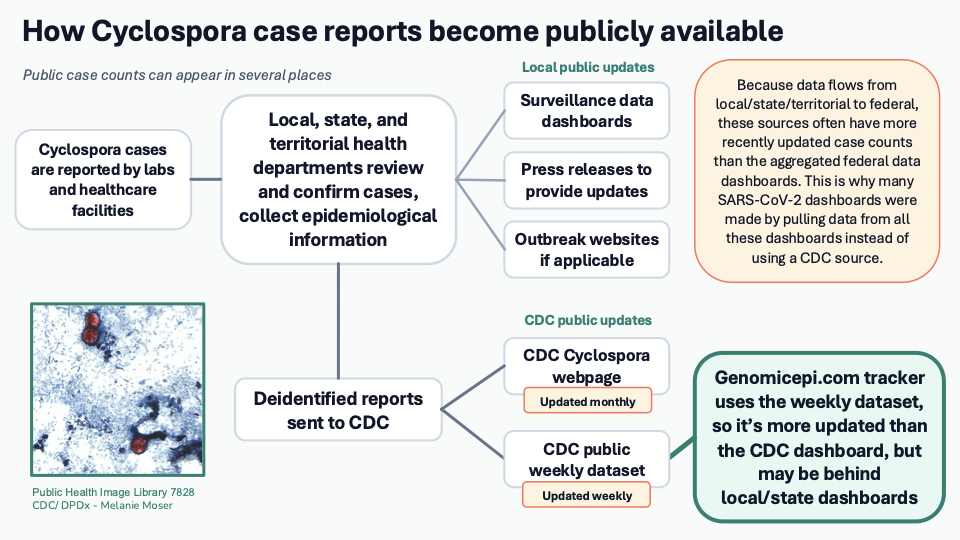
CDC Cyclosporiasis informationCDC DPDx laboratory informationFDA Cyclospora and food safetyCDC clinical and public health alertCDC NORS outbreak dataCDC NNDSS reported-case dataFDA foodborne illness outbreak investigationsPubMed literature searchMichigan health department outbreak updatesUSAFacts population data